Antares Audio Technologies Unveils Auto-Tune Advanced with Revolutionary Vibrato-Preserving DVA Engine

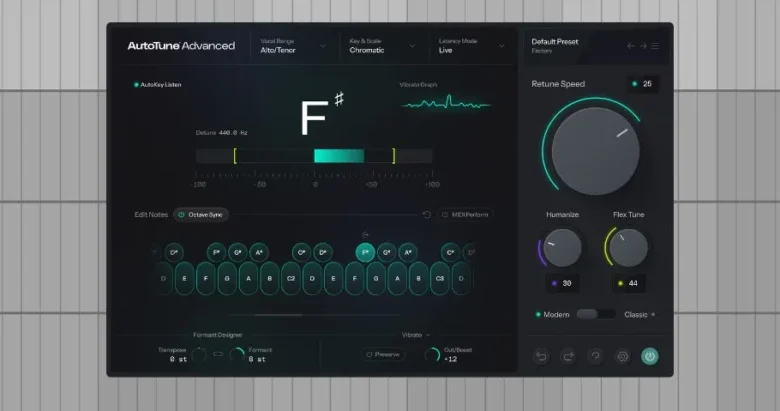
Antares Audio Technologies has officially announced the release of Auto-Tune Advanced, establishing a new flagship tier above Auto-Tune Pro 11 and standard software iterations. Designed specifically to address decades of criticism regarding artificial-sounding vocal processing, the new real-time pitch correction plugin is anchored by a patent-pending engine known as DVA (Dynamic Vibrato Analysis). This technological leap aims to bridge the historical divide between pristine pitch correction and the preservation of human emotional delivery in modern vocal production.

The Evolution of Pitch Correction Technology
Since its commercial debut in 1997, pitch correction software has transformed from an industry secret into a ubiquitous fixture of contemporary music production. Initially developed by Dr. Andy Hildebrand—a geophysicist who used seismic data processing techniques to interpret audio signals—Auto-Tune revolutionized the recording studio. While it allowed producers to salvage imperfect vocal takes, the software quickly developed a notorious reputation for stripping away the nuanced, organic qualities of human singing voices.

Traditional pitch correction algorithms rely on retune speeds that pull targeted notes firmly onto a strict chromatic grid. When set to aggressive parameters to achieve flawless intonation, these systems frequently flatten natural vocal articulation, including pitch bends, slides, and most notably, vibrato. Although subsequent iterations of pitch correction software introduced user-adjustable parameters like humanization features and relaxed tuning curves on sustained notes, producers have historically been forced to compromise between absolute pitch accuracy and the emotional authenticity of a performance.
The Engineering Breakthrough: Understanding the DVA Engine

Auto-Tune Advanced represents the most significant algorithmic overhaul undertaken by Antares since the inception of the product line nearly three decades ago. At the heart of this release is the DVA engine, a sophisticated analytical tool engineered to distinguish between accidental pitch errors and intentional expressive choices made by a vocalist.
According to Antares CEO Jeff Wright, the primary philosophical driver behind the development of Auto-Tune Advanced was confronting the medium’s oldest critique. In public statements accompanying the launch, Wright noted that industry feedback has remained remarkably consistent since 1997: standard pitch correction fundamentally removes the singer from the performance. By operating on top of a rebuilt Auto-Mode algorithm, the DVA engine actively detects a singer’s natural vibrato in real-time, isolating it from corrective algorithms and leaving the performance’s core character untouched.

To provide engineers with unprecedented visual and tactile feedback, the plugin interface features a real-time visualizer that tracks detected vibrato as audio passes through the system. Furthermore, for performances that naturally lack vibrato or feature diminished modulation, Antares has integrated a dedicated Vibrato FX section. This utility allows producers to synthesize vibrato using selectable waveforms—including sine, square, sawtooth, and triangle patterns—alongside granular rate and intensity controls.
Operational Modes, Latency Optimization, and Studio Integration

Auto-Tune Advanced is tailored primarily for Auto-Mode, focusing on real-time, low-latency workflow efficiency that modern tracking and mixing environments demand. While detailed graphical manipulation and manual pitch editing remain exclusive to Auto-Tune Pro 11, Auto-Tune Advanced introduces optimized performance tiers designed to fit seamlessly into complex, high-track-count professional sessions.
Engineers tracking live performances can utilize the newly developed Live mode, which boasts an impressively low plugin latency of 0.84 milliseconds at a 44.1kHz sample rate, though overall system delay remains dependent on host hardware and buffer configurations. Additional operational tiers include a Low Latency mode optimized for tracking sessions and a High Quality mode tailored for deep mixdown processing.

The software preserves legacy workflows by retaining both Classic Mode—reproducing the iconic, hard-tuned artifacts famously popularized in late-1990s and 2000s pop music—and Modern Mode, which delivers transparent, seamless correction. Industry-standard utility features such as Flex Tune and Humanize have also been carried over, ensuring that veteran users can integrate Auto-Tune Advanced into existing templates without a steep learning curve.
Industry Reception and Professional Endorsements

The introduction of Auto-Tune Advanced has already generated substantial discussion among elite mixing engineers and record producers who manage high-profile vocal chains. Because modern vocal production often requires stacking dozens of heavily processed harmonies and lead takes, maintaining natural-sounding articulation without introducing digital artifacts is a constant challenge.
Industry professionals who gained early access to the plugin have highlighted its impact on workflow efficiency. Renowned mix engineer Ann Mincieli, whose extensive credit list includes records for Alicia Keys, Beyoncé, and Jay-Z, praised the software’s ability to balance technical precision with artistic preservation. Mincieli noted that the plugin provides the necessary speed and flexibility for fast-paced commercial studio environments while successfully safeguarding the emotional nuance and individual character of a vocal take.

Similarly, producer and mixer Benjamin Thomas—known for his collaborative work with artists such as Pharrell Williams and Future—emphasized the creative freedom afforded by the DVA engine. According to Thomas, the technology allows engineers to drive the Auto-Tune algorithms harder for strict pitch stabilization without sacrificing the organic undulations of a natural vibrato.
Market Availability, Formats, and Licensing Structure

Auto-Tune Advanced is available immediately across major digital audio workstation (DAW) formats, supporting VST3, AU, and AAX architectures on both macOS and Windows operating systems. Antares is offering the plugin through multiple purchasing avenues, including a perpetual license model as well as integration into the comprehensive Auto-Tune Unlimited subscription service. Existing subscribers of Auto-Tune Unlimited receive access to the new flagship plugin at no additional charge, while prospective users can evaluate the software through a limited-time free trial hosted on the official Antares website.
Broader Implications for the Future of Vocal Production

The release of Auto-Tune Advanced marks an important milestone in the evolution of audio processing technology, illustrating a broader industry shift toward AI-assisted and analytically intelligent tools. As listeners and creators increasingly demand high-fidelity authenticity even within heavily produced commercial genres, software developers are forced to move beyond blunt-force correction tools in favor of context-aware algorithms.
By successfully decoupling pitch error correction from expressive modulation, Antares has set a new technical benchmark for the audio software industry. As competitors inevitably attempt to match the capabilities of the DVA engine, the standard for professional vocal production is poised to elevate, shifting the paradigm from mere correction to intelligent enhancement.
Related posts: