The Break-Even Line: Why Product Teams Must Audit AI Utility Before Implementation

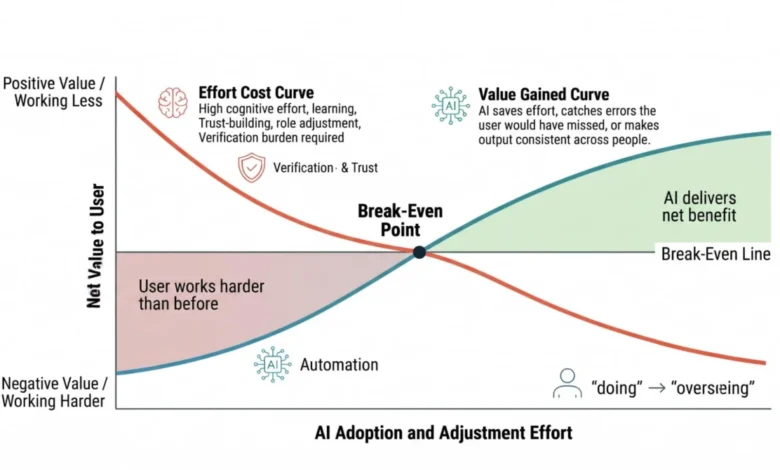
The rapid integration of artificial intelligence into enterprise workflows has created a paradoxical productivity crisis. Across sectors ranging from insurance to healthcare, product teams are discovering that the mere presence of AI does not equate to a gain in efficiency. Often, a feature designed to save users time succeeds only in forcing them to spend that saved time meticulously verifying the AI’s output. This phenomenon, which human-factors researchers call the "break-even line," serves as a critical juncture for developers: if the cognitive cost of verifying AI output exceeds the labor saved by the automation, the tool is, by definition, a net negative for the end user.
The Anatomy of an Implementation Failure
A recent case study involving a major health insurer provides a clear illustration of this friction. The insurance company tasked its internal product team with developing an AI tool capable of generating full written determinations for benefits appeals specialists. On a technical level, the system performed exactly as specified, drafting coherent, professional-sounding documents. However, after deployment, the results were counterproductive. Specialists either bypassed the tool entirely or, if they used it, took longer to complete their cases than they did using their manual, legacy processes.
Post-implementation evaluations revealed a straightforward but devastating flaw: the time required for a specialist to read, vet, and correct an AI-drafted determination was essentially equivalent to the time required to write the document from scratch. Furthermore, the specialists were forced to scan for errors that they would never have committed themselves, creating a cognitive burden known as "automation-induced vigilance." The AI had effectively turned experts into proofreaders, stripping away their autonomy and adding a redundant layer of labor to a task they had already mastered.
The product team eventually corrected the issue by rescoping the feature. Instead of generating the final document, the second iteration of the tool was designed to surface relevant policy provisions and prior case law directly to the specialist. By automating the search phase—a high-effort, low-value task—the tool reduced the specialist’s workload without encroaching on their expertise in writing the final determination. This shift preserved the human element where it was most effective, demonstrating that the value of AI lies not in the technology itself, but in the precision of its application.
The Cognitive Cost of Digital Transformation
The "break-even line" is rooted in the finite nature of human attention. Research in cognitive psychology, most notably the work of Nelson Cowan on working memory, suggests that humans can only hold approximately four items in their minds simultaneously. Every interface change—whether a button relocation or the introduction of an AI-generated draft—demands that the user expend some of this limited mental bandwidth to learn how the tool functions, where the information is located, and how much trust they should place in the output.
When AI is introduced into a professional environment, these costs are magnified because the tool changes the fundamental nature of the job. A recent 2025 study by Sophia Ackerhans and her colleagues highlights that when physicians are asked to sign off on AI-assisted clinical decisions, they report a significant threat to their professional identity. The study found that providing explanations for AI reasoning—intended to build trust—often had the unintended side effect of highlighting the distance between the clinician’s expertise and the machine’s logic, further alienating the user.
An AI feature earns its place only when the return on investment for the individual user exceeds the cost of adjustment. These returns typically manifest in three forms:
- Volume Handling: The AI processes more information than a human could reasonably manage.
- Speed/Consistency: The AI standardizes outputs across a large, distributed team.
- Error Mitigation: The AI identifies patterns or anomalies—such as in fraud screening—that a human would reliably miss.
A Framework for Strategic Evaluation
To avoid the pitfalls of "pro-innovation bias"—the assumption that any new technology is inherently beneficial—product teams should subject every proposed AI feature to a rigorous four-part audit before a single line of code is written.
1. Total Effort Assessment
Teams must count every click, thought, and verification step. Reducing the number of clicks is irrelevant if the user now has to spend ten minutes auditing the machine’s output. Developers must compare the "before" and "after" state of the task, ensuring that the burden of checking the AI’s work is factored into the total time cost.
2. Comparative Advantage
Does the AI beat the user’s current, manual method? If a specialist has a highly efficient, practiced workflow for a specific task, the introduction of AI may actually disrupt their efficiency. The goal should be to automate tasks where the current method is slow or prone to human error, rather than replacing tasks that are already performed quickly and reliably by human experts.
3. The Visibility of Error
Every AI system will eventually fail. The audit must map the "error surface"—the types of mistakes the AI is likely to make—and determine if they are visible to the user. An error that is "invisible" (e.g., an AI suggesting a flight that doesn’t exist) is dangerous because it encourages complacency. High-consequence, low-visibility errors must be mitigated by clear "provenance," where the system displays the source of its information and the logic behind its conclusions.

4. Long-term Skill Maintenance
A primary concern is the degradation of professional judgment. If an AI performs a task for a year, the user may lose the ability to effectively audit that task. A 2023 study by Thomas Dratsch on radiologists showed that even highly experienced professionals were susceptible to being misled by inaccurate AI suggestions. To combat this, design teams must build in mechanisms—such as periodic blind reviews or rotating manual shifts—to ensure the user’s critical thinking skills remain sharp.
The Path Forward: Defining Success
For product teams, the decision to implement AI should not be binary. The findings of an audit should result in a set of design conditions that act as project requirements. If a feature fails the audit but is still deemed strategically necessary, the scope must be adjusted. For example, if a tool creates high-stakes, low-visibility errors, the design requirement must mandate a "provenance display" that shows the data behind the AI’s reasoning. Without this, the feature should not ship.
The implications for enterprise software are significant. As organizations look to integrate Large Language Models (LLMs) and other generative tools into their stacks, the focus must shift from "what can the AI do?" to "what should the AI do?" By prioritizing the preservation of human expertise and accounting for the cognitive cost of verification, teams can build tools that truly augment, rather than complicate, professional workflows.
Ultimately, the most successful AI implementations are those that acknowledge the limits of human attention. By running an audit that evaluates the user experience from the perspective of a seasoned practitioner, product teams can move past the hype cycle and toward a future where technology functions as a quiet, efficient partner in complex decision-making, rather than a noisy, demanding administrative burden. The goal is not just to build software that works, but to build software that respects the expertise of the people who use it every day.
Related posts: