The Hidden Power of the Sea: How High-Tech Ocean Buoys Are Shaping the Future of Renewable Energy

When modern society evaluates the transition toward a sustainable energy matrix, the conversation almost universally defaults to two established pillars: solar photovoltaic arrays and wind turbine farms. Occasionally, large-scale hydroelectric infrastructure claims a share of the spotlight for its capacity to harness the immense kinetic force of flowing river systems. Yet, a vast and remarkably potent frontier of renewable generation remains underutilized and frequently overlooked in mainstream energy discourse. The world’s oceans—covering over 70 percent of the Earth’s surface—represent an immense, continuous reservoir of clean power. Among the most innovative marine energy technologies currently emerging from the experimental phase are high-tech, wave-powered buoys designed to generate electricity from the perpetual motion of the sea.
While smart buoys have historically been deployed for marine meteorological data collection, navigation assistance, and environmental monitoring, contemporary engineering has transformed these floating sentinels into localized power generators. The underlying physics of ocean waves offer an extraordinarily dense concentration of energy. According to data compiled by Oregon State University, the coastal waters of Oregon alone possess enough theoretical wave energy potential to supply electricity for approximately 28 million American homes annually. Looking at the national picture, the U.S. Energy Information Administration (EIA) estimates that recoverable wave energy along the United States coastline could theoretically supply roughly 63 percent of the nation’s total electricity generation capacity, based on 2023 output levels.
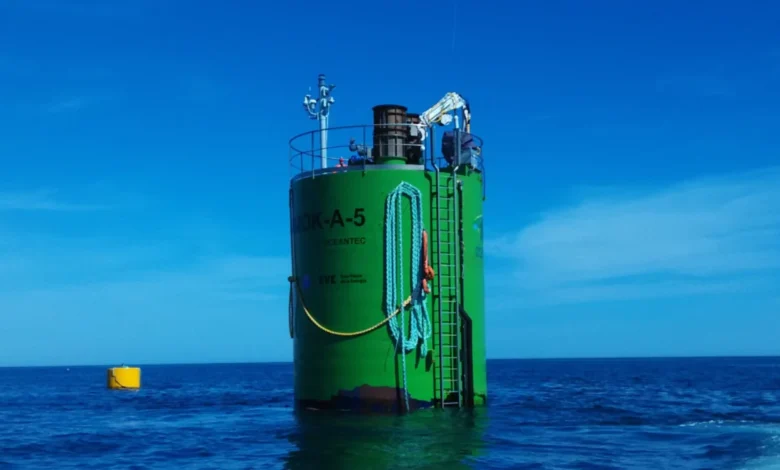
This staggering potential is gaining renewed urgency. As global energy grids face unprecedented strain driven by the exponential expansion of energy-hungry data centers, artificial intelligence infrastructure, and widespread vehicle electrification, grid operators are frantically searching for reliable, baseload-compatible renewable alternatives. Unlike wind and solar, which suffer from intermittency issues tied to weather patterns and diurnal cycles, ocean waves offer a more predictable and consistent cadence. Consequently, wave energy conversion (WEC) systems are transitioning from theoretical marine engineering concepts into operational field trials. Projects such as Spain’s MARMOK-A-5, Finland’s pioneering WaveRoller, and the OE-35 deployment in Hawaii are attracting serious attention from utility companies, defense agencies, and government regulators alike.
Anatomy of Ocean Wave Energy Converters
To understand how these maritime systems operate, it is necessary to examine the engineering mechanics behind modern wave energy converters. At their core, these devices capture the kinetic energy of horizontal water particle movement and the potential energy of vertical water surface displacement, translating this mechanical motion into usable electrical current. However, engineers must contend with vastly different marine environments, leading to a diverse array of competing structural designs.
Take, for instance, the waters off the Hawaiian coastline, where the U.S. Navy and maritime researchers have evaluated advanced wave technologies. In July 2024, an 826-ton behemoth known as the OE-35 wave energy converter buoy was deployed at the U.S. Navy’s Wave Energy Test Site located in Kaneohe Bay, Oahu. Developed through a collaborative partnership between Ocean Energy USA LLC (a subsidiary of the Ocean Energy Ireland Group), the U.S. Marine Corps, and the University of Hawaii, this device represents a monumental leap in utility-scale marine generation.
The operational mechanism of the OE-35 is distinct from traditional mechanical linkage systems. Rather than utilizing submerged paddles or underwater pistons that directly interface with the corrosive marine environment, the OE-35 relies on an internal air-compression chamber. As ocean waves rise and fall against the submerged structure, the water column inside the chamber oscillates vertically. This movement acts as a giant piston, compressing and decompressing air trapped inside the upper portion of the buoy. This high-pressure airflow is directed through an integrated turbine, spinning it continuously to generate up to 1.25 megawatts of electricity. By housing the delicate electrical turbine system safely above the waterline within the hull, engineers minimize direct exposure to highly corrosive saltwater, significantly enhancing the operational longevity of the mechanical components. The buoy successfully fed electricity into the local microgrid at Marine Corps Base Hawaii before completing its designated test phase and being decommissioned in 2025.
A continent away, in the turbulent waters of the Bay of Biscay off the coast of Spain, a different technological approach has been undergoing rigorous evaluation. The MARMOK-A-5 buoy program first achieved commercial grid connection in 2016, marking a milestone for European marine energy integration. Following years of performance data collection, the original unit was replaced in May 2026 with an upgraded buoy featuring a maximum rated capacity of 30 kilowatts.
Like its larger Hawaiian counterpart, the MARMOK-A-5 utilizes an oscillating water column system to generate electricity via airflow over a turbine. However, its scale, structural footprint, and mooring architecture are tailored to the distinct wave dynamics and shallower bathymetry of the European continental shelf. These varied deployments illustrate an industry still in its technological adolescence, wherein engineers are experimenting with multiple configurations to determine which hull designs, PTO (power take-off) systems, and anchoring methods yield the highest efficiency and structural resilience.
The Chronology of Marine Energy Development
The trajectory of wave energy technology has been marked by ambitious visions, intermittent funding freezes, and hard-won engineering breakthroughs. While hydroelectric dams have powered civilizations for over a century, harnessing the open ocean has proven to be a uniquely stubborn technological hurdle.
The modern era of wave energy research can be traced back to the oil crises of the 1970s, when soaring fossil fuel prices forced governments to aggressively explore alternative energy vectors. Japanese researcher Yoshio Masuda pioneered early modern navigation buoys powered by wave energy, inspiring academic and industrial research across the United Kingdom, Norway, and the United States. During the 1980s and 1990s, small-scale prototypes were deployed in coastal waters worldwide, yet most suffered catastrophic structural failures due to extreme storm surges, biofouling, and chronic material fatigue.
By the turn of the 21st century, computational fluid dynamics (CFD) and advanced materials science allowed engineers to model wave-structure interactions with unprecedented precision. This paved the way for the establishment of specialized testing facilities. In 2003, the European Marine Energy Centre (EMEC) was established in Orkney, Scotland, becoming the world’s first premier facility for testing wave and tidal energy converters in real-world sea conditions.
The subsequent two decades saw a wave of pilot projects across Europe and North America. Spain’s Mutriku breakwater wave plant—the first multi-turbine oscillating water column facility in commercial operation—began generating power for the local grid in 2011. Shortly thereafter, the development pipelines for the MARMOK-A-5 and the OE-35 projects were formalized. By the mid-2020s, marine energy transition had reached a critical juncture. According to international marine energy consortiums, the technology had matured past the proof-of-concept stage, shifting the primary focus from basic survivability to economic scalability and the development of multi-megawatt wave farms.
Economic and Environmental Obstacles to Widespread Adoption
Despite the staggering abundance of oceanic kinetic energy—with the EuropeWave program noting that global wave resources theoretically contain enough energy to meet total planetary electricity demand—marine energy currently contributes a negligible fraction to the global energy mix. Industry analysts point to several interconnected barriers that have historically impeded widespread commercial deployment.
First and foremost is the extreme hostility of the marine environment. The ocean is arguably the most punishing operating theater on Earth. Saltwater corrosion, violent marine growth (biofouling), relentless wave slamming loads, and extreme offshore weather events create an environment where mechanical components degrade at accelerated rates. Designing autonomous devices that can withstand Category 4 hurricanes, rogue waves, and sub-surface turbulence for decades without catastrophic failure requires exceptionally robust—and expensive—materials.
Second, capital expenditure remains a primary hurdle. Wave energy converters currently suffer from a high levelized cost of electricity (LCOE) compared to mature onshore wind and utility-scale solar installations. Because the industry has not yet converged on a standardized, globally accepted design blueprint, manufacturing economies of scale remain elusive. Each prototype often requires custom engineering, specialized offshore installation vessels, and complex subsea electrical cabling, driving initial capital costs sky-high.
Furthermore, regulatory frameworks governing maritime spatial planning, environmental impact assessments, and commercial leasing in federal and international waters are notoriously complex and time-consuming. Developers must navigate rigorous permitting processes to ensure that subsea cabling and oscillating structures do not disrupt marine mammal migration routes, commercial fishing grounds, or fragile benthic ecosystems.
Shifting Tides: Policy, Funding, and Global Momentum
Despite these formidable headwinds, recent geopolitical shifts, national security priorities, and decarbonization mandates are injecting fresh momentum into the marine renewable sector. Governments are recognizing that true energy independence requires a diversified renewable portfolio that extends beyond intermittent solar and onshore wind assets.
Europe has historically led the global charge in ocean energy research, propelled by ambitious climate targets and robust institutional frameworks like the EuropeWave initiative. However, the United States and China have actively accelerated their domestic programs to bridge the gap. In 2024, the U.S. Department of Energy (DOE) announced a historic $141 million funding allocation aimed at advancing marine energy technologies, with the lion’s share directed toward wave energy systems rather than tidal variations. This federal injection is intended to fast-track foundational research, environmental monitoring, and open-water prototype testing.
Concurrently, the People’s Republic of China introduced a series of strategic policy updates in 2024 specifically designed to subsidize and accelerate ocean energy development. Chinese state-owned enterprises and research institutes have begun constructing large-scale marine energy demonstration zones along their southeastern coastline, aiming to integrate wave and offshore wind hybrid farms into the national grid.
Implications for the Future Global Energy Matrix
The emergence of high-tech wave energy buoys carries profound implications for the future of global energy security, grid stability, and coastal economies. While wave power is unlikely to completely supplant solar or wind in landlocked regions, it offers a transformative localized solution for coastal communities, island nations, and remote marine operations that currently rely on expensive, carbon-intensive diesel generators.
From an energy systems perspective, wave power provides a vital complement to existing renewable portfolios. Because wave action often persists long after coastal winds subside and skies cloud over, wave energy can help smooth out the generation intermittency curves that plague modern grid operators. When integrated into multi-source marine microgrids—combining floating wind, solar, and wave assets sharing common subsea transmission lines—these buoys can dramatically increase overall capacity factors and grid resilience.
As research institutions, defense agencies, and private clean-tech enterprises continue to refine hull designs, optimize power take-off mechanisms, and leverage advanced corrosion-resistant composites, the economic viability of wave energy is steadily improving. The deployment of the OE-35 in Hawaii and the iterative upgrades of the MARMOK-A-5 in Spain signal that the industry is graduating from fragile experimentation to robust, commercial-scale engineering. If current capital investment trends and policy supports persist, the vast, churning power of the world’s oceans may finally be harnessed to light up the modern grid.