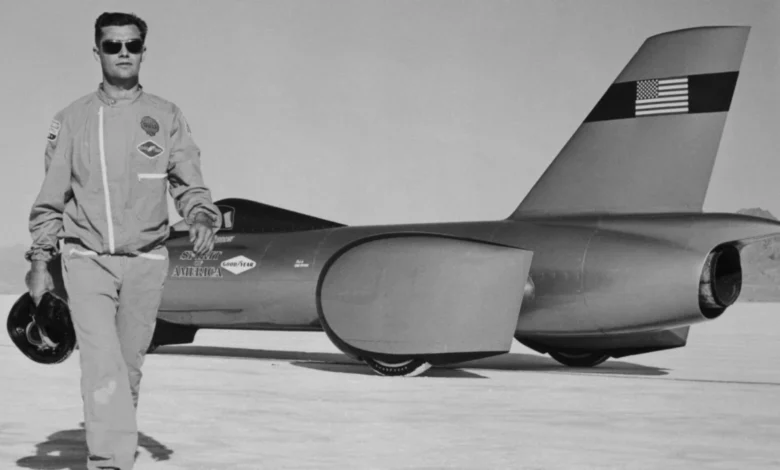
The pursuit of absolute velocity on the earth’s surface stands as one of humanity’s most enduring engineering endeavors, combining raw mechanical innovation with calculated peril. Defining the fastest vehicle on the planet remains a complex discipline, demanding exceptional aeronautical and automotive design, aerodynamic precision, and drivers willing to pilot machines that challenge the limits of physics. Since 1935, the historic Bonneville Salt Flats in Utah—a vast, sun-baked expanse left by an ancient prehistoric lake—has served as the premier proving ground for speed enthusiasts and record-seeking racing syndicates. Over the decades, this desolate flatland has witnessed some of the most outrageous, brilliantly engineered machines ever conceived, vehicles that blur the line between ground transportation and aviation.
The Engineering Paradigm of Extreme Land Speed
Achieving supersonic or near-supersonic speeds on the ground requires navigating aerodynamic forces that differ drastically from those encountered by traditional passenger automobiles. At velocities exceeding 400 miles per hour, vehicles are susceptible to lift, aerodynamic drag, and lateral instability that can instantly turn a car into an airborne projectile. Consequently, land speed record (LSR) engineering has historically borrowed heavily from military aerospace technology. Designers frequently utilize surplus jet turbines and rocket propulsion systems originally engineered for supersonic fighter aircraft.
The venue itself presents unique operational challenges. The Bonneville Salt Flats offer a surface that is expansive and flat, yet it demands meticulous tire management and vehicle tuning due to the corrosive nature of the salt and shifting traction conditions. Teams must account for thermal expansion, extreme vibration, and the massive deceleration forces required to bring these heavy machines to a safe stop, often deploying multiple parachutes and disc braking systems.
Chronology of the Jet Age: The 1960s Revolution
The 1960s represented a golden era of land speed record competition, characterized by intense rivalries, particularly between independent builders like the Arfons family and professional drivers such as Craig Breedlove. Prior to this decade, piston engines dominated the record books. However, the post-World War II surplus of military jet engines and rocket technology fundamentally altered the landscape of land speed racing.
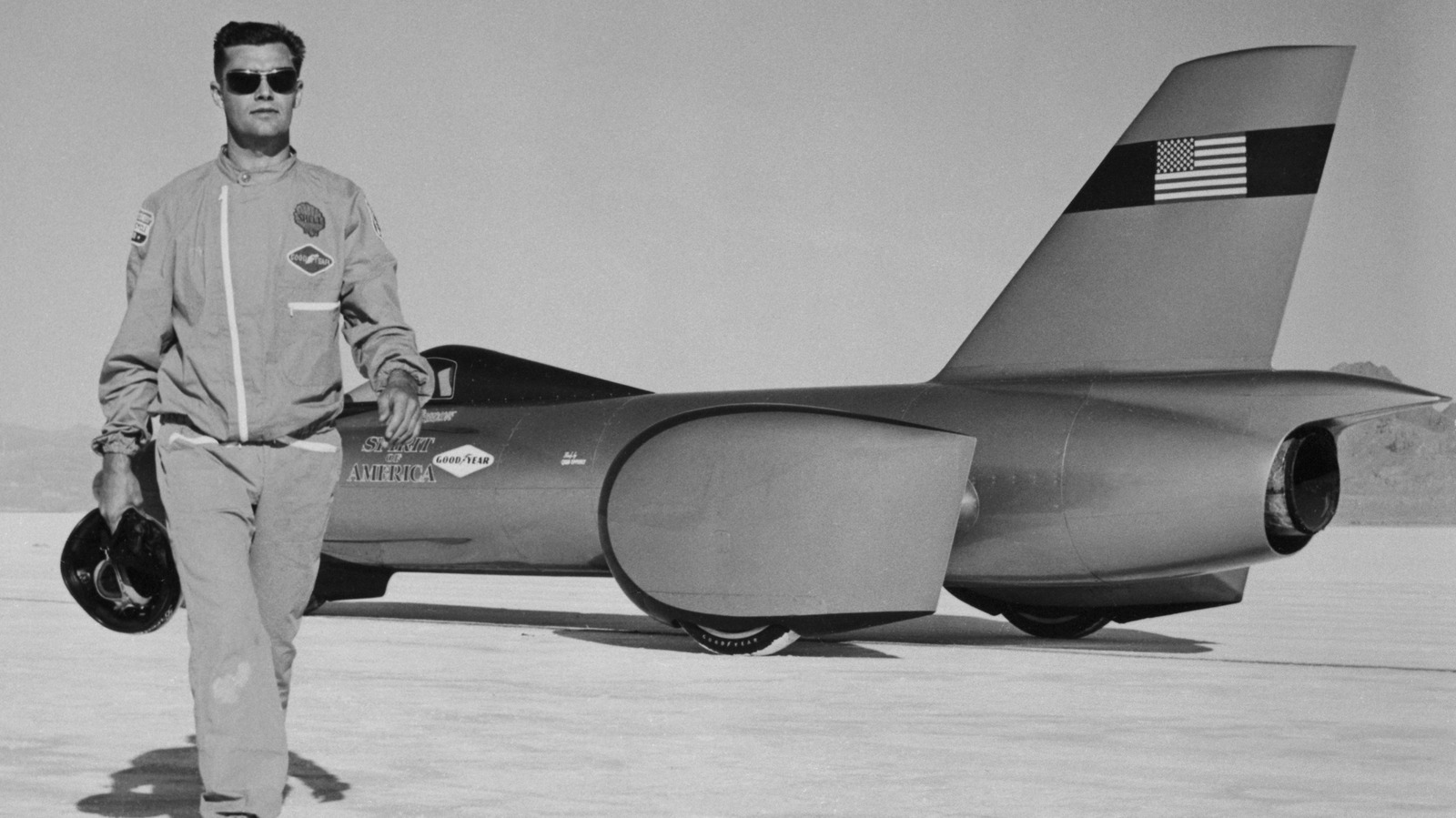
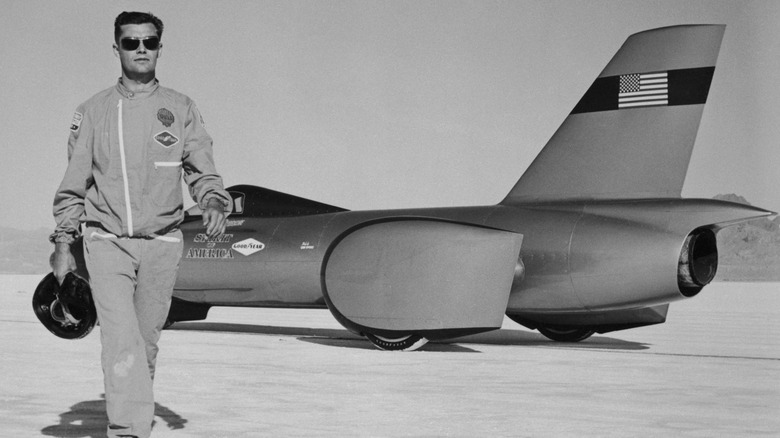
In 1963, Craig Breedlove introduced the Spirit of America, a three-wheeled vehicle powered by a General Electric J47 turbojet engine sourced from an F-86 Sabre fighter jet. Eschewing traditional automotive layouts, Breedlove designed the vehicle with a distinct fuselage, a pointed nose, and a vertical tail stabilizer to maintain directional stability at extreme velocities. Although political and sanctioning body disputes initially complicated the official recognition of his records, Breedlove’s creation shattered psychological barriers and inaugurated the jet-powered era of land speed racing.
Following this breakthrough, the competitive landscape intensified rapidly as other innovators sought to claim the absolute speed crown using increasingly volatile propulsion systems.
Wingfoot Express 2 and the JATO Rocket Phenomenon
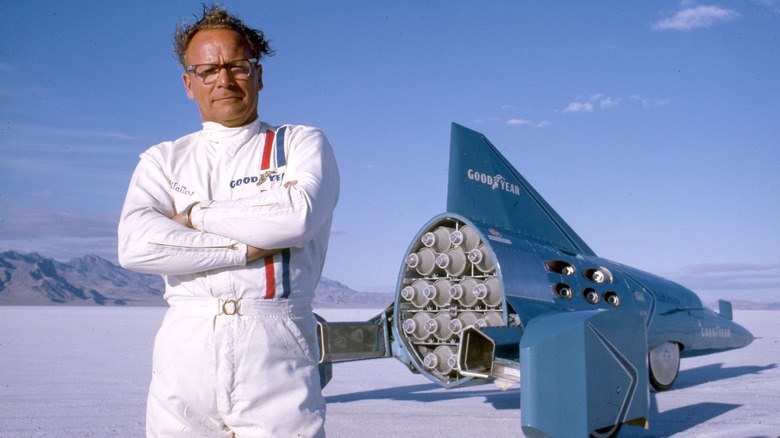
Among the most unconventional approaches to achieving record-breaking velocity was Walt Arfons’ Wingfoot Express 2. Drawing inspiration from aerospace applications where Jet-Assisted Take-Off (JATO) rockets provided military aircraft with short-duration, high-thrust acceleration, Arfons applied the concept to a ground vehicle.
The vehicle featured an arrowhead-inspired aerodynamic profile, characterized by a sharp front nose that gradually widened toward the rear. At the tail end, Arfons integrated an initial array of 15 JATO rockets to propel the machine down the salt crust. This configuration successfully pushed the vehicle to a blistering 485 mph.
Faced with mounting competition from rival teams pushing past the 500-mph threshold, Arfons elected to scale up the propulsion system rather than redesign the chassis. He integrated an additional 10 JATO solid-fuel rockets, bringing the total to 25. While this staggering concentration of chemical thrusters did not secure a permanent, uncontested world record, the Wingfoot Express 2 remains an engineering marvel of brute-force propulsion and external-thrust utilization.
The Green Monster and Trans-Sonic Perils
Art Arfons, the half-brother of Walt Arfons, approached the challenge of land speed records with a similarly aggressive philosophy, culminating in the development of The Green Monster. While competitors utilized standard turbojets, Art secured a surplus General Electric J79 axial-flow turbojet engine from a Lockheed F-104 Starfighter—a supersonic military interceptor capable of Mach 2.
The engine, capable of generating approximately 17,000 pounds of thrust, was mounted directly down the centerline of the vehicle, with the driver’s cockpit positioned to the immediate left. Initially painted a solid green by its builder, the exterior later incorporated red detailing at the behest of commercial sponsors.
Art Arfons piloted The Green Monster to multiple official records at Bonneville, eventually eclipsing the 576-mph mark. However, the quest for supersonic speed carried immense risk. During a subsequent run aiming to surpass the 600-mph barrier, Arfons experienced a catastrophic mechanical failure at extreme velocity, resulting in one of the most violent high-speed crashes in motorsports history. Surving the incident, Arfons secured an unintended and sobering distinction as one of the few individuals to walk away from a wreck exceeding 600 mph.
Pop Culture Legacy and Modern Implications
The aesthetic and mechanical footprint of these 1960s record-breakers extended far beyond the salt flats, permeating popular culture and industrial design. Notably, Julian Caldow, the lead designer for the 1989 cinematic adaptation of Batman, cited The Green Monster as a direct aesthetic and functional inspiration for the iconic Batmobile. The prominent, center-mounted jet turbine exhaust featured on the fictional crime-fighting vehicle was heavily derived from the exposed, high-output engines characteristic of mid-century land speed cars.
In contemporary motorsports, the lineage of these vehicles persists in modern technological marvels such as the ThrustSSC, which officially broke the sound barrier on land in 1997 by reaching 763.035 mph, and the ongoing development of the Bloodhound LSR project. These modern endeavors rely on advanced computerized telemetry, sophisticated computational fluid dynamics (CFD), and rigorous safety protocols—elements that were largely improvised during the pioneering era of the 1960s.
The legacy of machines like the Wingfoot Express 2, the Spirit of America, and The Green Monster underscores a pivotal chapter in automotive engineering. They demonstrated that the boundary between ground and air transportation is remarkably porous, driven forward by inventors who successfully harnessed military-grade propulsion in the pursuit of ultimate speed.