From Aldo Leopold’s Wisconsin Homestead to Modern Patios: The Evolution of the Here and There Collection

The intersection of ecological philosophy and industrial design has long yielded some of the most enduring functional objects in material culture. Often, the most profound innovations emerge not from complex engineering labs, but from immediate necessity and quiet observation of the natural world. In the 1940s, legendary conservationist, ecologist, and author Aldo Leopold constructed a remarkably straightforward wooden bench to sit outside his Wisconsin farmstead, contemplating both the primal forces of nature and humanity’s fundamental need for environmental stewardship.
Constructed from readily available dimensional lumber, the back-slanted seat presented an unpretentious, serendipitous brilliance. It was a quick assembly of a functional furnishing devised for a specific local need, yet it carried universal design potential. The core of its success lay in its X-shaped, self-bracing geometry, a zero-waste configuration, and an uncomplicated assembly process that required little more than basic carpentry skills.
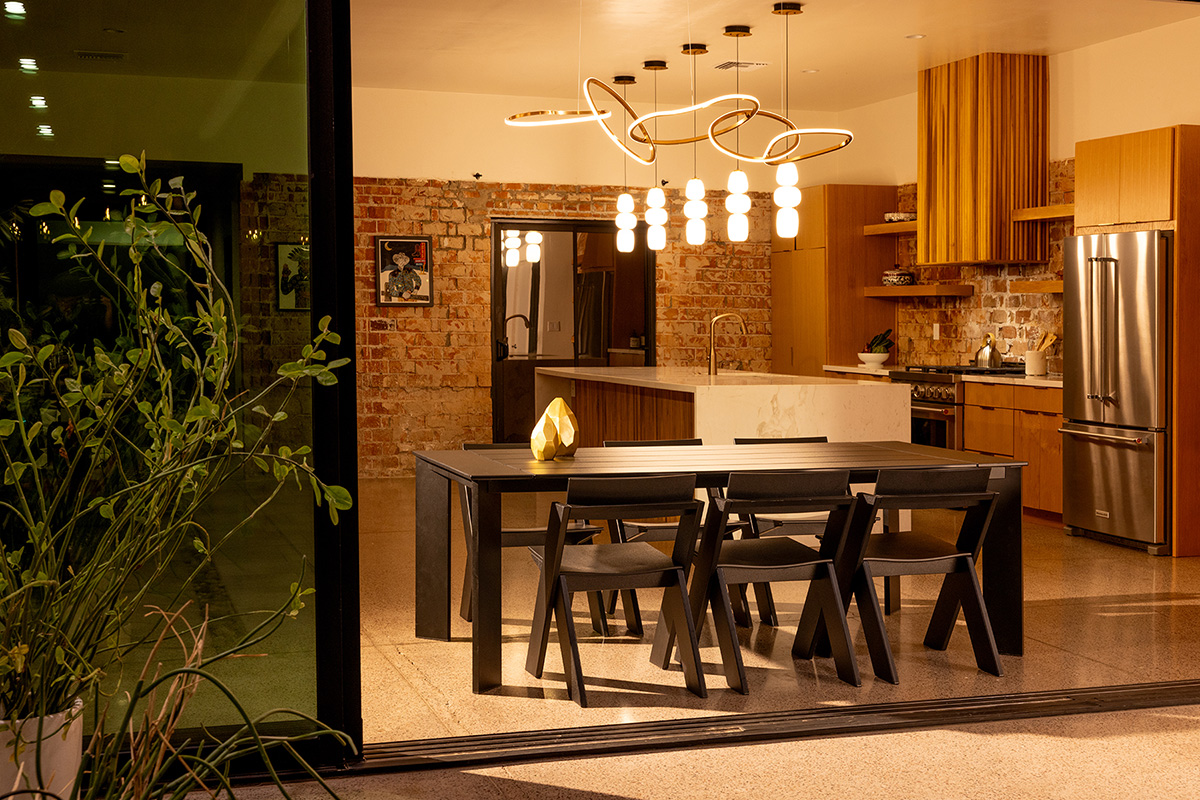
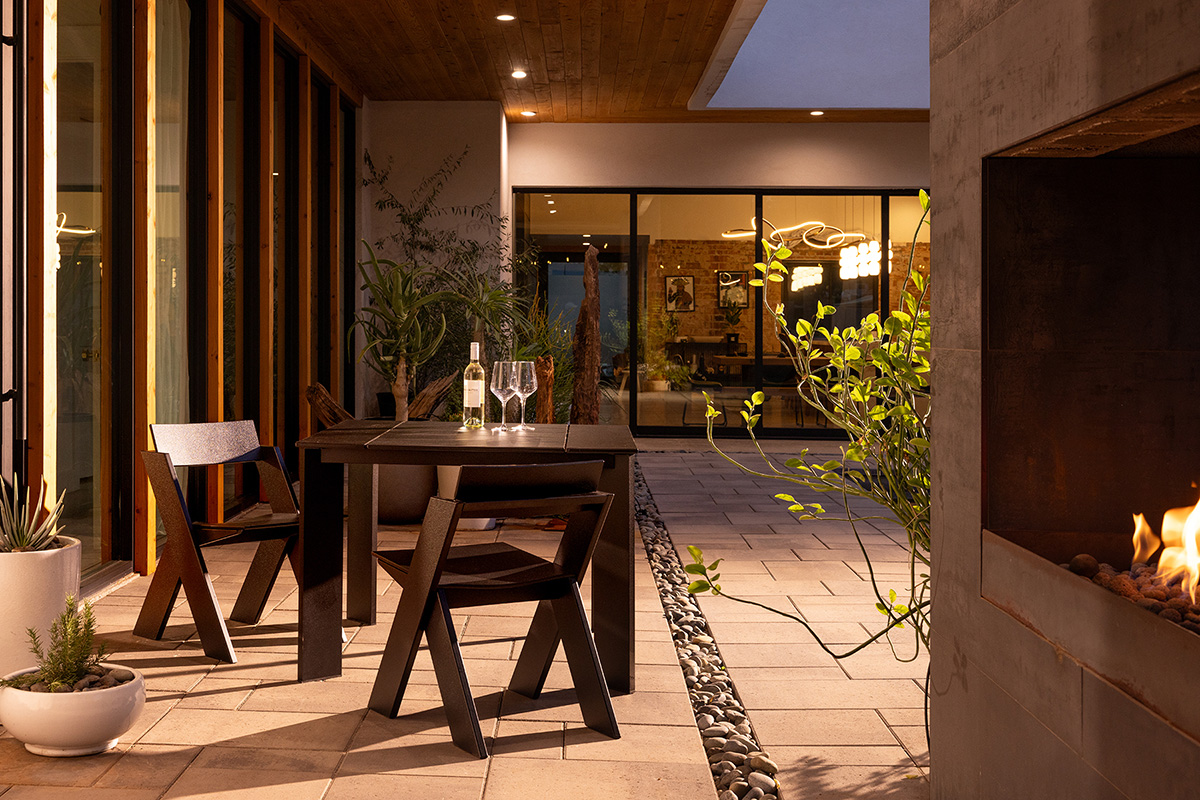
Decades later, this historical artifact has undergone a rigorous contemporary reinterpretation. Duluth-based outdoor furniture brand Loll Designs, in collaboration with Michigan industrial design studio Argenta Park, has transformed Leopold’s utilitarian concept into the Here and There Collection. Named in honor of Leopold’s philosophical belief that human appreciation of the natural world must balance between what is immediately nearby and what lies farther afield, the cohesive suite includes a dining chair, a dining table, and a reimagined iteration of the original bench.
A Twelve-Year Evolution: From Wedding DIY to Industrial Design
The journey from a mid-century conservationist’s workshop to a modern commercial catalog spans more than a decade of personal testing and material exploration. The contemporary reinterpretation of the Aldo bench was twelve years in the making, tracing its roots back to 2014.
Ahead of his outdoor wedding that year, Argenta Park designer Ricky Biddle faced the very same practical challenge that Leopold had surmounted decades prior: the creation of sturdy, durable, and comfortable outdoor seating for a gathering space. Unwilling to settle for generic, flimsy event furniture that contributes to a culture of disposability, Biddle decided to take matters into his own hands. During his bachelor party, he and his peers spent time assembling rudimentary reproductions of the Aldo bench.
The endeavor bore a striking resemblance to the open-source "Autoprogettazione" self-design methodology championed by influential Italian designer Enzo Mari, who encouraged users to build their own functional furniture using basic materials and straightforward instructions.
Rather than serving as temporary event props, those rudimentary benches became permanent fixtures of Biddle’s everyday family life. Their longevity and day-to-day utility prompted a deeper professional inquiry: Could the raw, functional genius of Leopold’s original design be successfully retooled using advanced manufacturing techniques, elevated ergonomic standards, and year-round material durability?
Driven by this question, Biddle brought the concept to Churu Yun, founder of Argenta Park, and the engineering team at Loll Designs, setting the wheels in motion for a commercial product line that honors historical integrity while embracing modern technological capabilities.
The Philosophy of Historical Preservation in Design
True historical preservation in industrial design rarely relies on the replication of past objects merely through nostalgic reverence. Instead, the most successful iterations implement cutting-edge manufacturing strategies and material sciences to solve the inherent flaws of the original models.
"Not all historical designs lend themselves to being evolved into a modern-day furniture piece," explains Brian King, Loll Designs Brand and Marketing Director. "It’s more about being hyper-selective in a design that has meaning, history, or a deep-rooted memory and identifying what’s most valuable."
Loll Designs is no stranger to this design philosophy. The Minnesota-based manufacturer has previously applied similar methodologies to elevate the ubiquitous Adirondack chair—another classic American outdoor furniture staple—up to contemporary ecological and structural standards.
When applied to the Aldo bench, the design team had to carefully address the physical limitations of simple timber construction. While historical wooden furniture holds immense nostalgic appeal, it often comes with significant drawbacks, including susceptibility to rot, splintering, seasonal warping, and the constant need for sanding, staining, and sealing. Furthermore, early utilitarian designs frequently neglected modern ergonomic standards, prioritizing rapid construction over long-term comfort.
Material Science and Ergonomic Refinement
To bridge the gap between mid-century utility and twenty-first-century expectations, the collaborative team behind the Here and There Collection implemented significant structural and material upgrades.
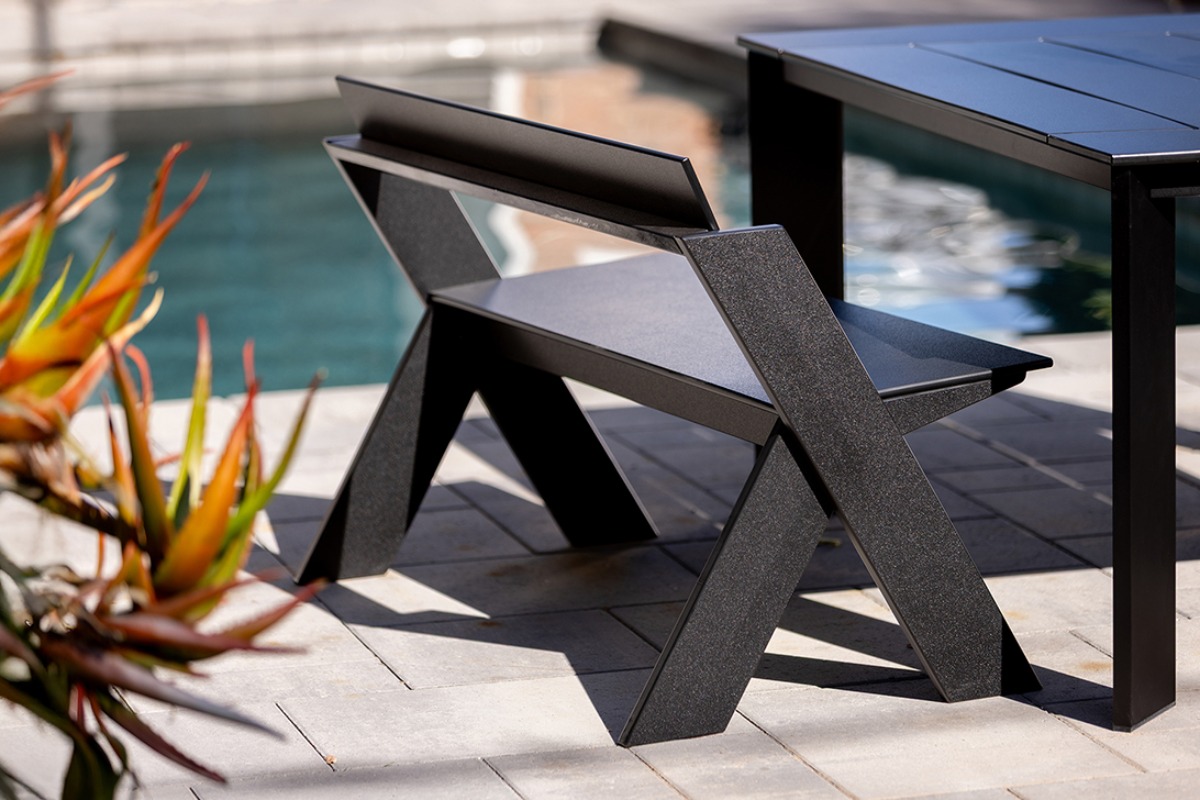
While the new collection retains the original design’s understated silhouette and distinctive X-shaped geometry, every surface and proportion has been meticulously re-evaluated. Softly contoured surfaces replace the flat, unyielding planks of the 1940s original, significantly improving lumbar support and tactile comfort. Streamlined fastener assemblies reduce visual clutter while enhancing structural rigidity.
Perhaps the most impactful departure from the historical artifact is the complete elimination of traditional wood in favor of 100% recyclable high-density polyethylene (HDPE). Sourced primarily from recycled post-consumer plastics such as milk jugs, HDPE offers exceptional resistance to harsh environmental conditions. The collection is initially offered in a sophisticated, nature-inspired color palette comprising Black, Charcoal Grey, Fog, and Sage.
This material shift is a direct response to changing consumer demands. Modern homeowners increasingly seek low-maintenance outdoor solutions capable of withstanding extreme seasonal shifts—from freezing winters to intense summer UV exposure—without sacrificing aesthetic refinement.
"With historical designs comes historical maintenance and poor ergonomics," notes Eric Swanson, president of Loll Designs. "People want to enjoy their time outdoors sitting in their furniture more than working on it, which is why using alternative materials to traditional wood is a benefit; why a curved seat and backrest is so important; and why the right proportions—the height of the dining table—make all the difference."
Broader Implications for the Outdoor Living Market
The launch of the Here and There Collection arrives at a time of significant evolution within the outdoor living and architectural products market. Consumers are placing a higher value on provenance, sustainability, and durability. The blending of historical narratives with circular manufacturing models represents a growing sector of the design industry that seeks to reduce environmental impact without compromising on product longevity.
By utilizing high-density polyethylene, Loll Designs and Argenta Park ensure that the furniture pieces in the Here and There Collection do not contribute to deforestation and can themselves be fully recycled at the end of their long lifecycles, aligning with the core conservation ethics practiced by Aldo Leopold himself.
Aldo Leopold remains widely celebrated as the father of modern wildlife ecology and environmental ethics, largely through his seminal collection of essays, A Sand County Almanac. His original wooden bench was never merely a place to rest; it was a viewing platform for ecological observation, designed to allow people to immerse themselves in the natural world for extended periods without physical discomfort.
Through the thoughtful translation of his minimalist creation into a durable, ergonomically refined suite of dining and lounging furniture, the Here and There Collection successfully carries on that legacy. It bridges the gap between the indoor spaces we inhabit and the vast natural environments we strive to protect, proving that good design, much like nature itself, is built to endure.