Napa Bistro and Wine Bar Stonecrest Brings 1976 Paris Wine Tasting Elegance to Charlotte

Charlotte, North Carolina, has rapidly evolved into one of the most economically dynamic and culturally vibrant metropolitan areas in the American Southeast. Amidst this rapid commercial growth and demographic expansion, the culinary landscape continues to mature. The latest addition to the city’s dining scene is the newly unveiled Napa Bistro and Wine Bar Stonecrest, a meticulously redesigned 6,500-square-foot hospitality destination located in the southern sector of the city.
The ambitious project represents a total reinvention of a formerly utilitarian structure. Transformed from a standard, casual taco eatery into a sophisticated, wine-focused haven, the venue captures the atmospheric duality of a classic Parisian bistro paired with the rustic, grounded warmth of a Napa Valley agricultural estate. Behind the spatial choreography and interior architecture is the collaborative genius of design studio FictionWorks—led by co-founders Andrea De Camps and Olivia King—working in tandem with the architectural firm In Situ Studio. Captured through the lens of architectural photographer Pablo Enriquez, the completed project stands as a testament to strategic interior intervention, material honesty, and narrative-driven interior design.

Historical Inspiration: The 1976 Judgment of Paris
To understand the conceptual foundation of Napa Bistro and Wine Bar Stonecrest, one must look back nearly five decades to a defining moment in global culinary history: the 1976 Paris Wine Tasting, colloquially known as the "Judgment of Paris." Organized by British wine merchant Steven Spurrier, the blind tasting pitted premier French wines against up-and-coming Californian contenders. In a shocking upset that fundamentally altered the global wine industry, judges ranked Californian Chardonnays and Cabernet Sauvignons above their legendary French counterparts.
This historic event shattered centuries of European vinicultural hegemony and proved that world-class excellence could emerge from unexpected soil. According to the design team at FictionWorks, this spirit of subverting expectations, challenging established hierarchies, and honoring agricultural heritage directly informed every architectural and design choice within the Charlotte establishment. Rather than mimicking a literal historical museum, the interior channels the disruptive elegance and quiet confidence of that era, celebrating the triumph of craft, terroir, and boundary-pushing ambition.
Architectural Chronology and Adaptive Reuse
The realization of Napa Bistro and Wine Bar Stonecrest was governed by a strict timeline and the inherent constraints of adaptive reuse. Working within a demanding nine-month window from conception to completion, the design and construction teams faced the formidable challenge of converting an open, flat, and acoustically harsh former taco restaurant into a layered, intimate culinary sanctuary.

Adaptive reuse projects of this scale typically present significant structural roadblocks, particularly regarding mechanical routing, spatial flow, and acoustic control. To overcome these hurdles, In Situ Studio and FictionWorks established a strict design hierarchy. The development followed a clear chronological roadmap:
- Phase 1 (Months 1–2): Architectural assessment, spatial programming, and the demolition of the existing open-plan layout to establish a sequence of interconnected, human-scale rooms.
- Phase 2 (Months 3–5): Installation of core infrastructural elements, including the specialized acoustic vaulting system and foundational millwork framework.
- Phase 3 (Months 6–8): Integration of high-impact visual features, custom artisanal lighting fixtures, and the centerpiece stained-glass installations.
- Phase 4 (Month 9): Final styling, placement of curated local and international artworks, and comprehensive operational testing ahead of the public launch.
This disciplined approach allowed the project to remain strictly on schedule while maximizing the fiscal efficiency of the renovation budget.
Strategic Budgeting and Material Hierarchy
One of the most notable achievements of the Stonecrest project is its masterclass in strategic capital allocation. Transforming a large footprint into an intimate venue requires substantial investment, yet uncontrolled expenditures can easily derail commercial viability. FictionWorks addressed this challenge by deploying a deliberate material hierarchy, concentrating financial resources on high-impact sensory touchpoints while adopting pragmatic solutions for secondary surfaces.

The bulk of the interior budget was funneled into custom architectural millwork, bespoke lighting design, and a striking artisanal stained-glass installation. Crafted from hand-blown glass rondels, the stained-glass feature explicitly references 1970s modernist glasswork while subtly taking the physical form of a wine bottle punt—the indentation found at the bottom of a wine bottle.
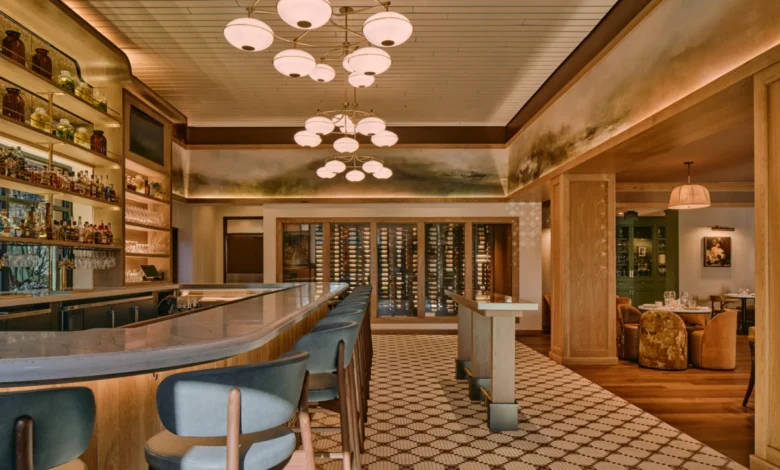
Conversely, the team exercised fiscal pragmatism on foundational and high-wear elements. Tabletops, accessories, and a portion of the eclectic artwork collection were sourced efficiently or thrifted, adding a layer of authentic lived-in charm. Grounding the expansive floor plan is a classic black-and-white mosaic tile pattern from Daltile’s Keystone collection. This geometric foundation provides a stark, clean contrast to the organic warmth of the surrounding millwork and upholstery, ensuring that the sprawling 6,500-square-foot space never feels cavernous or sterile.
Spatial Choreography and Acoustic Engineering
Managing sound within a bustling, high-volume restaurant is one of the most persistent challenges in modern hospitality design. Hard surfaces—such as wood, glass, and tile—frequently reflect sound waves, creating an uncomfortably loud environment where patrons must shout to converse.

To mitigate this while maintaining aesthetic integrity, the design team incorporated a curved, vaulted ceiling system engineered by Baswa Acoustics. This specialized acoustic plaster system absorbs ambient noise effectively, ensuring a comfortable decibel level even during peak weekend dining hours. Beyond its acoustic performance, the vaulted geometry contributes significantly to the interior’s spatial rhythm, guiding the eye smoothly through the series of connected rooms.
Each dining enclave within the venue has been thoughtfully scaled to offer a distinct atmosphere. Intimate banquettes upholstered in worn, rich green leather encourage guests to settle in for extended meals, while dim lighting and strategically placed linen pendant fixtures generate moody, cinematic vignettes. The overarching color palette draws directly from a trio of visual touchpoints: the verdant vineyards of Napa Valley, the earthy warmth of 1970s residential interiors, and the understated sophistication of a Parisian corner bistro. Deep bottle greens, rich wood tones, and flashes of amber and bronze evoke the tactile richness of aged wine and autumn foliage.
Community Integration and Artistic Collaboration
While the conceptual roots of Napa Bistro and Wine Bar Stonecrest stretch back to the vineyards of California and the bistros of France, its cultural heartbeat is firmly anchored in the local community of Charlotte. The interior design avoids the trap of generic, corporate styling by integrating locally sourced creative elements alongside international works.

A central highlight of the art curation is a series of photographic and digital pieces by California-based artist Julia Crane, which establish a visual dialogue with the restaurant’s namesake region. These are seamlessly intertwined with works by emerging and established creatives based right in Charlotte. This deliberate blending of local and external talent bridges the gap between the venue’s thematic inspiration and its immediate geographic home, fostering a sense of place that resonates deeply with local patrons.
Furthermore, the integration of a climate-controlled, glass-encased wine cellar acts as both a functional storage facility and an interactive visual anchor. Positioned adjacent to the marble-topped bar—which is flanked by deep blue upholstered stools—the visible cellar highlights the establishment’s extensive inventory, serving as a constant reminder of the beverage program’s central role in the guest experience.
Economic and Cultural Implications for Charlotte’s Dining Scene
The debut of Napa Bistro and Wine Bar Stonecrest arrives at a crucial juncture for Charlotte’s hospitality sector. As the city continues to attract corporate relocations, young professionals, and affluent families, consumer expectations regarding dining out have shifted dramatically. Diners increasingly seek out establishments that offer not merely sustenance, but a fully immersive, narrative-driven spatial experience.

By taking an ordinary commercial footprint and converting it into a multi-sensory destination, the project demonstrates the viability of high-design adaptive reuse in suburban and peripheral urban commercial centers like Stonecrest. Rather than defaulting to sterile, cookie-cutter renovations typical of suburban strip-mall developments, the collaboration between FictionWorks and In Situ Studio proves that sophisticated architectural interventions can thrive outside traditional downtown urban cores.
Industry analysts note that restaurants emphasizing localized storytelling, tactile craftsmanship, and flexible spatial design are exceptionally well-positioned to secure long-term consumer loyalty. By offering an environment that seamlessly transitions from an approachable weeknight dinner spot to a celebratory destination for fine wine enthusiasts, Napa Bistro and Wine Bar Stonecrest has successfully carved out a distinctive niche in the Southeast’s competitive culinary landscape.
As Andrea De Camps and Olivia King summarize, every operational and design decision—from the acoustic engineering and mosaic tilework to the curated art program and wine list—ultimately serves a singular purpose: to support a deeper, more mindful appreciation of food, wine, and the rich historical narratives that continue to shape modern American dining culture.