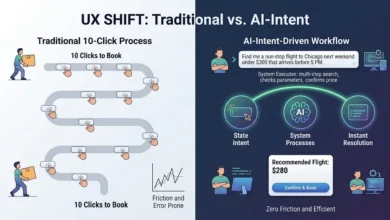
The Paradox of AI Adoption Why People Are Rejecting Artificial Intelligence Features in Favor of Human Centric Workflows

The global technology sector is currently grappling with a significant disconnect between executive enthusiasm for artificial intelligence and the actual needs of the end-user. While major corporations have integrated generative AI into nearly every facet of their digital ecosystems, recent industry data and user experience (UX) research suggest that the promised "AI revolution" is meeting substantial resistance. Contrary to the prevailing corporate narrative that consumers are craving more AI-driven features, evidence indicates a growing "adoption gap" characterized by low retention rates, increased workloads, and a fundamental misunderstanding of what constitutes a value proposition in the modern digital age.
The Misconception of AI as a Value Proposition
In the rush to capitalize on the success of large language models (LLMs) following the public release of ChatGPT in late 2022, many organizations transitioned to an "AI-first" strategy. However, market analysts and UX experts, including those from the Nielsen Norman Group (NNg), have observed that "powered by AI" is not, in itself, a value proposition. A value proposition must solve a specific problem or fulfill a distinct need; merely changing the mechanism of a task from manual to automated does not inherently add value if the new process is less reliable or more cumbersome.
Current AI implementations are frequently categorized as "bolt-on" features. These are tools that sit outside an employee’s or consumer’s established workflow, requiring them to "hop" between fragmented systems. This fragmentation often leads to cognitive overload. Instead of streamlining work, these tools frequently introduce new layers of administrative burden, as users must now manage the AI, verify its output, and correct the inevitable "hallucinations" or errors that arise from non-deterministic software.
The Hidden Labor of Artificial Intelligence
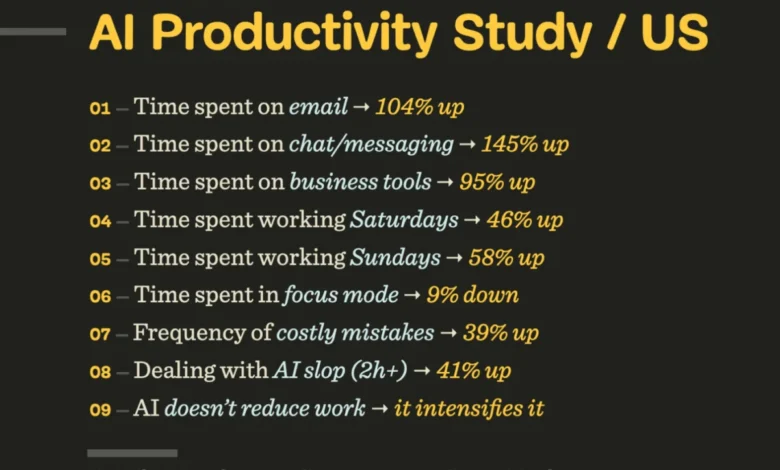
Supporting data from recent productivity studies in the United States highlights a startling trend: AI is often intensifying work rather than reducing it. According to aggregated reports from NBC News, the Harvard Business Review, and the Wall Street Journal, the introduction of AI into the workplace has correlated with several negative productivity metrics. Time spent on email has increased by an average of 104%, while chat and messaging volumes have surged by 145%. Furthermore, the use of business tools has risen by 95%, and the prevalence of weekend work has spiked, with Saturday work up 46% and Sunday work up 58%.
The primary cause of this intensification is the "cleanup" required for AI-generated content. While it may feel easier to ask an AI to draft a response or generate a report, the subsequent need for human intervention—checking for accuracy, tone, and logic—often exceeds the time it would have taken to perform the task manually from the start. This phenomenon, often referred to as "AI slop" management, has seen a 41% increase in the time spent by employees dealing with low-quality automated outputs. Consequently, focus mode—the period of time an employee spends on deep, uninterrupted work—has declined by 9%, while the rate of costly mistakes has risen by 39%.

A Chronology of the AI Integration Crisis
The current state of AI adoption can be traced through a specific timeline of technological overreach and market correction:
- The Generative Breakthrough (Late 2022 – Early 2023): The launch of GPT-3.5 and GPT-4 created a period of "AI euphoria." Companies feared being left behind and began integrating LLMs into everything from search engines to kitchen appliances.
- The Feature Fatigue Phase (Mid 2023 – Early 2024): Users began reporting "AI fatigue." The novelty of chatbots wore off as the limitations of the technology—unreliability, lack of empathy, and hallucinations—became apparent in professional settings.
- The Adoption Gap Realization (Mid 2024 – Present): Large-scale studies, including the IBM 2026 study, began showing that while companies were spending billions on AI infrastructure, actual adoption and retention by employees remained low. This period is marked by a shift in focus from "AI-first" to "AI-integrated."
Economic and Organizational Implications
AI is remarkably adept at amplifying existing shortcomings within an organization. If a company suffers from poor data quality, broken internal politics, or inconsistent decision-making processes, an AI layer will not fix these issues. Instead, it will process these inconsistencies and deliver them directly to the end-user with increased speed. This makes technical debt and cultural friction more visible and damaging to a company’s reputation.
Furthermore, the "Business Model Canvas," a strategic management template for developing new business models, suggests that AI is most effective when placed in the "Key Activities" and "Key Resources" categories. When companies attempt to place AI in the "Value Propositions" category, they risk alienating customers who are looking for reliability and consistency rather than experimental automation.

The Washington Post and the Brookings Institution have identified that while software developers and public relations specialists are highly "exposed" to AI automation, these roles also require high levels of adaptability and human taste. In contrast, roles like firefighting or manual labor remain least vulnerable. The tension lies in the fact that the very parts of the job that people find rewarding—the creative decision-making and the human-to-human connection—are the parts companies are most aggressively trying to automate.
Official Reactions and Industry Perspectives
Expert voices in the field of design and ethics have raised concerns about the dehumanizing aspects of current AI trends. Bo Young Lee, a prominent voice in workplace culture, noted that the public does not desire AI to replace human creativity. "I don’t want to read books written by AI… I want AI to do all the physical and mental labor that taxes me so I can read books written by humans," Lee stated. This sentiment reflects a broader desire for AI to function as a "subtle, humble, and ambient" support system rather than a front-facing replacement for human interaction.
Similarly, Vitaly Friedman, a leader in UX design, argues for an "AI-second" approach. This philosophy suggests that AI should be deeply integrated and almost invisible, augmenting existing workflows rather than replacing them. The goal is to provide tools that are fast, accessible, and—most importantly—predictable.

The Future of "AI-Second" Design
To bridge the adoption gap, the industry must move toward a model of AI that respects human mental models and decision-making processes. This involves several key shifts in strategy:
- From Replacement to Augmentation: AI should focus on automating the mundane, boring, and mentally exhausting tasks that provide no pleasure or professional growth for the worker.
- Deep Integration: Rather than being a separate tool, AI should exist within the software people already use, adapting to their existing habits rather than forcing them to learn new, non-linear ways of interacting with a machine.
- Reliability Over Speed: The market is signaling that it values consistency over the speed of delivery. A feature that works flawlessly 100% of the time is more valuable than an AI feature that works 80% of the time but requires constant supervision.
- Human-Centric Focus: Organizations must recognize that the ultimate goal of technology is to facilitate human connection and achievement. AI that takes time away from human interaction—such as AI therapists or AI-narrated children’s books—is being met with skepticism and rejection.
Broader Impact and Conclusion
The current resistance to AI features is not necessarily a rejection of the technology itself, but a rejection of how it is being implemented. People do not want "more" AI; they want more time, more headspace, and more meaningful human experiences. The companies that succeed in the next decade will likely be those that use AI to "clear the desk" of administrative clutter, allowing their employees and customers to focus on the things they actually love.
As the industry moves toward 2026, the focus will likely shift from the raw power of AI models to the refinement of AI interfaces. The challenge for leaders is to move past the hype and listen to the silent majority of users who are currently nodding at AI features in boardrooms but ignoring them in their daily workflows. The future of AI is not a magical box that speaks; it is a quiet, reliable infrastructure that makes being human a little bit easier. By prioritizing human-centric design and addressing the "boring stuff," AI can finally fulfill its promise as a tool for progress rather than a source of professional anxiety.