Expressive E Launches Noisy 2.6 Expanding the Boundaries of Resonance-Based Synthesis with New Resonator Engines and Enhanced MPE Support

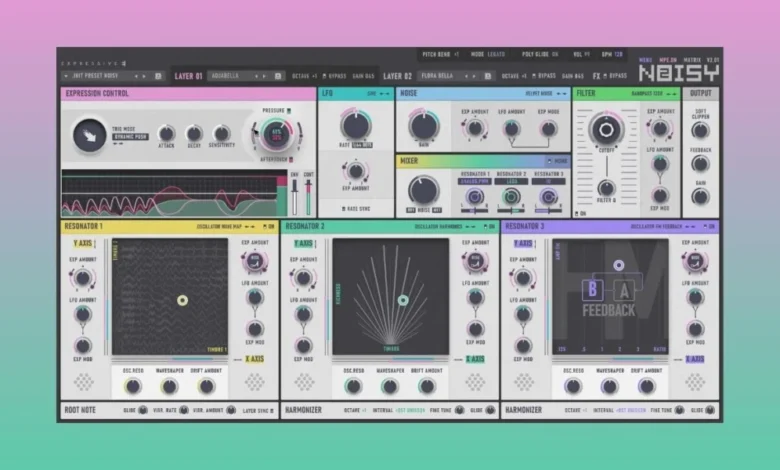
The French music technology company Expressive E has officially released Noisy 2.6, representing a significant evolution of its flagship noise-through-resonance software synthesizer. This major update, which is available as a free download for existing Noisy 2 owners, introduces a substantial expansion of the instrument’s synthesis capabilities, moving beyond its original organic roots into the realms of analog emulation, frequency modulation (FM), and advanced wavetable morphing. To celebrate the launch, the company has announced a limited-time introductory price of $89 (€89), marking a 40% discount from the standard retail price of $149 (€149).
The release of Noisy 2.6 arrives at a pivotal moment for the software synthesizer market, which is increasingly pivoting toward expressive control and multidimensional polyphony. Expressive E, a manufacturer that first gained international acclaim for its hardware controllers like the Touché and the Osmose keyboard, has designed Noisy 2.6 to bridge the gap between complex physical modeling and intuitive performance-based synthesis. Unlike traditional subtractive synthesizers that utilize oscillators to generate waveforms which are then filtered, Noisy utilizes a "noise-through-resonance" engine. In this architecture, various noise sources act as "exciters" that trigger resonators, mimicking the way physical objects—such as strings, skins, or pipes—respond to external energy.
A Diversified Synthesis Architecture
The centerpiece of the 2.6 update is the introduction of five new resonator types, which collectively broaden the instrument’s sonic palette. These additions allow the synthesizer to traverse a wider variety of genres, from cinematic soundscapes to modern electronic dance music.
The first of these, the Wide Analog Unison resonator, is designed to provide the thickness and harmonic instability associated with vintage hardware. By simulating multiple detuned voices within a single resonance structure, it allows for the creation of lush, expansive leads and pads that feel grounded in traditional synthesis. Complementing this is the FM Oscillator and the FM Feedback resonator. While traditional FM synthesis can often feel static, Noisy 2.6 integrates these algorithms into its resonance engine, allowing for gritty, industrial textures and metallic overtones that evolve dynamically based on the input noise.
The update also introduces a Harmonic resonator, focused on purity and mathematical precision in overtones, and a 2D wavetable-style resonator known as the Wave Map. The Wave Map allows for fluid digital morphing, enabling users to navigate through complex sonic landscapes by shifting between different spectral profiles. These additions bring the total count of noise sources to 26 and the total number of effects to 21, creating a modular-like flexibility within a streamlined plugin interface.
Enhancing the Expressive Ecosystem
Expressive E has long been a proponent of MIDI Polyphonic Expression (MPE), a protocol that allows for independent control of pitch, timbre, and volume for every individual note played. Noisy 2.6 is meticulously optimized for this workflow. The update expands the preset library to more than 1,400 sounds, including 650 dedicated MPE presets. These sounds are specifically programmed to respond to the nuanced gestures possible on controllers like the Osmose or the Roli Seaboard, such as pressure-sensitive vibrato, vertical sliding for filter sweeps, and polyphonic aftertouch.
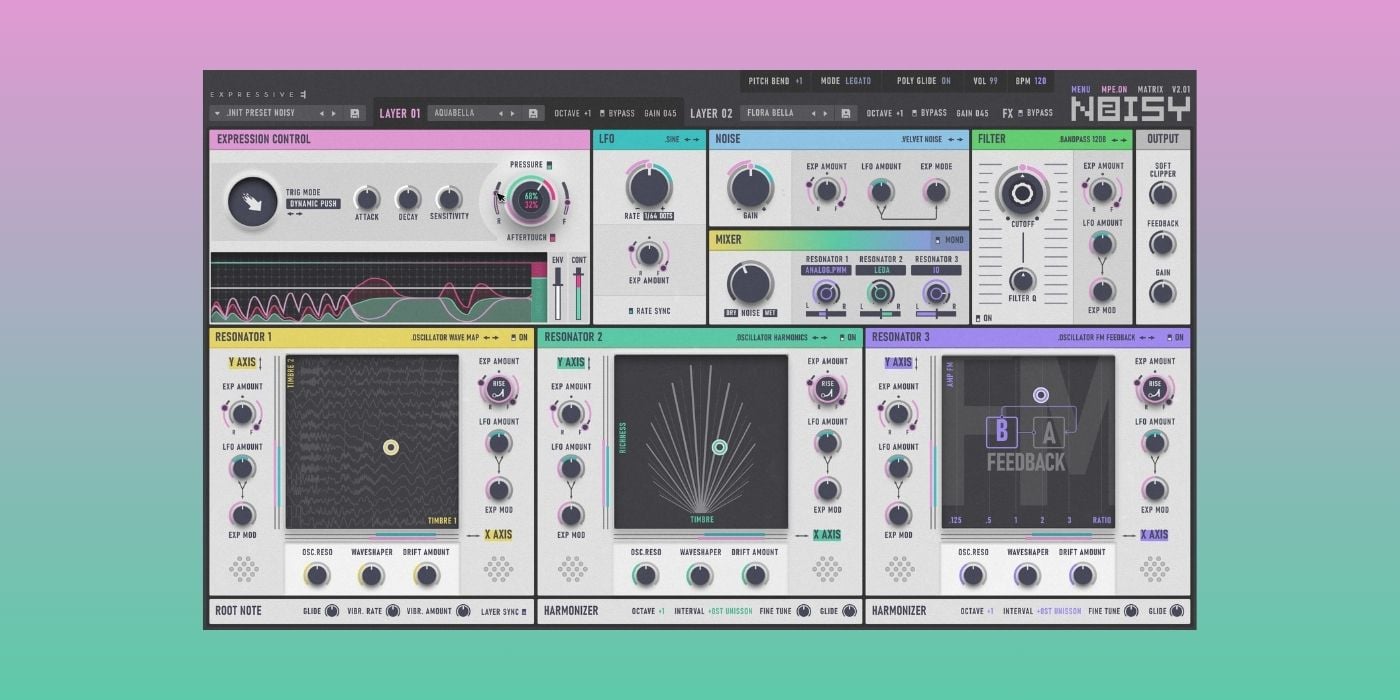
For users without MPE-capable hardware, the 2.6 update remains highly accessible. The library includes 750 standard MIDI presets and full support for DAW automation. The "Expression Blocks" feature—a signature of the Noisy interface—allows users to map complex multi-parameter changes to a single macro. In version 2.6, every preset includes four of these expression modules: one for each of the two primary sound layers and two shared across the effects engine. This ensures that even on a standard MIDI keyboard, the sounds remain "playable" and dynamic.
Technical Evolution and Development Timeline
The trajectory of Expressive E’s software development reflects a broader industry trend toward "physical modeling light"—synthesis that captures the feel of acoustic instruments without the extreme CPU overhead of full physical simulations. Expressive E first showcased its approach to tactile control at major trade shows like Musikmesse nearly a decade ago. Since then, the company has transitioned from a hardware-only manufacturer to a comprehensive ecosystem provider.
The chronology of Noisy’s development shows a consistent focus on refining the interaction between the user and the sound engine:
- Initial Launch: Noisy was introduced as a unique take on resonance synthesis, focusing on the "Touché" controller integration.
- Version 2.0: This update brought a redesigned engine and expanded the compatibility to the wider MPE market, significantly increasing the factory library.
- Version 2.6: The current update represents the "broadest sonic palette yet," integrating traditional synthesis methods (FM, Analog) into the noise-resonance framework.
The nine new effect algorithms included in version 2.6 are specifically optimized for real-time modulation. In high-performance synthesis, standard effects can often produce "zipper noise" or digital artifacts when parameters are moved rapidly. Expressive E’s engineers have focused on smoothing these transitions, ensuring that when a player performs a "shake" gesture or a rapid pressure release, the effects respond with the same fluidity as the core oscillators.
Industry Implications and Market Analysis
Industry analysts suggest that the expansion of Noisy 2.6 into more "synthetic" sounds (FM and Analog) is a strategic move to compete with established giants like Spectrasonics Omnisphere or Ableton’s built-in instruments. By moving away from purely "organic" or "acoustic" textures, Expressive E is positioning Noisy as a primary synthesizer for modern producers rather than a niche tool for sound designers.
The inclusion of the iLok licensing system, allowing for up to three activations without a hardware dongle, reflects a standard professional approach to digital rights management, balancing security with user flexibility. The software’s compatibility with macOS 15 Sequoia and Apple Silicon indicates a commitment to long-term stability in the rapidly changing hardware landscape.
Furthermore, the aesthetic design of the user interface has received praise from the design community. By utilizing a minimalist, high-contrast visual style, Expressive E reduces cognitive load for the user, allowing the focus to remain on the "movement" of the sound. This is particularly important for an instrument where the primary value proposition is "expression."

Official Response and Sound Design Philosophy
While the company maintains a focus on technical excellence, their stated philosophy emphasizes the "unpredictability" of sound. In technical documentation, Expressive E describes the noise-through-resonance method as a way to "inject life" into digital audio. By using noise as a source, no two notes are ever mathematically identical, creating a sense of "organic jitter" that mimics the imperfections of acoustic instruments.
The 150 new presets added in version 2.6 were curated to showcase this philosophy. They range from cinematic textures suitable for film scoring to aggressive, modern electronic timbres. Sound designers who have beta-tested the update note that the new FM Feedback resonator, in particular, offers a level of controlled chaos that is difficult to achieve with standard VST instruments.
Compatibility and Availability
Noisy 2.6 is available immediately through the Expressive E website and authorized retailers. It supports a wide range of operating systems, including macOS 11 (Big Sur) through macOS 15 (Sequoia) and Windows 10 or higher. The plugin is provided in VST2, VST3, and AU formats, ensuring compatibility with virtually every major Digital Audio Workstation (DAW), including Ableton Live, Logic Pro, Cubase, and Bitwig Studio.
The introductory offer of $89 is scheduled to expire in the coming weeks, after which the price will revert to the standard $149. For existing users, the update can be downloaded via the Expressive E user account area. As the industry continues to move toward more expressive and tactile interfaces, the release of Noisy 2.6 solidifies Expressive E’s position as a leader in the intersection of traditional synthesis and next-generation performance technology.
The broader impact of this update may be felt in the increasing adoption of MPE across the music production world. As high-quality software like Noisy becomes more versatile and covers more "traditional" sounds, the incentive for producers to invest in MPE-capable hardware grows. Noisy 2.6 stands as a testament to the idea that software synthesizers should not just be heard, but felt and performed with the same nuance as a physical instrument.