Robbie Williams Defends Olivia Rodrigo Over Song Similarity Debates and Calls for Industry Sanity

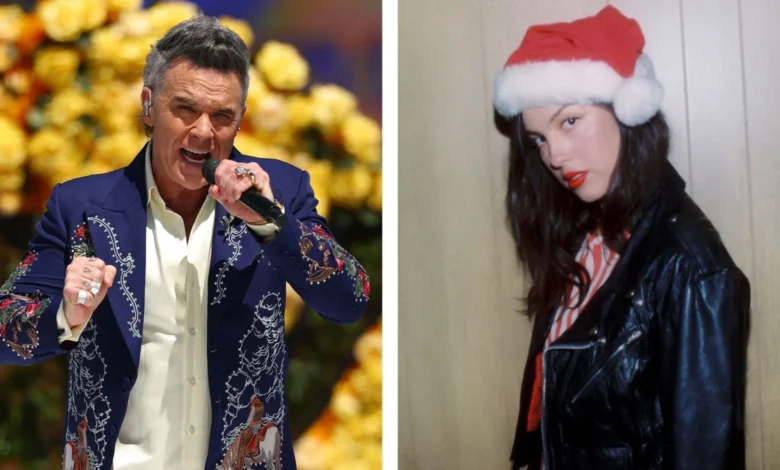
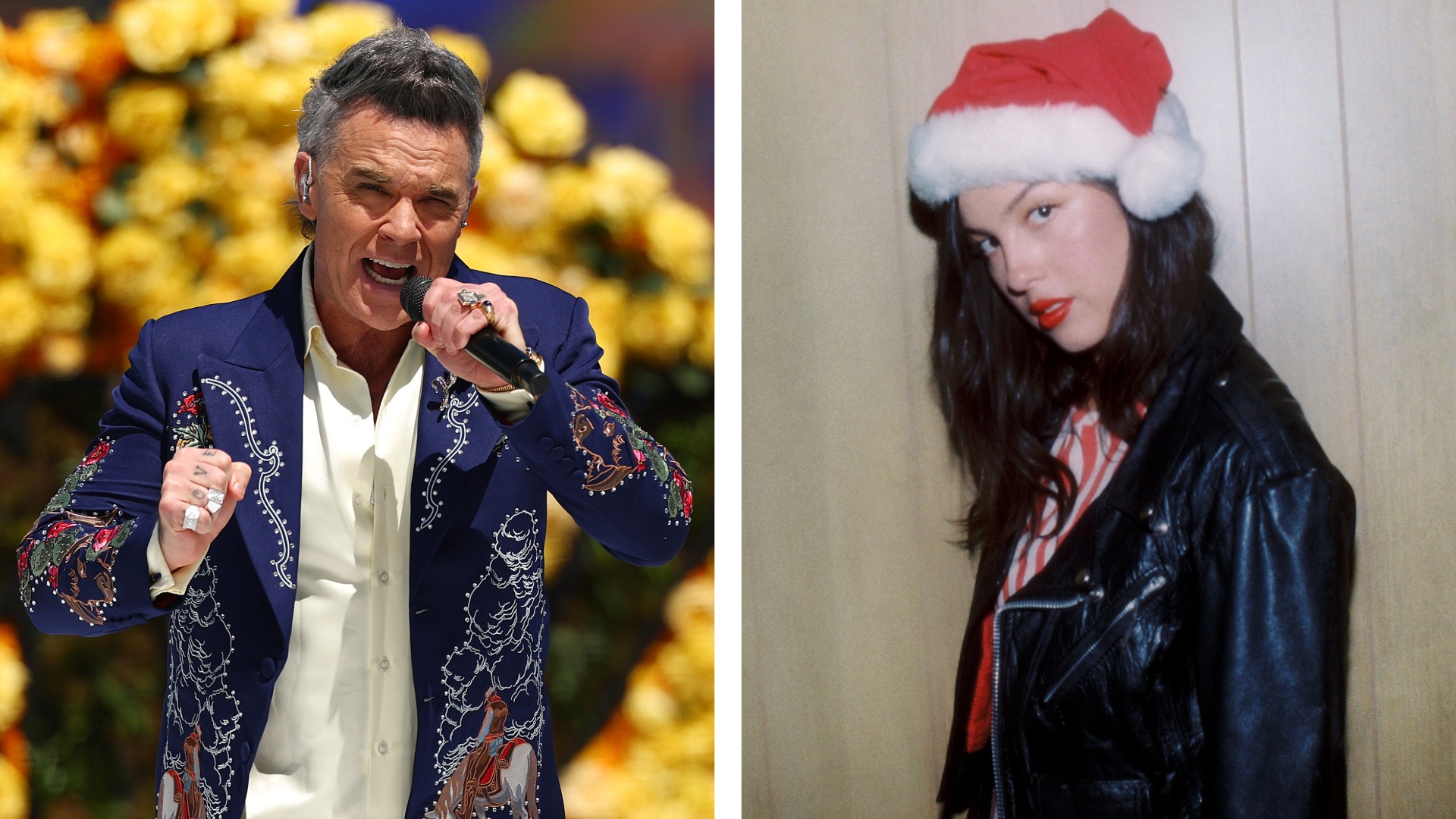
Pop icon Robbie Williams has stepped forward to offer a passionate defense of Grammy-winning singer-songwriter Olivia Rodrigo, pushing back against mounting online scrutiny and copyright comparisons involving her new single, Take Me Home (4 Christmas). Addressing his followers on social media, Williams expressed frustration with what he perceives as an increasingly litigious and hyper-critical music industry culture, where fans and commentators routinely dissect modern tracks in search of perceived similarities to older hits.
The controversy surrounding Rodrigo’s latest festive release arose after listeners noted certain stylistic parallels between Take Me Home (4 Christmas) and Williams’s 2012 pop hit, Candy. Rather than joining the chorus of critics or pursuing legal avenues, Williams adopted a pragmatic and protective stance toward the younger artist. His commentary highlights a broader, long-standing debate within the global music community regarding originality, copyright infringement claims, and the mathematical limitations of Western popular music composition.
A Plea for Industry Perspective
In a candid post shared via his official Instagram account, Williams did not mince words regarding the current state of discourse among music consumers and copyright watchdogs. He argued that while legitimate intellectual property theft certainly exists and deserves legal recourse, the vast majority of online plagiarism accusations are baseless.
"There’s something about the music industry that’s been bothering me for a while," Williams wrote. "People coming after people because they’ve spotted a similarity between two songs. Some of it I completely understand. Some of it is absolutely justified. Most of it, I think, is complete bollocks."
Drawing from his own decades-long career in the spotlight, the former Take That frontman revealed that he has frequently faced similar accusations regarding his own catalog. While acknowledging that some claims hold water upon closer inspection, he pointed out that others defy common sense. To illustrate his point, Williams referenced the finite nature of musical building blocks, noting that composers are inherently constrained by the fundamental structure of Western music.
"There are only so many notes," Williams continued. "Only so many chords. Only so many ways of putting them together before you inevitably find yourself somewhere somebody else has been."
Williams went on to praise Rodrigo’s artistic output, singling out her critically acclaimed 2021 debut studio album, Sour, as a landmark record. He confessed an admiration for her opening track, Brutal, stating bluntly, "What a fucking record. I wish I’d made it."
Addressing the specific comparisons between his track Candy and Rodrigo’s Take Me Home (4 Christmas), Williams suggested that any shared musical DNA was entirely coincidental. He reasoned that the younger artist likely stumbled upon a familiar melodic echo organically. Emphasizing his complete indifference to potential publishing or copyright entanglements, Williams firmly declared that he has no intention of initiating legal action or fueling the controversy. "At some point, some fucking sanity has to prevail," he concluded.
A History of Interpolation and Copyright Scrutiny
Williams’s defense arrives against the backdrop of a turbulent history for Olivia Rodrigo regarding songwriting credits and copyright disputes. Since bursting onto the global music scene with her record-breaking debut era, the American singer-songwriter has frequently found her work subjected to rigorous retrospective analysis by rights holders and internet sleuths alike.
The scrutiny began shortly after the explosive success of her 2021 pop-punk anthem Good 4 U. Following widespread online comparisons to Paramore’s 2007 hit Misery Business, retrospective songwriting credits were retroactively granted to Paramore members Hayley Williams and Josh Faro.
Similarly, transparency was established early with her track 1 Step Forward, 3 Steps Back, which directly interpolated Taylor Swift’s 2017 song New Year’s Day—an homage that Rodrigo acknowledged openly from the outset. However, tensions flared later that year surrounding her smash hit Deja Vu. Online speculation mounted regarding structural similarities between its bridge and the bridge of Swift’s track Cruel Summer, ultimately leading to Swift and co-writer Jack Antonoff receiving retroactive writing credits on the track.
Further comparisons emerged upon the release of Sour’s opening track, Brutal, with listeners drawing parallels to Elvis Costello’s 1978 classic Pump It Up. In that instance, however, Costello displayed a notably relaxed attitude toward the discourse. The veteran rock musician took to social media to dismiss the claims, writing, "This is fine by me… It’s how rock and roll works. You take the broken pieces of another thrill and make a brand-new toy. That’s what I did."
Musical Analysis of the Tracks in Question
Musicology experts and industry observers examining the tracks note that proving a direct copyright violation between Robbie Williams’s Candy and Olivia Rodrigo’s Take Me Home (4 Christmas) would present a significant legal challenge.
While both compositions share certain stylistic characteristics—specifically a syncopated, conversational vocal delivery that bounces rhythmically over upbeat instrumentation—these elements constitute general stylistic choices rather than concrete melodic or harmonic appropriation. In copyright law, general "vibes," vocal pacing, and stylistic delivery are notoriously difficult to protect, as they typically fall under unprotectable musical ideas rather than fixed expressions.

Interestingly, music critics and industry insiders have pointed out that Take Me Home (4 Christmas) bears a much closer stylistic resemblance to another classic track: The Waitresses’ beloved 1981 holiday staple Christmas Wrapping. Chris Butler, the principal songwriter behind Christmas Wrapping, revealed that Rodrigo proactively reached out to him months prior to the single’s release to ensure he had an opportunity to listen to the track beforehand.
When approached regarding whether he felt entitled to a formal songwriting or publishing credit, Butler firmly rejected the notion. Echoing Williams’s sentiment regarding the limitations of copyright law, Butler noted on social media, "Can’t copyright a vibe. Her song has no copy of melody/chord progression… nothing to justify a claim. I’ll take flattery for the win!"
Broader Implications for the Modern Music Industry
The public intervention by an established legacy artist like Robbie Williams highlights a growing industry-wide fatigue regarding the modern legal landscape of songwriting credits. In the wake of high-profile legal battles—most notably the landmark 2015 "Blurred Lines" verdict involving Robin Thicke, Pharrell Williams, and the estate of Marvin Gaye—pop songwriters have operated in an environment of heightened caution.
Many contemporary creators and publishers have expressed concern that aggressive litigation over minor musical similarities or shared stylistic choices risks stifling creativity. When artists are forced to preemptively clear or credit historical works due to fear of litigation over common chord progressions or rhythmic cadences, the natural evolution of popular music can be compromised.
By publicly waving away potential grievances and advocating for a return to common sense, Williams’s remarks serve as a counterweight to the prevailing litigious climate. For Olivia Rodrigo, who has navigated intense public scrutiny over her songwriting credits throughout her meteoric rise, the veteran artist’s endorsement offers a welcome shield from unnecessary controversy. As the music industry continues to grapple with the fine line between inspiration, interpolation, and infringement, voices like Williams’s and Costello’s advocate for a preservation of the foundational ethos of rock and pop music: artists building upon the sonic traditions of those who came before them.