Meta Expands Paywall Tests by Limiting Facebook Page Link Posts to Two Per Month for Non-Subscribers

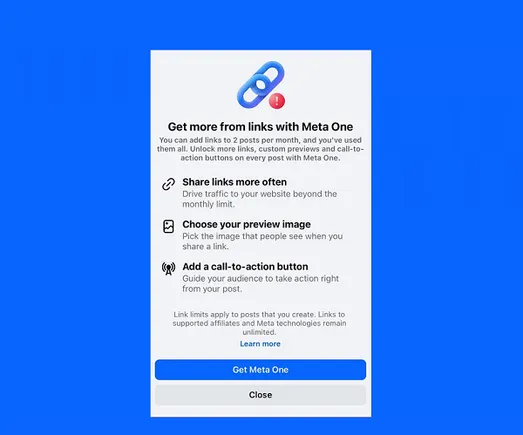
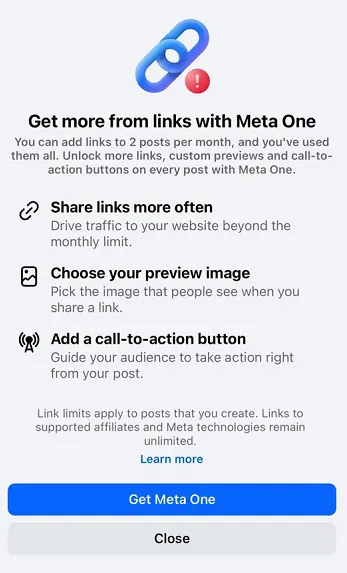
Meta is expanding its platform monetization efforts by rolling out stricter limitations on organic traffic for business accounts. Following the recent introduction of the Meta One for Business subscription packages, numerous Facebook Page managers have reported receiving notifications that their accounts are now restricted to publishing a maximum of two link posts per month. This test, which initially surfaced in late 2025 on a smaller scale, now appears to be scaling up as a core incentive for businesses to adopt Meta’s new paid tiers.
The move highlights a broader, long-term shift in how social media conglomerates manage business visibility, prioritizing paid promotion while systematically diminishing the reach of organic outbound links. For brands, publishers, and marketers relying on social media traffic to drive website engagement, this policy shift represents a crucial juncture that demands a reevaluation of digital marketing strategies.
Background Context and the Evolution of Meta One for Business
The introduction of Meta One for Business marks a significant evolution in how Meta structures its offerings for professional accounts, brands, and small-to-medium enterprises. Initially teased through various beta programs and localized tests, Meta One for Business is designed as a tiered subscription model that bundles several administrative, analytical, and promotional tools into a single package.
Among the features tied to these paid tiers is the ability to incorporate outbound links into Instagram posts and Reels beyond standard baseline limitations, with allowances scaling depending on the specific financial commitment of the subscriber. While the initial rollout documentation heavily emphasized Instagram integration, indicators quickly pointed toward a broader implementation across Meta’s entire ecosystem, including Facebook Pages.
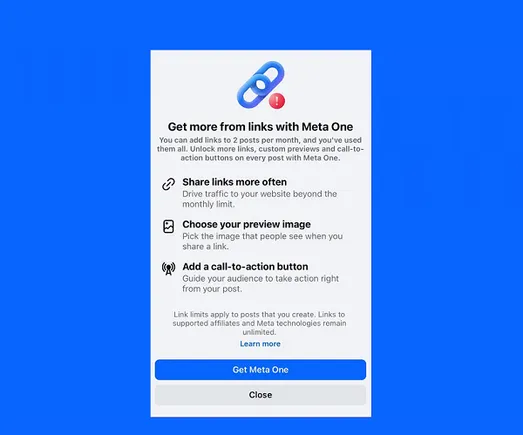
The recent wave of pop-up alerts received by Facebook Page administrators confirms that this strategy is now active in live testing environments. Accounts that fall outside the paid subscription tiers are greeted with explicit notices informing them that their capacity to share links pointing to external websites is capped at two per month. To bypass this restriction and publish an increased volume of content featuring outbound links, page operators are directed toward the Meta One subscription packages.
Chronology of the Link Restriction Strategy
To understand how Meta arrived at this juncture, it is necessary to examine the timeline of its experimentation with link-sharing constraints.
December 2025: Meta quietly launches an initial, localized test restricting select business and creator pages to a maximum of two link posts per month. At the time, company representatives frame the initiative as an exploratory study aimed at measuring whether an increased volume of external links provides tangible value to users, while explicitly exempting verified publisher pages to maintain news distribution channels.
Early 2026: Throughout the first quarter, data from Meta’s Transparency Reports reveals a precipitous drop in the visibility of external links across feeds. Organic reach for link-containing posts plummets to historic lows, establishing a baseline where the vast majority of user engagement occurs strictly within the platform ecosystem.
Current Rollout: Meta officially debuts the Meta One for Business subscription tiers. Concurrently, the two-link-per-month restriction expands from a limited trial to a more widespread enforcement mechanism targeting non-paying professional accounts on Facebook. Pop-up alerts begin appearing globally for page managers, formally tying volume allowances for outbound links to paid subscription status.
Data Analysis: The Declining Value of Organic Link Posts
While restricting business pages to two link posts per month may initially sound catastrophic to marketing professionals, a rigorous analysis of platform data suggests that the practical impact on day-to-day engagement may be less severe than anticipated. Meta’s own metrics demonstrate that organic link posts have been losing traction on Facebook for years.

According to Meta’s Widely Viewed Content Report for the first quarter of 2026, an astounding 98.7% of all post views in the United States during that period did not include a link to an external source outside of Facebook. Users increasingly consume video content, native images, and text-based discussions without clicking away from the application.
This trend represents a multi-year decline in external traffic generation. Historical data from Meta’s transparency reports indicates that in 2022—when the company first began publishing comprehensive viewership insights—approximately 9.8% of viewed content included an external link. By early 2026, that figure had cratered to just 1.3%.
This statistical reality undercuts the panic surrounding the new restrictions. Because the platform’s algorithmic distribution heavily favors native content—such as Reels, short-form video, and community interactions—organic link posts already struggle to achieve meaningful reach. Consequently, capping these posts at two per month largely formalizes an algorithmic reality that has been developing for years: Facebook is fundamentally an enclosed ecosystem designed to keep users on-platform, rather than a referral engine for external websites.
Industry Implications and Strategic Adjustments for Brands
The tightening of link-sharing capabilities forces marketing departments and digital strategists to rethink how they allocate resources on social media. For years, the playbook for Facebook marketing involved sharing blog posts, product pages, and news articles to funnel traffic back to proprietary websites.
With organic outbound reach hovering near zero and access to link-sharing now subjected to artificial caps or subscription paywalls, brands must pivot toward alternative strategies:
- Prioritizing Native Content: Marketers are increasingly shifting their focus toward native formats—such as high-engagement video, interactive polls, and community-building discussions—that align with Meta’s algorithmic preferences.
- Utilizing Paid Advertising: Rather than relying on organic link posts, businesses are finding that targeted ad campaigns remain the most reliable method for driving qualified traffic to external websites, bypassing organic limitations entirely.
- Leveraging Direct Messaging and Bio Links: On platforms like Instagram, brands are utilizing direct message automation, stories, and link-in-bio tools to direct interested consumers toward conversion funnels without relying solely on standard feed posts.
- Evaluating Subscription ROI: Page managers must weigh the cost of Meta One for Business against the actual return on investment derived from native link-sharing. For organizations where social referral traffic is paramount, the subscription fee may become a mandatory operational expense.
Meta’s Three-Stage Monetization Playbook
The decision to charge business users for foundational publishing capabilities is entirely consistent with Meta’s long-term corporate strategy. In 2016, during an annual stockholder meeting, Meta CEO Mark Zuckerberg outlined a definitive three-stage monetization framework that has guided the company’s platform development over the past decade.
The framework dictates that the company first builds a consumer audience by offering engaging, free-to-use communication tools. Second, it organically integrates businesses into the ecosystem, allowing brands to establish free pages, build followings, and interact with consumers. Third, once businesses become heavily reliant on the platform’s audience and infrastructure, Meta introduces monetization mechanisms, gradually shifting organic utilities behind paywalls or advertising requirements.
This playbook has been mirrored across nearly all of Meta’s properties, from the gradual reduction of organic reach for business pages in the late 2010s to the recent implementation of paid verification badges across Facebook and Instagram. While charging businesses for features they once enjoyed for free often draws criticism from marketing professionals who view the practice as a bait-and-switch, it remains a textbook execution of corporate scaling and platform monetization.
Looking Ahead: The Future of Platform Dependencies
As Meta continues to refine its Meta One for Business packages and expands testing parameters globally, the digital marketing landscape faces a permanent transformation. The era of free, high-reach organic referral traffic from major social networks has effectively drawn to a close.
For enterprise brands, small businesses, and independent publishers alike, success on social media will no longer be measured by the frequency of outbound links shared, but by the sophistication of their native engagement strategies and their willingness to integrate paid tiers into their marketing budgets. Whether smaller businesses will absorb these subscription costs or redirect their efforts toward alternative channels remains one of the defining questions for the digital economy in the years ahead.