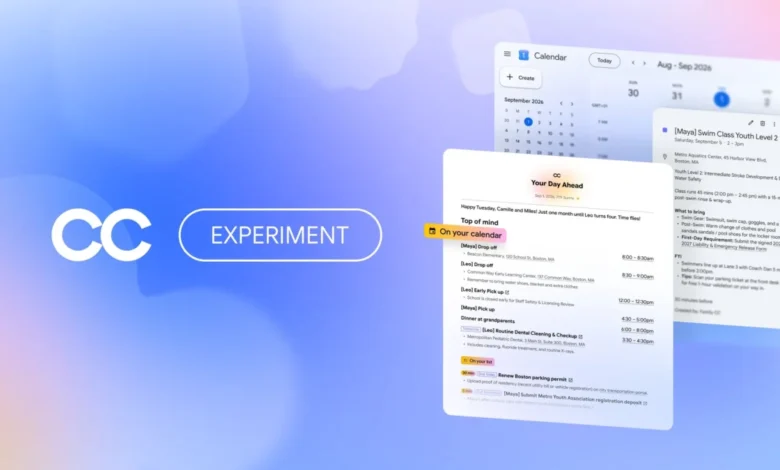
Google is officially shifting the scope of its experimental artificial intelligence agent, CC, transforming the productivity tool into a dedicated coordinator for family logistics and household management. Initially designed as an individual assistant that summarized daily schedules, the newly updated version of CC is engineered to handle complex, multi-person tasks ranging from tracking school permission slips and organizing extracurricular calendars to drafting weekly meal plans and constructing collaborative shopping lists.
The update reflects a broader, rapidly accelerating industry trend. Across the technology sector, major tech giants and agile startups alike are rushing to determine how agentic artificial intelligence can best integrate into the everyday rhythms of consumer life. As households increasingly lean on digital infrastructure to navigate demanding schedules, automated agents are emerging as the next frontier in personal computing. By targeting the chaotic operational overhead shared by modern families, Google is positioning CC to compete directly with emerging niche tools like Ollie and Fambot, which have recently launched specialized AI assistants marketed specifically as digital chiefs of staff for parents.
From Productivity Pilot to Family Chief of Staff
The evolutionary path of CC highlights Google’s iterative approach to agentic artificial intelligence. The tool originally debuted as a standalone productivity agent designed to interface seamlessly with personal data ecosystems, including Gmail, Google Calendar, Google Drive, and the broader internet. By synthesizing information across these silos, CC originally generated a comprehensive "Your Day Ahead" briefing delivered straight to a user’s inbox. In May, Google integrated core components of this technology directly into the primary Gemini mobile application under the moniker "Daily Brief," making the summarization features widely accessible to everyday consumers.

However, internal usage metrics and qualitative user feedback revealed a significant shift in consumer demand. Rather than merely utilizing the AI to optimize individual workflows, early adopters were actively repurposing the technology to manage household operations. Parents requested that the AI help them stay abreast of intricate school calendars, sports practices, recurring utility bills, medical appointments, and dietary requirements. Recognizing this organic pivot, Google re-architected CC to function as a collaborative, multi-user agent tailored specifically to collective household management.
Architecture, Permissions, and Cross-Platform Mechanics
To facilitate collaborative management among household members, the updated version of CC is assigned its own dedicated Google account. This architectural choice allows the AI agent to operate as an active participant in shared workflows while maintaining strict data access permissions. Google’s privacy framework ensures that household members retain granular control over what personal information they choose to disclose to the agent. Participants can forward relevant communications—such as school announcements, sports schedules, birthday party invitations, or doctor appointment confirmations—directly to CC’s unique email address, or they can establish automated sharing rules.
To streamline this process, users can designate specific email senders whose outgoing messages will automatically route to CC. Educational institutions, travel providers, athletic leagues, and extracurricular clubs are prime candidates for this automated ingestion. Furthermore, the AI agent proactively analyzes communication patterns to suggest new email senders for inclusion on a weekly basis. Google has structured the platform to support up to six distinct family members, enabling a tightly knit group to share data, assign tasks, and collaborate with the agent in real time.
Beyond email triage, CC integrates deeply into household coordination by actively monitoring critical dates and actionable to-dos, automatically populating shared calendars and task lists. If an orthodontist’s office sends a confirmation email regarding an upcoming procedure, or if a school district announces an unexpected teacher workday, the agent captures the metadata and updates the collective schedule without requiring manual human intervention. Moreover, the agent possesses the capability to execute administrative tasks on behalf of the family. It can parse complex PDF documents, fill out digital permission slips, generate categorized school supply shopping lists, draft weekly meal plans with corresponding grocery lists, and calculate optimal driving times between sequential afternoon activities. When faced with missing details or ambiguous scheduling conflicts, the agent initiates clarifying queries, continuously refining its group memory to improve future utility.

Technical Foundation and Current Limitations
Under the hood, CC is powered by Google’s advanced agentic framework, known as Antigravity, operating in tandem with the multimodal capabilities of the Gemini model family. To ensure high levels of performance and security, the agent executes within its own isolated cloud computing environment. Despite these robust technical underpinnings, the current deployment of CC comes with notable geographical, demographic, and systemic limitations.
At present, the experimental rollout is restricted strictly to users located within the United States who maintain personal Gmail accounts and are at least 18 years of age. This restriction introduces a substantial barrier for households involving older children, tweens, and teenagers. Because minors cannot officially access the service without circumventing age restrictions on their Google accounts, families cannot fully integrate adolescents into the AI’s collaborative loop. Furthermore, the exclusion of school-issued accounts presents a major operational hurdle. Many modern K-12 educational institutions rely entirely on Chromebook ecosystems and enterprise Google Workspace environments for daily communication. Because students and teachers operate within these locked-down institutional domains, families are often unable to connect critical school inboxes directly to their personal CC agents.
Demographic Shifts and the Multi-Generational Household
Google’s timing for a family-centric AI agent coincides with significant structural shifts in contemporary living arrangements. Economic pressures, housing market constraints, and evolving caregiving dynamics have contributed to a notable rise in multi-generational households. Recent demographic data indicates that approximately one-third of young adults continue to reside with their parents, while older generations frequently share living spaces or coordinate closely with adult children to manage childcare and eldercare responsibilities.

In these expanded household units, logistical coordination extends far beyond the traditional nuclear family model. Parents must frequently synchronize schedules with other resident adults, grandparents, external caregivers, and professional nannies. The sheer volume of disparate schedules, medical appointments, dietary preferences, and logistical obligations in multi-generational homes creates an acute need for centralized coordination. An autonomous agent capable of ingesting information from multiple distinct human vectors and harmonizing them into a single, cohesive operational plan addresses a genuine market void.
Deployment Strategy and Market Outlook
Google is rolling out access to the updated CC platform in phases. Existing users of the productivity agent will receive email invitations in the coming days prompting them to upgrade their accounts to the new family-oriented architecture. Meanwhile, new consumers interested in evaluating the technology can sign up for an official waitlist via the Google Labs landing page.
As the race toward consumer-facing agentic artificial intelligence intensifies, the success of tools like CC will likely hinge on striking a delicate balance between automation utility and rigorous data privacy safeguards. While startups such as Ollie and Fambot pioneer alternative privacy-first models in the family assistant space, Google’s deep integration across the Android, Gmail, and Calendar ecosystems gives the technology giant a formidable distribution advantage. Whether families will willingly entrust the intricate details of their daily lives to an autonomous cloud agent remains to be seen, but the tech industry’s heavy investment in household AI signals that the kitchen table is rapidly becoming the next major battleground for artificial intelligence adoption.