Kia Unveils the All-Electric PV7 Van With Up to Nine Seats and Ultra-Fast 800-Volt Charging, Though U.S. Buyers Are Left Out

The automotive landscape is undergoing a silent yet profound structural evolution as economic pressures reshape consumer purchasing habits. For nearly three decades, the American family driveway was defined by the sport utility vehicle, a segment that successfully usurped the cultural and commercial dominance previously held by the 1980s and 1990s suburban minivan. However, with the average cost of a new automobile hovering stubbornly near the $50,000 threshold, modern households are systematically reevaluating their transportation priorities. Practicality, cost-efficiency, and spatial optimization are rapidly reclaiming their status as paramount consumer metrics. This shifting paradigm was underscored in 2025 by a striking 21 percent surge in minivan sales nationwide, signaling that the utilitarian people-mover is far from obsolete.
Yet, despite this resurgence in consumer interest, the electric vehicle marketplace has lagged significantly in providing viable, zero-emission multi-passenger options. Currently, the Volkswagen ID. Buzz stands as the sole all-electric minivan available in the United States, and temporary production pauses have severely constrained its dealership inventory. While automotive enthusiasts look forward to the Buzz’s scheduled return for the 2027 model year, overseas manufacturers continue to innovate at a rapid pace. Among these developments is Kia’s newly detailed PV7, a spacious electric vehicle that checks nearly every box for modern families and commercial operators alike. Regrettably, current corporate deployment strategies dictate that the PV7 will launch exclusively in European and South Korean markets, leaving North American consumers on the sidelines.
The Genesis of Kia’s PBV Strategy and the Expansion of the PV7
The introduction of the PV7 represents a major expansion of Kia’s ambitious Platform Beyond Vehicle, or PBV, architecture. This specialized commercial and passenger EV framework was formally introduced to the global market with the unveiling of the smaller PV5 van in 2025. Designed from the ground up to accommodate a myriad of commercial and private applications, the PBV lineup utilizes a skateboard-style electric vehicle platform that maximizes interior volume relative to its exterior footprint.
The PV7 scales up this foundational philosophy. Measuring approximately two feet longer than its sibling, the PV5, the PV7 is engineered to serve dual purposes as both a high-capacity passenger transport and a heavy-duty cargo hauler. From a baseline manufacturing standpoint, the vehicle is designed to offer exceptional modularity. Kia has confirmed that the PV7 will come standard with a robust 71.5 kWh battery pack—a capacity offered merely as an optional upgrade on the smaller PV5. For consumers and fleet operators requiring extended operational ranges, a larger 96.2 kWh battery pack will also be made available, positioning the vehicle for long-haul capability without frequent stops at public charging infrastructure.
Comparative Metrics: How the PV7 Sets Itself Apart
When evaluating multi-passenger transport and light commercial vans, prospective buyers consistently prioritize two primary performance indicators: driving range efficiency and interior spatial utility. The PV7 addresses these demands through advanced packaging and next-generation electrical architecture.
Much like the PV5, the PV7 utilizes a completely flat floor layout, eliminating the traditional transmission tunnels and center consoles that typically eat into cabin space. However, while the PV5 is restricted to a maximum seating capacity of seven occupants, the passenger-configured variant of the PV7 expands this threshold to accommodate up to nine passengers comfortably. Furthermore, the interior architecture facilitates seamless transit between the front and rear compartments. In a nod to executive transport and social seating arrangements, the cabin features swiveling seats capable of transforming the interior into a face-to-face conference or lounge configuration.
Driving range and charging infrastructure represent critical benchmarks for commercial fleet integration and family road trips alike. While the PV5 achieves a maximum Worldwide Harmonized Light Vehicles Test Procedure (WLTP) driving range of 256 miles—translating roughly to an estimated 205 miles under the stricter Environmental Protection Agency (EPA) testing protocols—the long-range cargo variant of the PV7 pushes boundaries further. It delivers an impressive WLTP-rated range of up to 289 miles on a single charge.
Crucially, the PV7 transitions from the 400-volt electrical architecture found in the PV5 to an advanced 800-volt system. This high-voltage framework enables compatibility with ultra-fast direct current (DC) public charging stations, allowing the vehicle to replenish its battery state of charge from 10 percent to 80 percent in approximately 20 minutes.
Powertrain Options and Cargo Versatility
Versatility remains a cornerstone of the PV7’s engineering blueprint. While the PV5 is strictly limited to a front-wheel-drive configuration across both its passenger and cargo trims, Kia has announced plans to introduce a dual-motor, all-wheel-drive powertrain option for the PV7. Initial production models, however, will launch with a single-motor, front-wheel-drive setup generating a respectable 268 horsepower, providing ample torque for heavy loads and highway passing maneuvers.
For commercial buyers focused on logistics, the cargo iteration of the PV7 will be available in two- and three-seat configurations. To accommodate diverse cargo handling needs, customers can choose from regular, long, and high-roof body styles. Additionally, rear access can be customized via either a traditional twin-swing tailgate or a vertically lifting tailgate, depending on operational preferences and loading dock compatibility.
Styling, Digital Architecture, and Advanced Safety Features
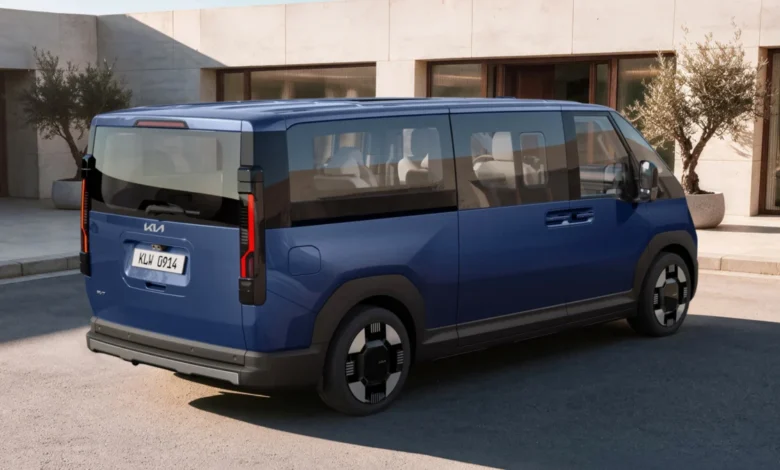
Aesthetically, the PV7 departs significantly from traditional internal combustion minivans and even from Kia’s own conventional U.S. market minivan offering, the Carnival. Embracing a distinctly utilitarian ethos, the PV7 showcases a boxy, upright, and ultra-modern exterior silhouette. Its blunt nose, flat vertical planes, and vertically oriented headlamps project a futuristic, industrial aesthetic. While this cab-forward design maximizes interior volume, industry analysts note that it may encounter traditionalist resistance in North American markets, where consumers have historically favored more sculpted, aerodynamic hood lines.
Inside the cabin, the driver is greeted by a state-of-the-art digital environment anchored by a sprawling 14.6-inch central touchscreen interface paired with a fully digital gauge cluster. The infotainment infrastructure is powered by Kia’s new Android OS-based Pleos Connect system, engineered to replicate the intuitive, responsive user experience of a modern smartphone. The system features a native open-application marketplace and an advanced, artificial intelligence-powered voice assistant capable of controlling navigation inputs, climate systems, and vehicle functions seamlessly.
For fleet managers, the vehicle incorporates the proprietary Kia Business Solutions Portal, a dedicated software suite designed to streamline vehicle maintenance tracking, diagnostic monitoring, and fleet oversight. Safety technology has also been elevated with the inclusion of innovative active driver-assistance systems, most notably Pedal Misapplication Safety Assist 2.0. This system is engineered to mitigate the statistical risks associated with unintentional accelerator pedal actuation in tight parking spaces or urban environments.
Camper Van Conversions and Aftermarket Potential
Beyond its intended roles as a corporate shuttle or commercial delivery van, the physical dimensions of the PV7 open up lucrative opportunities in the burgeoning recreational vehicle and camper van conversion market. Because the PV7 is substantially wider and longer than the PV5, it provides an ideal volumetric foundation for mobile living quarters.
The viability of this platform for outdoor enthusiasts is already being validated across the Atlantic. Following successful aftermarket camper conversions of the smaller PV5 by specialized outfitters—such as the UK-based Sussex Campervans—industry partners have already signaled definitive plans to adapt the larger PV7 platform into dedicated motorhomes featuring dual interior layout options.
Broader Market Implications and Geographic Disconnects
The formal rollout of the PV7 highlights a growing strategic divergence between South Korean and European automotive deployments and the realities of the North American market. Kia has slated the official market release of the PV7 for the latter half of 2027, targeting commercial and consumer sectors in Europe and South Korea. As of the time of publication, corporate leadership at Kia has made no public commitments regarding a potential U.S. importation timeline.
This absence leaves a notable void in the American automotive ecosystem. As macroeconomic pressures continue to inflate the cost of private vehicle ownership, families and commercial enterprises are actively seeking affordable, highly efficient, high-capacity electric alternatives to traditional gasoline-powered SUVs. By restricting the PV7 to international territories, automakers leave domestic consumers with limited choices in the electric people-mover segment, underscoring a missed opportunity to capture a surging market demand for practical, multi-passenger electrification.