From Practical Craft to Digital Canvas: ILM Veteran John Goodson on the Evolution of Visual Effects Artistry

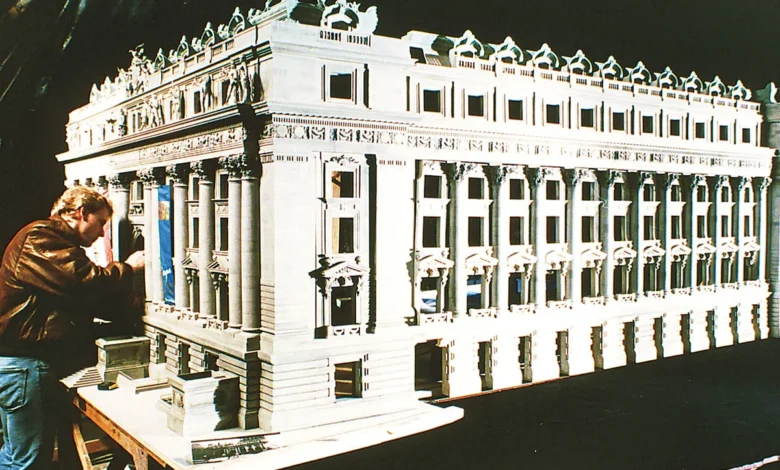
The transition from physical craftsmanship to digital rendering stands as one of the most transformative eras in modern cinema history. At the epicenter of this evolution was Industrial Light & Magic (ILM), the pioneering visual effects studio established by filmmaker George Lucas in 1975 to realize the groundbreaking space battles of the original Star Wars. While ILM is widely celebrated for midwifing the digital revolution, the human cost of that technological pivot—specifically the closure of the legendary ILM Model Shop—remains a poignant chapter in Hollywood history.
Among the artisans who navigated this seismic shift is digital artist and veteran modelmaker John Goodson. His career bridges two distinct epochs of filmmaking: the tactile, analog world of physical miniatures and the expansive, software-driven landscape of modern computer-generated imagery (CGI). Goodson’s journey offers a rare window into how an institution adapted to the relentless march of technology, balancing the loss of traditional trades with the birth of entirely new digital disciplines.

The Genesis of a Dream and the Analog Era
Goodson’s fascination with visual storytelling began long before he set foot on an ILM soundstage. Born into a military family and raised on an Air Force base, a three-year-old Goodson was mesmerized by "The Derelict," an episode of the classic science fiction television series Lost in Space, which featured full-frame shots of the Jupiter II spacecraft being pulled into a giant alien vessel. Influenced by a neighbor who was a fighter pilot and inspired by an early copy of The Making of Star Trek, Goodson developed an early understanding of cinematic illusion.
When Star Wars premiered in 1977, a 14-year-old Goodson began writing letters to ILM, eager to understand how the cinematic magic was constructed. Observing that many artists listed in the Art of Star Wars books hailed from industrial arts or architecture backgrounds, Goodson pursued Product Design at the School of Design at North Carolina State University.
By 1988, Goodson relocated to California and secured his first professional gig at ILM: a brief, one-week stint working on Body Wars, a simulator ride attraction comparable to Star Tours that transported audiences through a miniaturized journey of the human body. This baptism by fire introduced Goodson to the rigorous, collaborative environment of the ILM Model Shop, a physical workshop that served as a vocational film school where techniques were openly shared and artistic instincts were forged.

Navigating the Digital Shift: The Closure of the Model Shop
The eventual winding down of ILM’s Model Shop marked a painful turning point for practical effects artists. As computer graphics capabilities matured through the 1990s and 2000s, studios increasingly favored digital assets for their flexibility, cost-effectiveness, and speed.
Reflecting on the closure, Goodson acknowledges the profound disruption it caused within the industry. The transition, while historically inevitable as new technology replaced older job categories, caught many traditional artisans unprepared. For workers caught in the gears of technological advancement, the shift was stark and unforgiving.
For Goodson, survival meant reinvention. After receiving roughly a month of crash-course training in digital tools, he was thrust into the digital painting department. His first major assignment involved executing revisions for the Special Edition release of Star Wars: A New Hope, specifically painting Luke Skywalker’s landspeeder using software he had barely mastered. Early digital tools presented steep learning curves, but as software matured—particularly with the adoption of applications like Mari, which allowed artists to paint in complex layers of physical materials—the digital medium began to rival and occasionally surpass real-world fidelity.
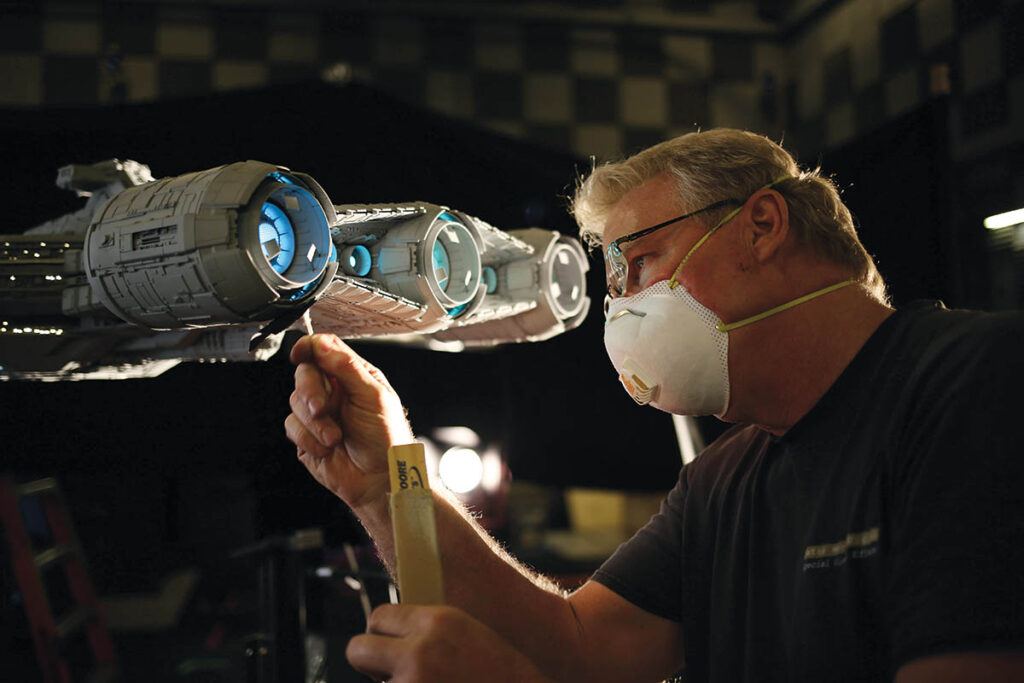
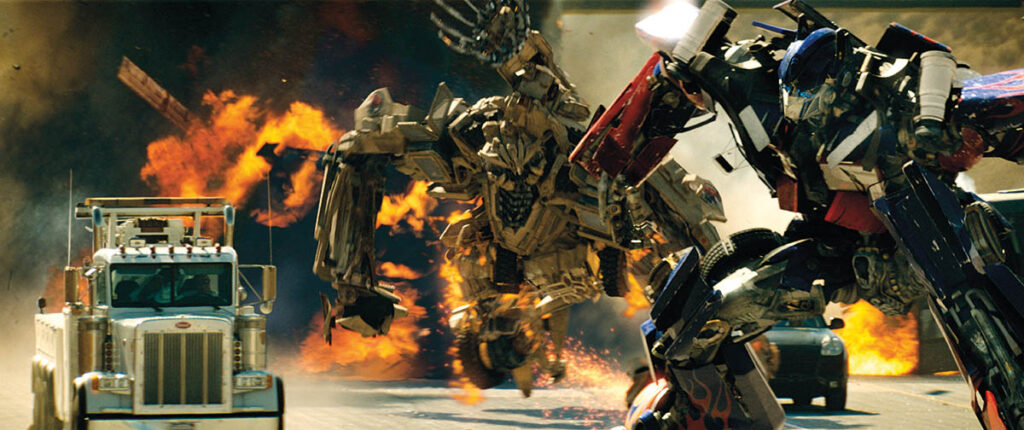
Despite embracing digital artistry, Goodson maintained a foot in both worlds. His career spans contributions to massive franchises, earning him Visual Effects Society (VES) Award nominations for his work on high-profile projects including The Mandalorian, Transformers: Age of Extinction, Star Trek Into Darkness, Mission: Impossible – Ghost Protocol, and Iron Man 2.
Blurring the Lines: Practical Models in the Digital Age
Rather than rendering practical effects entirely obsolete, modern blockbusters have increasingly embraced hybrid workflows that merge physical miniatures with virtual production environments. This convergence was prominently displayed during production on projects set within the Star Wars television universe, such as The Mandalorian.
Working alongside machinists and fabricators like Dan Patrascu, Goodson helped construct two-foot and four-foot physical models of the Razor Crest ship for sequences shot inside advanced LED volumes. Unlike traditional bluescreen stages, LED volumes provide real-time interactive lighting that naturally illuminates physical models, ensuring seamless integration when composited into digital plates.
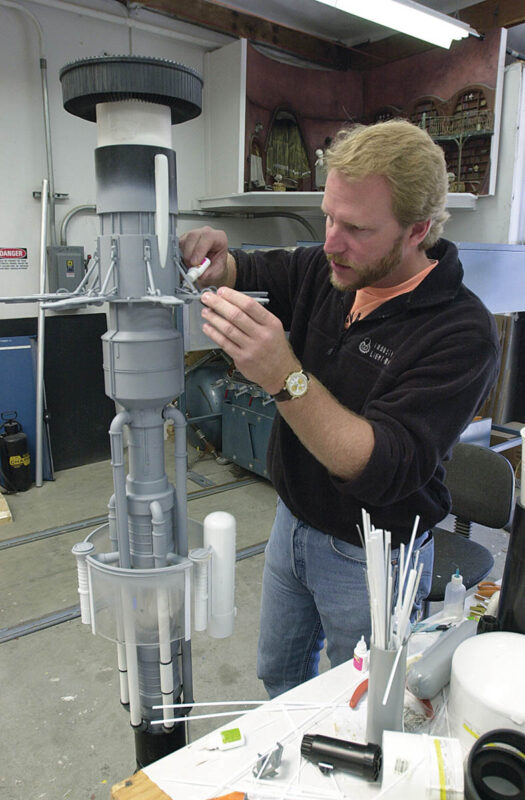
However, hybrid workflows introduce unique engineering hurdles. For instance, designing Ahsoka’s ship with a rotating wing required complex mechanical problem-solving. Because a front-mount configuration prevented placing a motor at the center of gravity, engineers had to manufacture specialized peripheral gears around a narrow tube to achieve smooth rotation—a testament to the ongoing intersection of mechanical engineering and cinematic artistry.
Goodson’s pragmatic approach extends to material selection. While traditional modelmakers often view 3D printing with skepticism due to material fragility, modern fabrication has found a vital niche in complex components. On the Razor Crest and Moff Gideon’s Light Cruiser, full-scale 3D printing was utilized for intricate elements like engines and weaponry, while fuselages were meticulously built by hand.
Improvised Ingenuity Under Pressure
The hallmark of the ILM Model Shop was its ability to solve seemingly impossible logistical crises under crushing production deadlines. Throughout his tenure, Goodson encountered numerous curveballs that tested his resourcefulness.
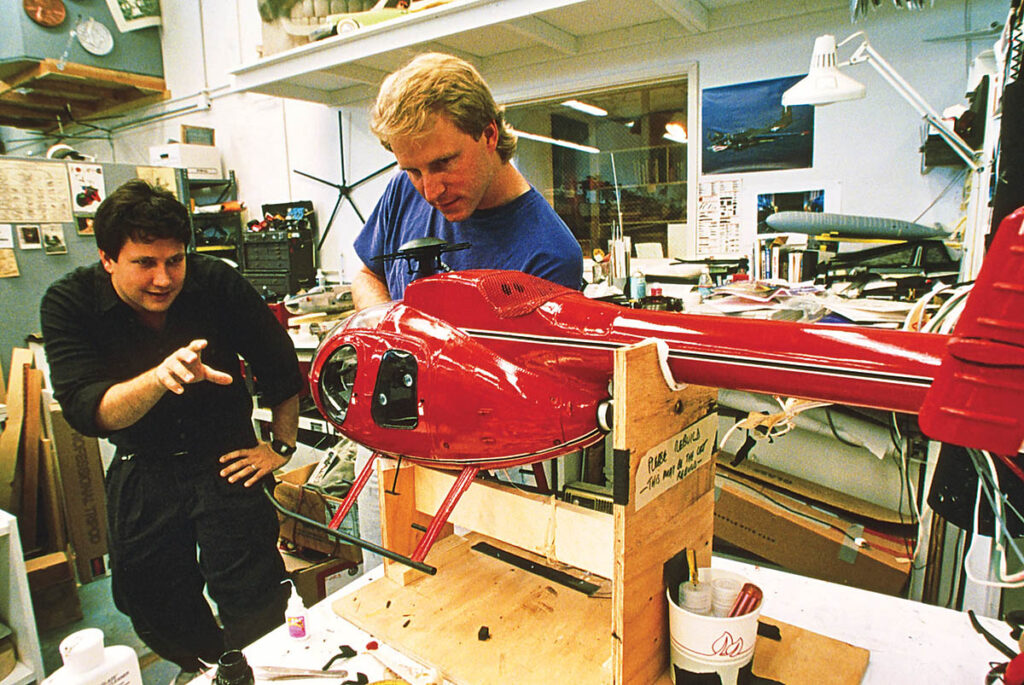
During the production of Ghostbusters 2, Goodson faced a scenario requiring immediate structural adjustments to the hull of a Titanic miniature during a crew lunch break. Relying on sheer improvisation, he packed modeling clay into low spots, utilized a chopped chip brush to rapidly apply a stipple texture, and pounded pastel dust ground from 60-grit sandpaper into the surface. The resulting makeshift finish was successfully captured on camera.
A similarly breathless exercise occurred during the making of The Day After Tomorrow. When a digital asset of a frozen oil tanker was deemed unusable by the production team, Goodson was tapped to build a physical miniature from scratch. Over a single weekend, utilizing plywood, styrene plastic sheets, push-pins for bollards, and artificial snow, Goodson—with assistance from master modelmakers Lorne Peterson and Paul Huston, who sculpted horizontal ice-cicles out of silicone to simulate fierce gale-force winds—delivered a completed physical miniature by early Monday morning. The shot was finalized days later, prompting a direct note of gratitude from director Roland Emmerich.
The Legacy of "Three Garages Productions" and Industry Implications
Today, the collaborative ethos of the ILM Model Shop survives in scaled-down, decentralized forms. Goodson, Patrascu, and visual effects veteran John Knoll jokingly refer to their modern independent efforts as "Three Garages Productions," utilizing home workshops and localized fabrication spaces to continue building physical assets before capturing them on motion-capture stages.
This decentralization reflects a broader shift in the visual effects industry. While large-scale practical workshops employing dozens of pattern-makers, mold-makers, electricians, and painters have largely given way to lean, distributed digital pipelines, the foundational principles of observation, physical weight, and spatial realism remain vital.
Whether crafting a physical spaceship miniature or painting a digital asset, the ultimate goal of the visual effects artist remains unchanged: to ground fantasy in a tangible sense of reality so completely that the audience never questions its existence. As technological paradigms continue to shift, the bridge built by artists like John Goodson between the analog workbench and the digital pixel ensures that the foundational craft of cinematic illusion endures.