Alibaba Researchers Unveil SkillWeaver to Solve AI Agent Tool Overload and Skill Composition Challenges


The rapid evolution of artificial intelligence has moved beyond simple text generation into complex, multi-step agentic workflows where Large Language Models (LLMs) must actively interact with external digital environments. As enterprise ecosystems and public Model Context Protocol (MCP) registries expand to host thousands of community-contributed tools, developers face a severe architectural bottleneck. Shoving thousands of discrete application programming interfaces (APIs) into a single LLM prompt rapidly exhausts context windows, introduces debilitating latency, drives up operational costs, and increases the likelihood of model hallucinations. To counter this systemic limitation, artificial intelligence researchers at Alibaba have introduced SkillWeaver, a pioneering framework designed to streamline how autonomous agents discover, select, and sequence specialized capabilities.
The Core Problem: Skill Routing and Context Bloat in Modern AI Agents
Modern AI agent architectures heavily rely on specialized skills to execute complex tasks that cross multiple domains, such as data extraction, automated transformation, cloud infrastructure management, and visual reporting. Traditionally, developers have relied on the ReAct (reason-act-observe) framework to guide models through sequential problem-solving. While effective for simple applications, standard ReAct loops collapse entirely when confronted with enterprise-scale libraries containing thousands of potential tools.
According to Alibaba researchers, standard thought-action loops were never engineered for explicit compositional routing across vast tool ecosystems. When exposed to thousands of capabilities, models suffer from three distinct structural failures. First, they encounter a context problem, consuming hundreds of thousands of tokens merely to read tool documentation. Second, they face a decision-making crisis, struggling to classify minor semantic differences among APIs with overlapping descriptions but entirely different schemas. Finally, they experience severe planning failures, unable to natively manage multi-step sequences and interdependent data flows.

Empirical evaluations conducted during the development of SkillWeaver revealed that traditional ReAct loops achieved a staggering 0% Decomposition Accuracy when tasked with breaking down enterprise-level queries into accurate sub-task blueprints. Without a structured methodology for filtering and organizing capabilities, providing an agent with a larger tool library often diminishes its actual performance rather than enhancing it.
The Birth of SkillWeaver and Skill-Aware Decomposition (SAD)
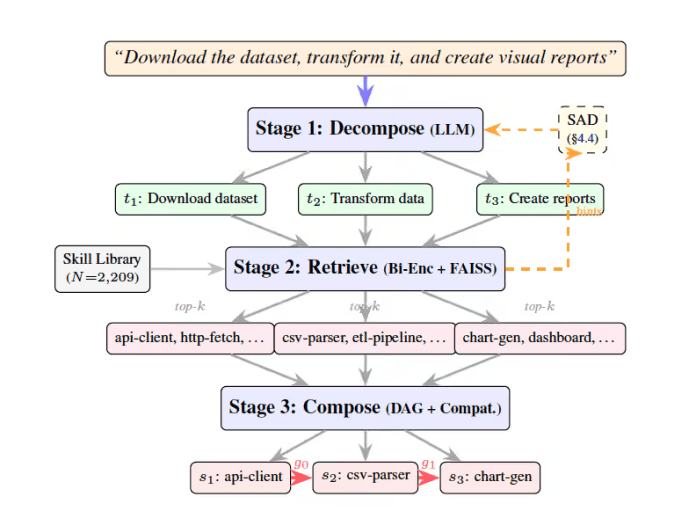
To resolve the friction of compositional skill routing, the Alibaba research team conceptualized SkillWeaver, anchored by a core technical innovation known as Skill-Aware Decomposition (SAD). Rather than attempting to route a user query through a massive tool library in a single, error-prone pass, SkillWeaver approaches complex orchestration as a multi-stage pipeline consisting of three distinct phases: Decompose, Retrieve, and Compose.
The workflow begins in the decomposition phase, where a task-decoupling LLM analyzes the user prompt to break it down into a logical sequence of atomic sub-tasks. Once these preliminary steps are established, the system leverages high-efficiency semantic search tools—such as MiniLM integrated with a FAISS index—to comb through the tool library and pull a focused shortlist of candidate APIs tailored to each individual sub-task.
The final composition phase represents the framework’s primary differentiator. Instead of blindly executing tools sequentially, a dedicated planning module evaluates the retrieved candidates for systemic compatibility. It verifies that the output schema of one tool naturally feeds into the input parameters of the next. The system then compiles the final execution blueprint into a directed acyclic graph (DAG), explicitly mapping out dependencies and identifying opportunities for parallel task execution.
Overcoming the Granularity Mismatch
A persistent hurdle in automated tool routing is the granularity mismatch between how an LLM conceptualizes a task and how an API library is structured. For instance, a model might issue a macro-level instruction to "download and parse a remote dataset," failing to recognize that the underlying library maintains separate, highly specialized functions for file-fetching and CSV parsing. Conversely, a model might over-decompose a single, comprehensive HTTP operation into micro-steps like connecting, transmitting, receiving, and parsing, despite a single tool covering the entire workflow.
To bridge this semantic gap, the SkillWeaver framework incorporates the iterative feedback loop of Skill-Aware Decomposition (SAD). SAD takes the initial task decomposition, maps it against preliminary retrieval hints, and feeds that specific operational vocabulary back into a secondary decomposition pass. By grounding the model in the actual capability boundaries of the available software ecosystem, the framework prevents hallucinations and forces the LLM to structure problems around tools that genuinely exist.
Rigorous Benchmarking and Performance Metrics
To rigorously measure the efficacy of SkillWeaver in realistic environments, the research team constructed a specialized evaluation suite dubbed CompSkillBench. This benchmark comprises 300 diverse multi-step queries spanning varying levels of complexity. To mirror authentic enterprise conditions, the team coupled the benchmark with a sprawling library of 2,209 real-world skills pulled from public MCP registries, covering 24 distinct functional categories ranging from cloud databases to financial analytics.

Using a lightweight 7-billion parameter model (Qwen2.5-7B-Instruct) as the primary task engine, comparative testing demonstrated the undeniable value of the SAD feedback loop. In vanilla baseline tests without SAD, the 7B model achieved a meager 51.0% decomposition accuracy. When the SAD feedback loop was activated, accuracy jumped significantly to 67.7%. On exceptionally challenging tasks requiring four to five distinct skills, the inclusion of SAD boosted accuracy by a remarkable 50%.
Furthermore, testing revealed unexpected dynamics regarding model scale. Unmitigated larger models—such as 14-billion parameter variants—frequently performed worse than smaller models in vanilla setups because they tended to over-decompose simple tasks into excessive, microscopic steps. However, once integrated with SkillWeaver’s tool-vocabulary hints, these larger models were successfully re-anchored, yielding superior performance. This finding suggests that aligning an agent with the precise lexicon of its tool library is frequently more impactful than simply upgrading to a larger, more resource-intensive base model.
Dramatic Token Reduction and Operational Implications
Beyond accuracy gains, SkillWeaver yields staggering efficiency improvements in token consumption during the execution phase. Exposing an entire library of 2,209 tools directly to an LLM prompt typically consumes an estimated 884,000 tokens per query. SkillWeaver shrinks this footprint down to approximately 1,160 tokens—representing a 99% reduction in execution-time tool context.
Project leads have emphasized that this efficiency translates to far more than mere cost savings on API calls. By constraining the active toolset during execution, the system minimizes irrelevant choices, drastically lowers the probability of API hallucination, stabilizes prompt behavior, and generates transparent execution plans that developers can manually review and audit prior to deployment.

Broader Industry Implications and Future Outlook
The introduction of SkillWeaver arrives at a critical juncture for enterprise artificial intelligence. As businesses transition from experimental chatbot interfaces to autonomous agents capable of orchestrating complex backend operations, reliability and computational overhead have become dominant concerns. Frameworks that successfully decouple high-level planning from low-level API execution—while maintaining tight semantic alignment—are expected to become foundational standards in agentic engineering.
Alibaba’s research underscores a vital paradigm shift in how developers must design AI infrastructure. As tool ecosystems continue to scale exponentially via community contributions and decentralized registries, brute-force prompt engineering is no longer viable. Intelligent mediation layers like SkillWeaver demonstrate that the path forward for enterprise-grade autonomous agents lies in structured, feedback-driven skill composition rather than unguided context stuffing.
Related posts: