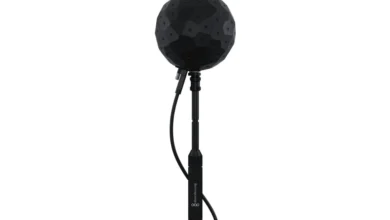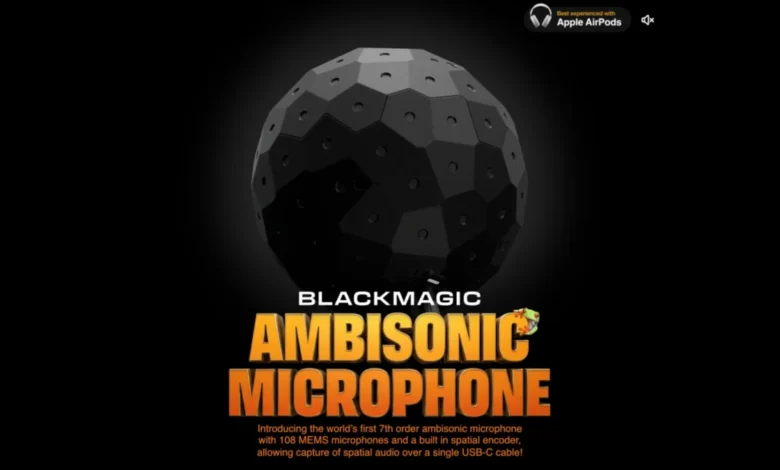
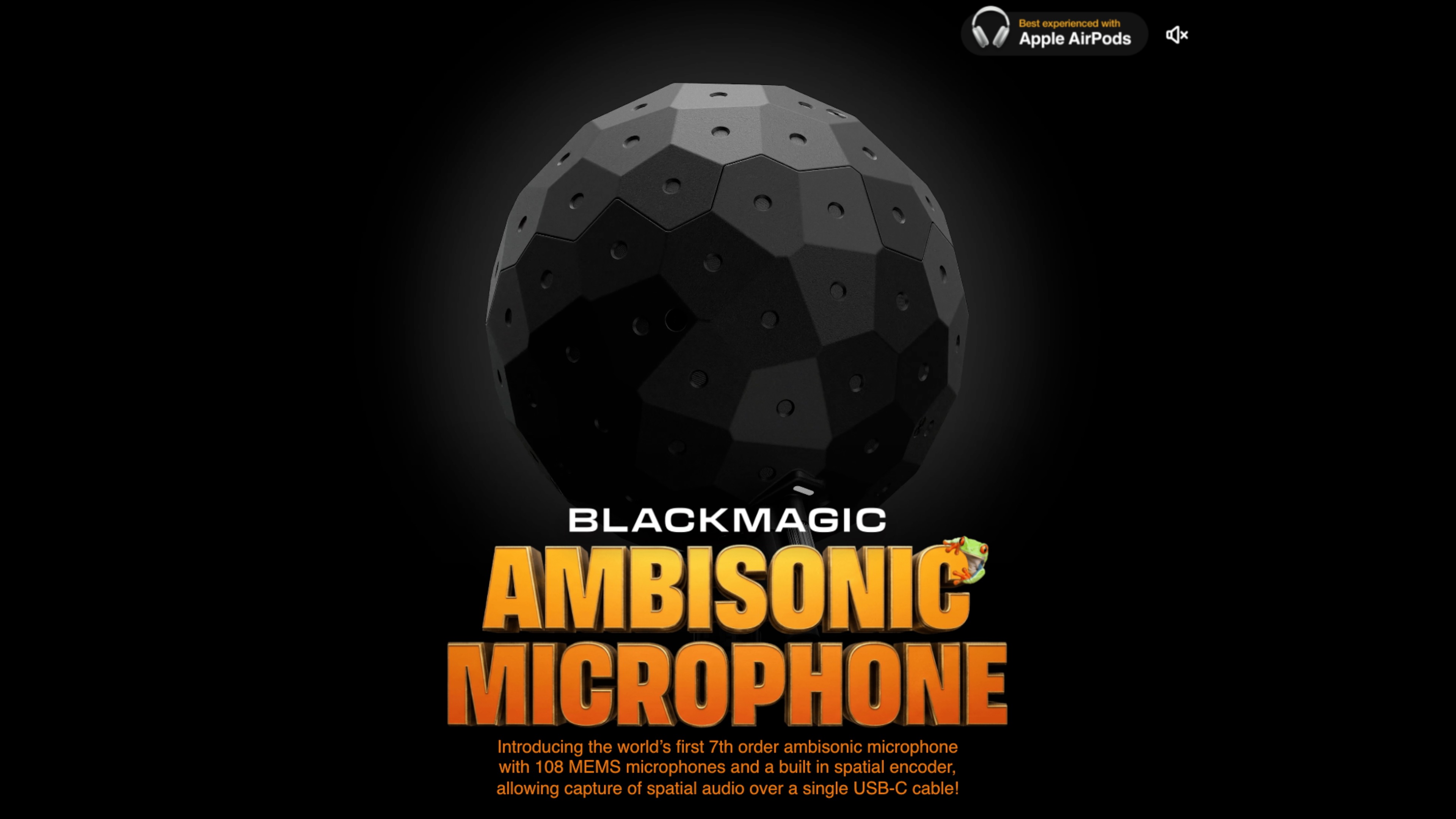
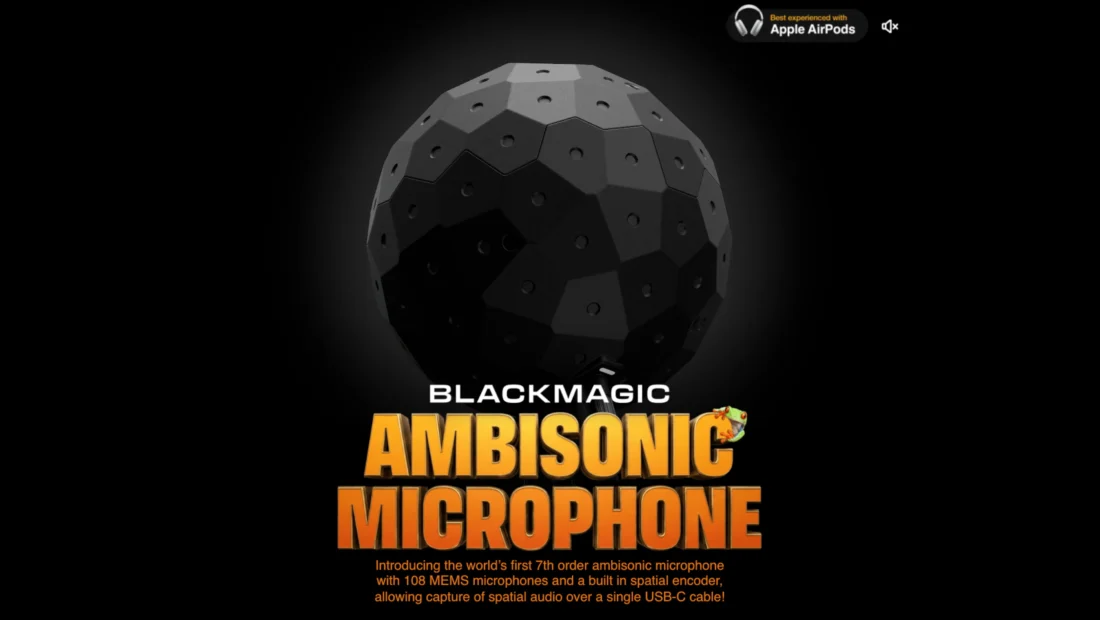
The audio industry has long sought a bridge between complex, multi-microphone arrays and the streamlined workflows required by modern digital cinema production. With the introduction of the Blackmagic Ambisonic Microphone, Blackmagic Design is attempting to disrupt the high-end spatial audio market by condensing 108 individual MEMS (Micro-Electro-Mechanical Systems) microphone capsules into a single, ruggedized aluminum sphere. This development marks a significant shift in how field recordists, documentary filmmakers, and immersive media creators approach 360-degree sound design.
Technical Architecture and Design
The core innovation behind this device lies in its dense array of MEMS capsules. By utilizing 108 separate elements, the microphone achieves a 7th-order ambisonic resolution. In the context of spatial audio, "order" refers to the mathematical precision of the sound field capture. While first-order ambisonics provide basic directional cues, 7th-order resolution offers an unprecedented level of spatial accuracy, allowing for sharper localization of sound sources and more immersive playback in virtual reality (VR), augmented reality (AR), and cinematic surround-sound environments.
The internal processing architecture is equally ambitious. Rather than requiring external hardware to decode or manage the massive data stream generated by 108 capsules, the microphone features an integrated spatial encoder. This encoder performs the complex mathematical heavy lifting on-board, processing the raw data into 64 distinct channels of 32-bit audio. The transition to 32-bit float audio is significant for production workflows, as it effectively eliminates the risk of digital clipping, providing a massive dynamic range that is highly forgiving in unpredictable acoustic environments, such as outdoor location shoots or crowded urban settings.
The Single-Cable Workflow
One of the most notable aspects of the Blackmagic Ambisonic Microphone is its commitment to a streamlined "single-cable" workflow. Historically, capturing high-order ambisonic audio required a complex rig of microphones, external preamps, and multi-track recorders, often involving a tangle of XLR cables and complex synchronization settings.
By consolidating the power supply, data transmission, and control signals into a single USB-C connection, Blackmagic Design has significantly lowered the barrier to entry for spatial audio production. The USB-C standard provides sufficient bandwidth to carry the 64 channels of high-resolution audio simultaneously, simplifying the setup process for solo operators and small crews who may not have the luxury of a dedicated sound department.
Chronology of Spatial Audio Development
The path to this release can be traced back to the early 1970s with the invention of the Soundfield microphone, which introduced the concept of B-format ambisonics. For decades, spatial audio remained a niche field reserved for high-end studio installations and specialized research laboratories.
- 1970s–1990s: The era of analog ambisonic development. Spatial audio was largely theoretical and hindered by the high cost of custom-built multi-capsule arrays.
- 2000s–2010s: The rise of digital signal processing (DSP) allowed for the miniaturization of arrays. Companies began experimenting with first-order and second-order ambisonic microphones, though these remained expensive and required complex software post-processing.
- 2015–2020: The emergence of consumer-grade VR and 360-degree video platforms created a massive demand for immersive sound. This forced hardware manufacturers to rethink microphone design for mobile creators.
- 2026: Blackmagic Design enters the market with a 7th-order solution, signaling a shift toward professional-grade spatial audio becoming a standard feature in high-end production rather than an experimental add-on.
Implications for the Industry
The introduction of a 7th-order device at the $1,909 price point suggests a strategic play by Blackmagic Design to dominate the mid-tier professional market. By offering such high technical specifications at a price point significantly lower than custom, boutique-built ambisonic rigs, the company is likely to see rapid adoption among independent documentary filmmakers and content creators specializing in spatial media.
The impact on post-production workflows is also noteworthy. With 64 channels of audio available, sound editors will have granular control over the sound field. In a post-production environment, this allows for the precise "steering" of the soundstage, enabling editors to isolate specific environmental sounds or adjust the orientation of the audio to match the visual perspective of a 360-degree camera rig. The inclusion of the Blackmagic Ambisonic Recorder for macOS further suggests an ecosystem-based approach, ensuring that users have a direct path from acquisition to ingest.
Data and Technical Specifications
- Microphone Array: 108 MEMS capsules
- Ambisonic Order: 7th-order
- Output Format: 64 channels of 32-bit audio
- Connectivity: USB-C (Power + Data)
- Chassis: Ruggedized aluminum sphere
- Compatibility: Native integration with macOS Ambisonic Recorder software
- Launch Date: December 2026
- Pricing: $1,909 USD (MSRP for the standalone unit)
Official Support and Ecosystem
Blackmagic Design has confirmed that the microphone will be available as part of a complete kit, which includes a dedicated mount and a high-performance windshield designed to mitigate wind noise—a critical requirement for field recording. By bundling these accessories, the company is addressing the specific pain points of location sound professionals who often struggle with wind interference in 360-degree capture setups, where traditional foam windscreens are often insufficient.
While the current technical specifications are impressive, industry experts note that the success of this microphone will depend heavily on the software ecosystem that supports it. The integration with macOS is a strong start, but broader adoption across non-linear editing (NLE) platforms like DaVinci Resolve—and potentially third-party DAWs—will be vital for professional sound designers who rely on specific plugin chains and workflows.
Fact-Based Analysis of the Market
The spatial audio market is currently experiencing a period of rapid growth. According to industry analysis, the demand for immersive content is projected to rise as hardware manufacturers continue to release high-resolution VR headsets and spatial audio playback systems for mobile devices.
By moving to 7th-order, Blackmagic Design is effectively "future-proofing" the content created with this microphone. While current playback devices may not always be able to resolve the full complexity of 7th-order audio, the high-fidelity capture ensures that the archival value of the audio remains high for years to come. This is a critical factor for documentary filmmakers who often operate on long-term project cycles.
Furthermore, the choice of MEMS technology over traditional condenser capsules is a calculated decision. MEMS microphones are known for their consistency and stability, which is essential when matching 108 individual elements. Traditional condenser microphones often suffer from sensitivity variations that would make an array of this size nearly impossible to calibrate. MEMS technology ensures that the phase coherence across the 108-capsule array is maintained, which is the foundational requirement for accurate ambisonic imaging.
Conclusion
As the industry prepares for the December release, the Blackmagic Ambisonic Microphone represents a convergence of hardware accessibility and high-end technical capability. Whether this device will become the new industry standard for spatial audio remains to be seen, but its arrival serves as a clear indicator that the technical barriers to immersive, high-order ambisonic recording are rapidly eroding. With its robust build, simplified connectivity, and high channel count, the device is positioned to influence the next generation of soundscapes in cinema and beyond.
Related posts: