Meta Artificial Intelligence Enhancements Deliver Significant Boosts to Ad Clicks, Conversions, and Revenue Across Platforms

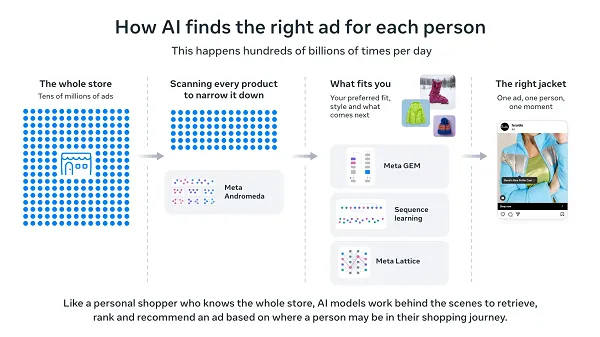
Meta Platforms has released a comprehensive set of performance data detailing the profound impact of its newly integrated artificial intelligence systems on its advertising ecosystem. According to the company, continuous algorithmic upgrades to its ad delivery and ranking infrastructure are yielding substantial improvements in audience targeting, resulting in a dramatic increase in user engagement metrics, conversion rates, and overall merchant return on investment.
The announcement, which highlights metrics gathered throughout recent quarters, underlines a broader industry trend toward machine-learning-driven digital marketing. As privacy regulations tighten and third-party data tracking becomes increasingly restricted, platform-owned artificial intelligence models have emerged as vital lifelines for digital advertisers seeking to maintain profitability and precision in their campaigns.
The Quantifiable Impact of AI on Ad Ranking Systems
Meta’s latest operational insights indicate that its algorithmic improvements are no longer just theoretical enhancements; they are translating directly into measurable financial and operational gains for brands utilizing Facebook, Instagram, and other Meta-owned properties.
In an official corporate announcement, the tech giant revealed that successive iterations of its ad ranking system during the second quarter drove an 8.3% increase in ad clicks and an impressive 15.7% uplift in conversions on the Facebook platform alone. These figures represent a massive leap in platform efficiency, suggesting that the underlying machine learning models are becoming markedly more adept at discerning user intent, predicting behavioral patterns, and matching relevant promotional content with receptive audiences.
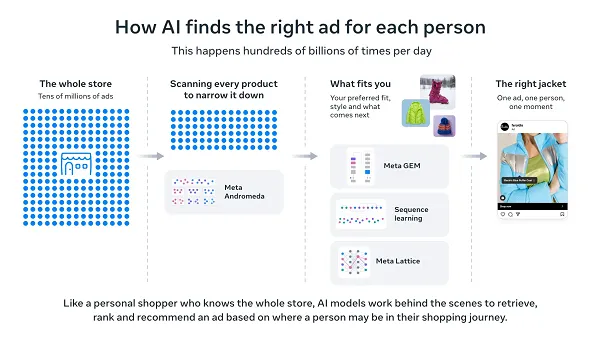
Behind these performance leaps is a fundamental transformation in how Meta’s data processing architecture operates. By expanding its data analysis capabilities, the platform can assess a vastly broader range of user actions, content formats, and product catalogs at unprecedented speeds. This structural shift allows the system to recognize micro-trends and behavioral correlations that traditional, rule-based algorithms would likely miss. Consequently, Meta’s automated targeting systems are continually refining themselves, reducing ad waste for brands while maximizing the relevance of the commercial content displayed to everyday users.
The Rise of AI-Powered Business Assistants and Conversational Commerce
Beyond traditional ad ranking improvements, Meta is aggressively embedding artificial intelligence directly into the merchant-facing tools designed to streamline campaign management. A primary beneficiary of this strategy is the company’s proprietary AI business assistant, a generative tool that is currently rolling out to a broader base of global advertisers.
Initial performance reports indicate that the AI business assistant is already delivering a 5% increase in conversions while maintaining a flat cost baseline for participating businesses. This efficiency is achieved by automating routine campaign setup tasks, offering real-time creative optimization suggestions, and providing data-backed recommendations that help smaller enterprises—often lacking dedicated marketing departments—compete effectively against larger corporations with specialized media-buying teams.
Simultaneously, Meta is pushing deeper into conversational commerce and in-stream purchasing journeys. The company is actively developing native checkout options within its suite of specialized AI agents, including conversational solutions like Muse. By integrating transactional capabilities directly into AI-driven chat interfaces, Meta aims to reduce friction in the consumer purchase funnel. Users will soon be able to discover products, ask detailed questions, and complete transactions entirely within a unified, AI-managed environment, effectively transforming passive ad views into immediate, frictionless sales.
Partnership Ads and Creator Economy Integration
While algorithmic refinements and generative assistants form the technological backbone of Meta’s modern advertising apparatus, collaborative marketing formats are also experiencing unprecedented growth. Meta reported that partnership ads—mechanisms that allow brands to co-create and amplify promotional content alongside independent creators and strategic business partners—surged by more than 97% year-over-year in the third quarter.
This explosive growth has propelled partnership ads past a remarkable milestone, crossing a $15 billion annual revenue run-rate. The synergy between creator-led content and Meta’s AI-powered distribution networks highlights a powerful formula: authentic, human-generated creative assets supercharged by hyper-targeted machine learning delivery systems. Advertisers increasingly recognize that while AI can optimize where and to whom an ad is shown, the collaborative content model ensures high creative resonance and consumer trust.
Infrastructure Investments Fueling Algorithmic Scale
The immense computational power required to process billions of real-time signals, analyze vast streams of user interaction data, and run advanced generative AI agents cannot be understated. Meta’s current advertising performance gains are the direct byproduct of multi-billion-dollar commitments to next-generation AI infrastructure.
The company has previously outlined monumental capital expenditure projections, including massive data center development projects across the United States. These facilities are specifically engineered to house clusters of high-performance graphics processing units (GPUs) and specialized tensor hardware capable of training and executing deep learning models at scale.
Industry analysts point out that Meta’s willingness to sustain heavy capital expenditures for infrastructure is the primary competitive moat separating it from smaller social media platforms. By concentrating immense data processing capacity into centralized networks, Meta can continuously update its ranking models, test new algorithmic permutations, and deploy generative AI features globally without experiencing latency bottlenecks.

Fact-Based Analysis of Industry Implications
The rapid digitization and automation of ad delivery systems carry profound implications for the broader digital marketing landscape. For brands and media buyers, the evolution toward AI-driven platforms demands a strategic pivot. Manual keyword targeting, rigid demographic slicing, and static audience buckets are rapidly losing efficacy compared to broad-targeting frameworks governed by algorithmic machine learning.
Advertisers are increasingly required to act as creative directors rather than technical operators, feeding diverse libraries of creative assets, video variations, and product feeds into Meta’s systems, and allowing the AI to orchestrate dynamic content delivery based on real-time user signals.
However, this transition also raises important considerations regarding transparency and control. As black-box algorithms assume greater autonomy over budget allocation and audience selection, marketers must navigate a reduced ability to audit the granular pathways of ad delivery. To mitigate this, platforms like Meta are under continuous pressure to provide clearer attribution metrics and intuitive performance dashboards—such as the granular quarterly data and assistant metrics recently published by the company.
Future Outlook for Meta’s Advertising Ecosystem
Looking ahead, Meta’s trajectory in the advertising sector appears inextricably linked to its aggressive artificial intelligence roadmap. The integration of in-stream checkout features within AI agents, the continuous refinement of the ad ranking matrix, and the scaling of generative business assistants signal a future where social media platforms function simultaneously as discovery engines, creative studios, and transactional marketplaces.
As these AI systems mature, advertisers can anticipate even tighter correlations between algorithmic upgrades and return on investment. For Meta, maintaining this momentum will depend heavily on the seamless execution of its massive infrastructure projects, the preservation of user trust amidst evolving data privacy standards, and the ongoing delivery of tangible, bottom-line value to the millions of businesses that rely on its digital ecosystem for commercial survival.