TikTok Releases Comprehensive Q5 Marketing Playbooks to Help Gaming and Mobile App Brands Capitalize on the Post-Holiday Surge

The digital marketing landscape is perpetually evolving, yet one of the most underutilized and lucrative windows of the retail and entertainment calendar remains the period bridging Christmas Day and the start of the New Year. Commonly referred to by industry insiders and digital platforms as "Q5," this interstitial week has increasingly become a prime target for brands seeking to capture highly engaged consumer attention. Addressing this strategic imperative, short-form video giant TikTok has published two new, comprehensive marketing guides designed specifically to help gaming and mobile application brands maximize their promotional efforts during this critical end-of-year window.
The newly released playbooks arrive as consumer behavior data continues to underscore a profound shift in how audiences spend their time and money immediately following the traditional December holidays. Far from experiencing the post-holiday slump that many legacy retailers historically anticipated, the digital ecosystem sees a massive influx of active, entertainment-seeking users. By releasing these targeted resources, TikTok aims to equip advertisers with the technical know-how, data-backed insights, and campaign execution strategies necessary to turn post-holiday browsing into high-value conversions.
Decoding the Q5 Phenomenon: Background and Context
To understand the strategic value of TikTok’s new playbooks, it is essential to examine the unique economic and behavioral ecosystem of Q5. Historically, the fourth quarter of the calendar year is dominated by major shopping events such as Black Friday, Cyber Monday, and the weeks leading up to Christmas. During this high-stakes period, competition among advertisers reaches a fever pitch. Ad auctions become fiercely contested, and the cost per acquisition (CPA) and cost per click (CPC) skyrocket as brands across every imaginable vertical vie for finite consumer wallet share.
Once Christmas Day passes, however, a fascinating shift occurs. Many traditional retail brands dramatically scale back their advertising expenditures, assuming that holiday fatigue has set in and that consumers have exhausted their discretionary funds. This sudden exodus of mainstream retail advertisers creates a vacuum in the digital ad auctions.
Enter Q5: the roughly seven-to-ten-day period between December 26 and January 1. During this window, digital consumption surges. Millions of consumers find themselves with newfound leisure time, schools are out for winter break, many corporate offices operate on skeleton crews or close entirely, and individuals are gifted new smartphones, tablets, gaming consoles, and gift cards. Furthermore, data consistently shows that a significant portion of the population receives cash gifts or holiday bonuses, leaving them eager to spend.
Consumer Behavior and Spending Patterns During Q5
TikTok’s newly published research sheds light on the exact mechanics of consumer intent during this post-holiday window, providing empirical backing for what digital marketers have long suspected. According to statistics highlighted in the platform’s new guides, seventy percent of consumers actively plan to shop during the week immediately following December 25. Their motivations are twofold: to capitalize on post-holiday clearance sales and to redeem gift cards received during the holidays.
For a platform like TikTok, whose user base skews heavily digital-first and mobile-centric, these trends are amplified. The platform notes that 75 percent of its active users spend the exact same amount of time—or significantly more time—shopping and browsing on the app during Q5 compared to the weeks leading up to Christmas. This sustained high level of engagement shatters the myth that holiday shopping abruptly halts on December 26.
Perhaps most intriguingly for brands outside of traditional e-commerce, TikTok’s data reveals that 63 percent of users surveyed shop specifically for themselves during Q5. After weeks of purchasing gifts for friends, family members, and colleagues, consumers use the post-holiday period to treat themselves. This "me-first" shopping mentality creates an ideal psychological environment for the promotion of digital goods, mobile apps, video games, subscriptions, and in-app purchases.
Tailored Strategies for the Gaming Industry
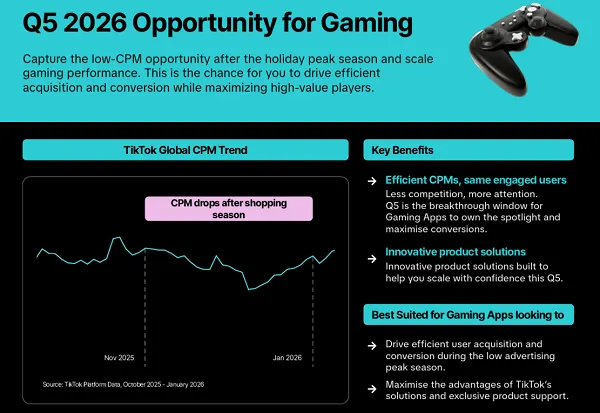
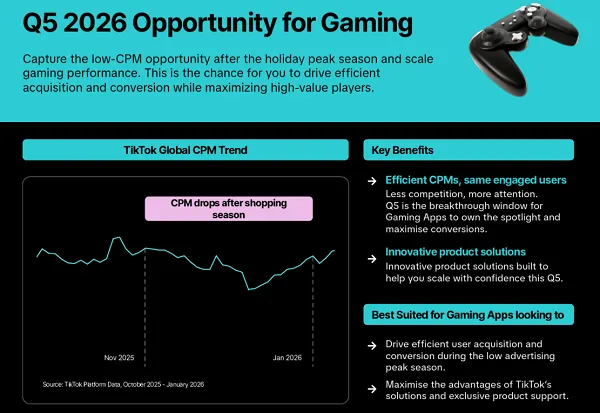
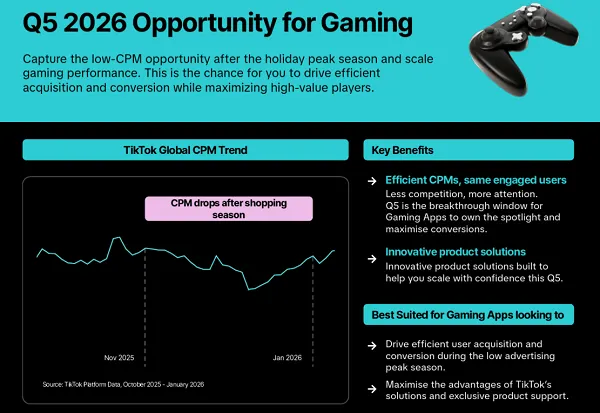
The first of TikTok’s two new publications is a specialized, four-page guide directed squarely at gaming brands and publishers. The gaming industry has historically thrived during the winter holiday season, as console sales spike and players dive into newly acquired titles. However, mobile gaming and digital game distribution platforms face unique challenges in breaking through the noise during the pre-Christmas rush.
TikTok’s gaming playbook addresses these hurdles head-on by emphasizing the economic advantages of advertising during the Q5 window. Because traditional retail competition drops off sharply after December 25, the cost per ad on platforms like TikTok decreases significantly. For gaming companies, this reduction in auction pressure translates directly into a lower cost per acquisition, allowing publishers to acquire new users at a fraction of the cost seen earlier in the fourth quarter.
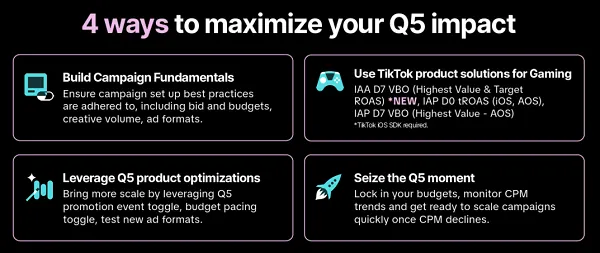
Beyond macroeconomic ad-pricing advantages, the gaming guide dives into the technical execution of campaigns. It offers step-by-step instructions on how gaming brands can set up specific campaign types tailored to the platform’s algorithmic discovery engine. Recommendations include leveraging user-generated content (UGC), partnering with gaming creators who are actively streaming or posting during the holiday break, and utilizing TikTok’s Spark Ads to amplify organic community engagement. The guide also outlines best practices for targeting newly minted device owners—individuals who unwrapped a new smartphone or gaming tablet on Christmas morning and are immediately looking to populate their home screens with high-performance gaming apps.
Mobile App Promotion Playbook: Tracking and Best Practices
Complementing the gaming resource, TikTok has released a second comprehensive guide focused broadly on mobile application marketing. While many of the seasonal consumer behaviors overlap between gaming and non-gaming apps, the technical infrastructure required to scale a utility, fintech, entertainment, or lifestyle app differs significantly.
TikTok’s Q5 app marketing guide bridges this gap by providing granular insights into tracking setups, attribution configurations, and promotion-specific best practices. The transition from holiday spending to New Year’s resolution planning provides a massive tailwind for specific app categories. Fitness applications, meditation and mental health tools, budgeting software, and language-learning platforms experience a natural surge in consumer interest as individuals look ahead to personal improvement goals for the upcoming year.
The mobile app playbook emphasizes the importance of robust tracking setups ahead of the Q5 rush. With privacy frameworks and attribution models growing increasingly complex across the mobile ecosystem, TikTok details how brands can optimize their use of the TikTok Pixel and the Events API to ensure accurate conversion tracking. By establishing clear attribution pathways before December 26, app marketers can run performance-driven campaigns that dynamically adjust bids based on real-time user engagement data.
Furthermore, the guide outlines optimal promotional strategies for different types of app installs. It covers creative best practices, such as showcasing immediate app utility within the first three seconds of a video ad—a critical window for capturing attention on a fast-paced, vertical-video platform.
Industry Implications and Strategic Analysis
The release of these two playbooks by TikTok signals a broader evolution in how digital media platforms view seasonality and campaign planning. For years, digital advertising strategies treated the calendar year in rigid, quarterly blocks. Q4 was universally designated as the peak holiday shopping season, while Q1 was often viewed as a cooling-off or recovery period where brands reassessed annual budgets and laid groundwork for the spring.
By coining and heavily promoting the concept of "Q5," platforms like TikTok are actively reshaping how enterprise brands and performance marketers allocate their annual marketing spend. The strategy behind Q5 encourages brands to view the final week of the year not as an afterthought, but as a distinct, high-yield operational window that requires its own dedicated budget, creative assets, and technical configuration.
From an analytical perspective, the economic rationale for Q5 marketing is sound. Supply and demand dynamics in digital ad auctions dictate that when demand falls (as mainstream retailers pull back post-Christmas) while supply remains high (as consumers spend more time on their devices), the price efficiency for remaining advertisers improves dramatically. Brands that heed TikTok’s advice and maintain or pivot their ad spend into Q5 stand to capture high-intent users at a significantly lower cost than what they paid during the heat of Black Friday or Cyber Monday.
Moreover, the timing of these guides—made available well in advance of the holiday cycle—reflects a sophisticated understanding of modern marketing operations. Enterprise-level gaming companies and major mobile app developers require weeks, if not months, of lead time to conceptualize creative campaigns, produce video assets, clear legal and compliance reviews, and configure technical tracking infrastructure. By publishing these resources early, TikTok is ensuring that its major advertising partners can integrate Q5 planning into their broader fourth-quarter strategies rather than scrambling at the eleventh hour.
Looking Ahead: The Future of Post-Holiday Advertising
As digital ecosystems continue to mature, the blurring of lines between traditional holiday retail and digital entertainment consumption will only intensify. The modern consumer does not compartmentalize their digital experiences; a user sitting on the couch on December 28 is simultaneously evaluating e-commerce sales, downloading mobile games, exploring new productivity apps, and consuming entertainment content.
TikTok’s dual playbooks for gaming and mobile apps provide a valuable roadmap for navigating this complex consumer journey. By combining empirical data on post-holiday shopping habits with actionable, platform-specific technical advice, the company has provided a compelling blueprint for brands seeking to maintain momentum through the end of the year.
As the digital marketing community prepares for the upcoming holiday season, the adoption of Q5 strategies is expected to grow. Brands that successfully leverage the lower ad costs, high user engagement, and self-gifting mentality highlighted in TikTok’s reports will likely find themselves well-positioned not only to close out the current year on a high note, but to build powerful momentum heading into the new year.