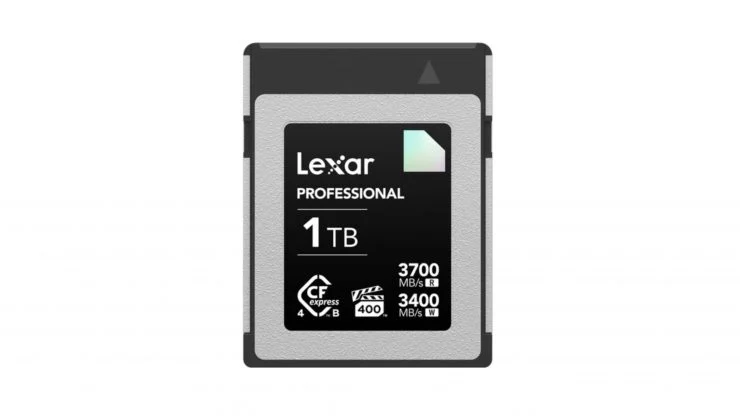
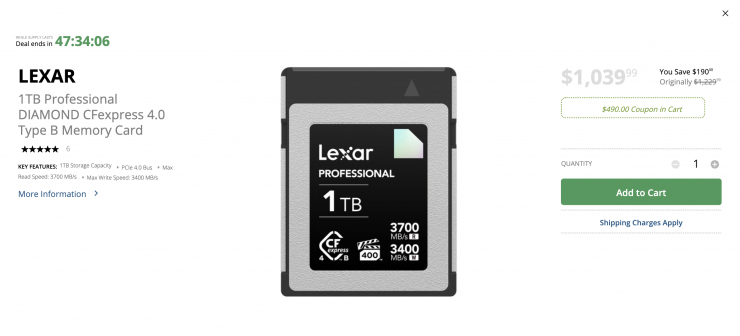
Save $680 USD on the Lexar 1TB Professional DIAMOND CFexpress 4.0 Type B Memory Card

This promotion represents a substantial reduction in the barrier to entry for high-end cinematography and professional photography workflows that demand the extreme throughput of the CFexpress 4.0 standard. As modern cinema cameras move toward higher resolutions—including 8K RAW acquisition and high-frame-rate recording—the reliance on high-performance storage media has become a critical bottleneck in the production chain.
The Evolution of Storage Standards
The transition from CFexpress 2.0 to 4.0 has been defined by a doubling of the PCIe interface speed, utilizing the PCIe Gen 4 x2 lane configuration. While previous iterations were sufficient for 4K workflows, the rapid adoption of high-bitrate codecs like ProRes RAW, Blackmagic RAW, and REDCODE has necessitated a shift in how data is offloaded and sustained.
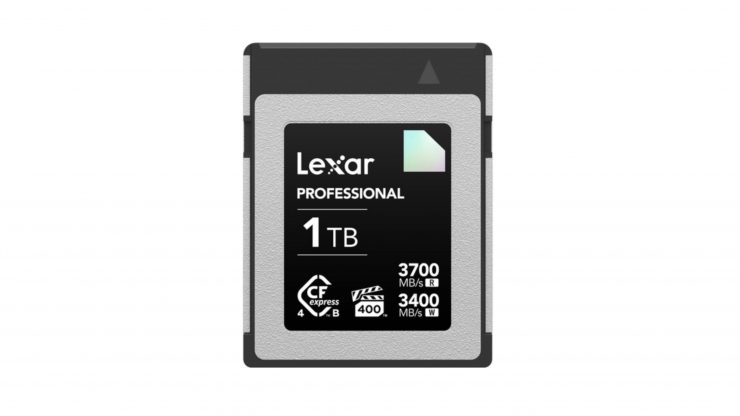
The Lexar Professional DIAMOND series was engineered specifically to address the requirements of high-bitrate recording. By moving to the CFexpress 4.0 standard, the card achieves read speeds of up to 3700 MB/s and write speeds of 3400 MB/s. Perhaps most importantly for professional videographers, the card maintains a sustained write speed of 3200 MB/s. This sustained performance ensures that frames are not dropped during intensive, prolonged recording sessions, which is a common failure point for lower-tier memory cards that rely heavily on fluctuating cache buffers.
Chronology of the CFexpress Transition
The storage industry has undergone a rapid maturation period over the last five years. In 2019, CFexpress Type B cards were widely viewed as a niche, high-cost solution for early adopters of mirrorless flagships like the Nikon Z6 and Z7. By 2021, the standard had become the de facto requirement for professional cinema cameras, including those from Canon and Fujifilm.
The introduction of the 4.0 specification in 2023 marked a paradigm shift. Unlike previous incremental updates, the jump to 4.0 allowed manufacturers to fully leverage the bandwidth capabilities of modern computer interfaces, specifically Thunderbolt 4 and USB4. This synergy allows for offload times that are essentially limited by the computer’s SSD, rather than the memory card itself. The current discount on the Lexar 1TB DIAMOND card is a reflection of the market’s stabilization, as these once-premium speeds begin to permeate the broader prosumer and professional market.
Technical Specifications and Performance Metrics
The Lexar 1TB Professional DIAMOND CFexpress 4.0 Type B card is not merely defined by its top-line burst speeds; its utility is cemented by its VPG-400 (Video Performance Guarantee) rating. This certification guarantees a minimum sustained write speed of 400 MB/s. While this number may appear modest compared to the card’s maximum throughput, the VPG-400 rating is the industry benchmark for reliable 4K and 8K video capture, ensuring that the camera’s internal processor will not halt recording due to a buffer overflow.
Beyond throughput, the physical durability of the card addresses the harsh environments often encountered by professional cinematographers. The "8-point protection" suite includes:
- Thermal Management: Resistance to extreme temperature fluctuations, preventing data corruption during extended outdoor shoots.
- Vibration and Shock Resistance: Critical for drone operations or handheld work in high-impact environments.
- Environmental Sealing: Rated IP5X for dust protection, shielding internal components from fine particulates.
- Structural Integrity: Tested against compression and bending, which is vital given the thin form factor of Type B cards.
Furthermore, the inclusion of a limited lifetime warranty and dedicated data recovery software adds a layer of risk mitigation. For production houses, the cost of a memory card is often dwarfed by the cost of data loss; thus, manufacturers like Lexar have increasingly bundled recovery services as a value-add to ensure brand loyalty among high-budget production teams.
Market Analysis: The Cost of Throughput
The $680 reduction in price is indicative of a broader trend in the semiconductor and storage media sectors. As 3D NAND flash manufacturing processes have become more efficient, the cost-per-gigabyte for high-speed storage has begun to decline. However, CFexpress 4.0 cards remain significantly more expensive than standard SD UHS-II cards.
The rationale for this price difference lies in the controller complexity. CFexpress cards function essentially as miniaturized NVMe SSDs. They contain sophisticated controllers capable of wear-leveling, bad-block management, and advanced error correction code (ECC). When a photographer or cinematographer invests in a 1TB DIAMOND card, they are paying for a level of data integrity that is unnecessary for still photography but indispensable for video production.
The current deal from B&H Photo Video effectively positions this card as a mid-range price point for a high-end product. For independent filmmakers who have previously relied on multiple smaller-capacity cards, this price point may incentivize a shift toward larger, single-card workflows, which reduce the risk of media failure during critical shooting moments.

Implications for Post-Production Workflows
The adoption of CFexpress 4.0 has profound implications for the post-production pipeline. Traditionally, the bottleneck in video editing was the "import" phase. With speeds of up to 3700 MB/s, an editor can offload 1TB of 8K footage in roughly five minutes, provided the destination drive is a fast NVMe SSD.
This speed, combined with the reliability of the Lexar DIAMOND series, enables a "shoot and edit" workflow that was previously impossible. In live-event coverage, such as sports or breaking news, the ability to rapidly transfer data to a laptop for immediate editing or transmission is a competitive advantage. The stability provided by the VPG-400 certification ensures that there is no variation in performance from the first minute of the shoot to the last, eliminating the "variable performance" anxiety that plagues some budget storage options.
Broader Industry Context
Lexar, alongside competitors such as ProGrade Digital and Angelbird, has been in a sustained "speed war" to maximize the utility of the CFexpress 4.0 interface. This competition is largely driven by camera manufacturers. As sensors continue to increase in resolution and bit-depth, the demand for bandwidth is growing exponentially.
According to market research on professional cinematography trends, the total addressable market for high-speed storage is expected to grow as 8K becomes the standard for streaming platforms and high-end broadcast television. By offering the 1TB DIAMOND card at a substantial discount, Lexar is likely looking to capture market share among professional users who are currently in the process of upgrading their media kits for the 2026/2027 production season.

Practical Considerations for Buyers
Prospective buyers should consider the compatibility of their current hardware. While CFexpress 4.0 cards are backward compatible with 2.0 cameras, the performance will be capped by the camera’s internal bus speed. Users of older equipment will not achieve the 3700 MB/s read speeds; however, the card will still provide the benefit of robust construction and the longevity of the NAND flash architecture.
For those operating modern systems—such as the latest high-resolution mirrorless cameras from Sony, Canon, or Nikon—the investment is more justifiable. The card effectively future-proofs the user’s storage kit, ensuring that when the camera is eventually upgraded to a newer model, the memory card will not become a bottleneck.
The current discount represents a rare opportunity to acquire professional-grade infrastructure at a price point that acknowledges the volatility of the current economic climate in the media production sector. Given the high reliability and the specific performance guarantees provided by the VPG-400 rating, the Lexar 1TB Professional DIAMOND CFexpress 4.0 Type B card remains a top-tier choice for professionals who cannot afford the downtime associated with equipment failure.