The software development firm Morphoice has officially announced the release of EightyTen, a new virtual instrument that emulates the architecture and sonic characteristics of the classic Roland JX-8P and SuperJX-10 synthesizers. This release marks the fourth major vintage emulation from the developer in a span of less than eighteen months, signaling an aggressive expansion of their "Eighty" series of digital signal processing (DSP) tools. EightyTen is currently available as a free beta, following a distribution model that has become a hallmark of the Morphoice brand: offering early access to the public while providing an incentive for financial contribution to secure permanent licensing.
The release of EightyTen follows a rapid succession of product launches from Morphoice. In February 2025, the developer introduced Unstable, an emulation of the legendary Yamaha CS-80. This was followed in May 2026 by EightySix, a recreation of the Roland Juno-6, and in June 2026 by EightyEight, which targeted the iconic Roland Jupiter-8. The introduction of EightyTen on July 17, 2026, completes a significant quartet of analog-modeling plugins, focusing this time on the mid-to-late 1980s era of Roland’s synthesizer history.
Historical Context: The Roland JX Series and the MKS-70
To understand the technical foundation of EightyTen, one must look at the historical significance of its hardware predecessors. The Roland JX-8P was released in 1985, a pivotal year in the transition from purely analog synthesizers to digitally controlled hybrids. While the JX-8P utilized Digitally Controlled Oscillators (DCOs) to ensure tuning stability—a common issue with earlier Voltage Controlled Oscillators (VCOs)—it retained a fully analog signal path, including the filters and amplifiers.
In 1986, Roland expanded this architecture with the SuperJX-10, which was essentially two JX-8P engines housed in a single chassis. This allowed for 12-voice polyphony and the ability to "stack" or "split" two different six-voice patches. The MKS-70, also emulated within the EightyTen framework, was the rack-mount equivalent of the SuperJX-10, favored by professional studios for its space-saving design and expanded MIDI capabilities.
The JX series was often overshadowed by the digital revolution led by the Yamaha DX7. However, the JX-8P and JX-10 eventually found a dedicated following due to their "lush" and "glassy" textures, which differed significantly from the aggressive tones of the Juno or Jupiter series. Morphoice’s EightyTen seeks to capture this specific aesthetic, providing modern producers with the warmth of the 1980s analog-digital hybrid era.
Technical Specifications and Architecture
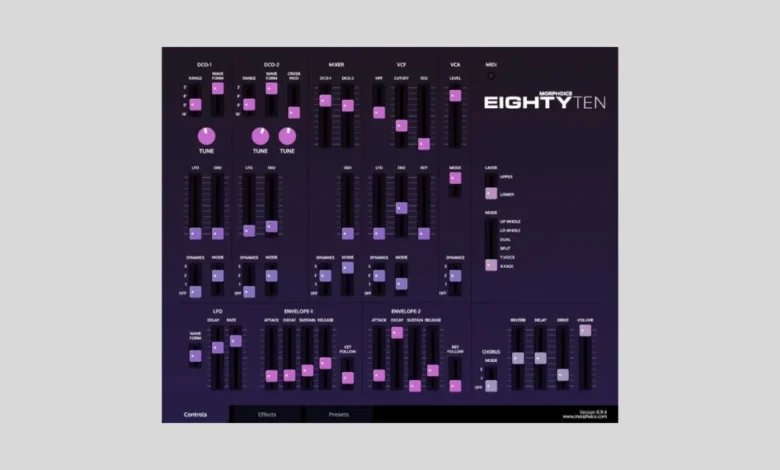
EightyTen integrates the core functionalities of both the JX-8P and the SuperJX-10 into a unified software interface. The plugin’s architecture is centered around a dual-DCO system per voice. A critical feature of this engine is Cross Modulation, a technique where one oscillator modulates the pitch of the other. In the original hardware, this allowed for the creation of bell-like, metallic, and FM-style timbres that were otherwise difficult to achieve on traditional subtractive synthesizers. This specific capability was famously utilized in the production of mainstream hits during the mid-80s, most notably in the synthesized textures of Chaka Khan’s "I Feel For You."
The filtering section of EightyTen consists of a 24 dB/octave resonant low-pass filter, designed to replicate the smooth, non-stepping sweep of the original Roland hardware. This is paired with a non-resonant high-pass filter, providing users with the ability to clean up the low-end frequencies of complex pads. For modulation, the plugin provides two ADSR (Attack, Decay, Sustain, Release) envelope generators per voice, allowing for intricate control over both the filter cutoff and the amplitude over time.
One of the most defining characteristics of the Roland JX series was its internal chorus effect. EightyTen includes a meticulous recreation of this stereo chorus, featuring the classic "I" and "II" settings (fast and slow). This effect is widely regarded as the "secret sauce" of the Roland sound, responsible for the wide, shimmering stereo image that defined 80s pop and film scores.
Modern Enhancements and Interface Design
While EightyTen remains faithful to the original signal path, Morphoice has implemented several modern features to enhance the user experience and expand the sonic palette. The user interface is modeled after the PG-800, an external hardware programmer that was originally sold separately for the JX-8P and JX-10. Because the original synthesizers relied on a tedious "data entry" system with minimal buttons, the PG-800 was essential for real-time sound design. By integrating this slider-heavy interface directly into the plugin, Morphoice ensures that all parameters are immediately accessible to the user.
In addition to the vintage features, EightyTen includes a dedicated effects suite that goes beyond the original hardware’s capabilities:
- DarkStar Reverb: A high-fidelity reverb algorithm inspired by modern boutique hardware like the Strymon BigSky, capable of creating massive, atmospheric spaces.
- Lo-fi Tape Delay: A delay module designed to add rhythmic complexity and vintage "warble" to the signal.
- HeatBurn Drive: A distortion and saturation circuit that allows users to add harmonic grit and "edge" to the otherwise smooth JX-style patches.
The inclusion of velocity and aftertouch sensitivity also brings a level of expressiveness that exceeds the limitations of many 1980s-era MIDI implementations, making EightyTen a viable tool for contemporary keyboardists and composers.
Distribution Model and Development Timeline
The release of EightyTen is currently in an "early beta" phase. Morphoice has adopted a unique go-to-market strategy that balances community testing with commercial sustainability. The plugin is available for free download on the Gumroad platform, allowing users to test the software for bugs and provide feedback during the development cycle. However, the developer has issued a caveat: these free beta versions may cease to function if the product transitions to a fully paid version in the future.
To mitigate this, Morphoice offers a "lifetime license" for a contribution of $10 or more. This model serves as a form of "pay-what-you-want" crowdfunding that secures the user’s access to all future updates, including the final stable release. This strategy has proven successful for Morphoice’s previous releases, building a loyal user base within the Bedroom Producers Blog community and the wider VST market.
The plugin supports a wide range of operating systems and formats, including AU, VST, and VST3 for macOS, Windows, and Linux. The inclusion of native Linux support is particularly noteworthy, as the Linux audio community is often underserved by major plugin developers.
Broader Implications for the Virtual Instrument Market
The emergence of EightyTen highlights a growing trend in the music technology industry: the democratization of high-quality analog modeling. Historically, accurate emulations of Roland hardware were the exclusive domain of larger companies like Roland itself (via the Roland Cloud) or Arturia. However, independent developers like Morphoice are increasingly capable of producing sophisticated DSP tools that rival the incumbents in both sound quality and ease of use.
Furthermore, the focus on the JX-8P and JX-10 suggests a shift in nostalgic demand. While the industry has spent decades recreating the Juno-106 and the Jupiter-8, producers are now looking toward the "later" analog era for sounds that are less ubiquitous. The JX-10, often called the "last of the great analog synths" before the industry moved fully toward digital workstations like the Roland D-50 and the Korg M1, offers a bridge between the warm 70s and the clinical 90s.
Analysis of Potential Market Impact
Industry analysts suggest that Morphoice’s rapid-fire release schedule may be a strategic move to capture market share before larger competitors can update their own legacy collections. By offering these tools for a nominal $10 fee (or free for testers), Morphoice is positioning itself as a high-value alternative to subscription-based models.
The reaction from the online producer community has been largely positive. Early adopters have praised EightyTen for its low CPU overhead and its ability to replicate the "unison" and "dual" modes of the SuperJX-10, which are critical for creating the thick, detuned leads used in synthwave and cinematic underscore. However, as with any beta software, some users have reported minor stability issues with specific DAW (Digital Audio Workstation) environments, which the developer is expected to address in subsequent patches.
Conclusion
Morphoice’s EightyTen represents a significant contribution to the landscape of free and affordable music production software. By combining the architectures of the JX-8P and the SuperJX-10, and augmenting them with modern effects and an intuitive interface, Morphoice has provided a comprehensive solution for those seeking the specific "sheen" of mid-80s Roland hardware. As the beta progresses toward a stable 1.0 release, EightyTen is poised to become a staple in the virtual arsenals of electronic musicians worldwide.
For those interested in exploring the evolution of synthesis further, the developer also points toward other niche libraries, such as Wavelet Audio’s Runa, indicating a broader ecosystem of specialized sound design tools currently entering the market. As of July 17, 2026, EightyTen stands as a testament to the enduring legacy of Roland’s engineering and the continued innovation of independent software developers.
Related posts: