Gliff Unleashes Advanced MIDI Chord Identification and Guitar Translation Tool for Producers and Musicians

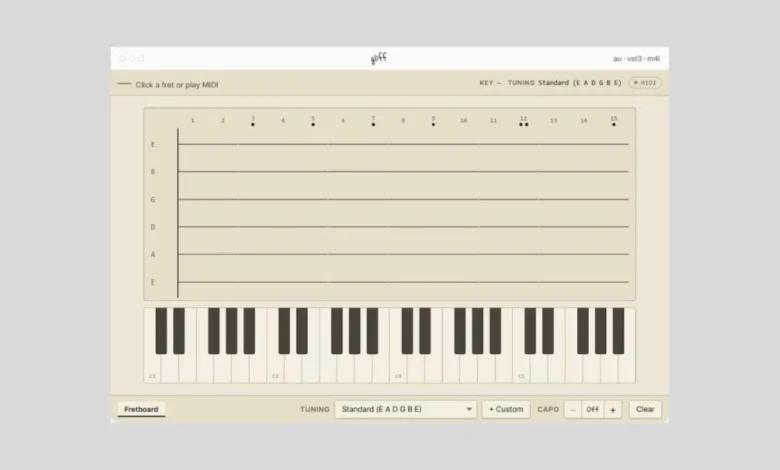
The digital music production landscape has witnessed a significant expansion in specialized utility tools designed to bridge the gap between physical instrumentation and digital MIDI composition. Gliff, a newly released free plugin compatible with both macOS and Windows, has emerged as a versatile solution for guitarists and keyboardists seeking to streamline their harmonic workflows. Developed to facilitate the creation of clean, polyphonic MIDI chord patterns, the software functions as a translation layer that identifies complex chord structures and converts them into visual fretboard representations or drag-and-drop MIDI data. While its primary interface is modeled after a guitar, the software’s utility extends to any musician operating within a Digital Audio Workstation (DAW) environment, providing a technical bridge between different instrumental disciplines.
Technical Architecture and Core Functionality
Gliff is engineered to operate within modern DAW environments through AU and VST3 formats, alongside a dedicated Max for Live device specifically optimized for Ableton Live users. A critical distinction in the software’s architecture is its reliance on MIDI data rather than audio processing. Unlike traditional guitar-to-MIDI converters—which utilize pitch-tracking algorithms to analyze the frequency of an incoming audio signal—Gliff processes incoming MIDI notes directly. This design choice ensures a high level of accuracy and eliminates the latency and "glitching" often associated with real-time audio-to-MIDI conversion.
The software functions through two primary operational modes. The first is tailored for the "MIDI Guitar" user, where an instrument equipped with a hexaphonic pickup or a dedicated MIDI controller (such as those produced by Jamstik or Fishman) feeds data into the plugin. Gliff then organizes this data into clean, polyphonic patterns, allowing the user to capture the specific nuances of guitar-voiced chords and export them as MIDI files. This process is particularly advantageous for guitarists who possess technical proficiency on their instrument but may struggle to manually program complex MIDI sequences in a piano roll editor.
The second operational mode serves keyboardists and electronic music producers. By inputting MIDI data via a standard keyboard controller, users can utilize Gliff’s internal engine to translate those notes into guitar fretboard shapes. This feature addresses a common hurdle in modern arrangement: the difficulty of voicing chords on a keyboard that would sound natural or physically playable on a guitar. By visualizing the fretboard, producers can ensure their arrangements maintain a sense of instrumental realism, even when they lack the physical skill to perform the parts on a real guitar.
Advanced Chord Identification and Harmonic Analysis
One of the most sophisticated aspects of Gliff is its integrated chord identification engine. In contemporary music production, particularly in genres like neo-soul, jazz, and sophisticated pop, the use of extended chords—such as 9ths, 11ths, and 13ths—is prevalent. However, identifying these chords for the purpose of charts or further arrangement can be a technical challenge for self-taught musicians. Gliff addresses this by providing real-time chord naming based on the MIDI input it receives.
The software does not merely provide a static label; it offers a nuanced "match percentage" and suggests context-dependent alternatives. This functionality is vital for understanding the functional harmony of a piece. For instance, if a user inputs the notes D, F, A, and C, the software will identify the chord as a D minor 7th (Dm7). However, Gliff’s engine is programmed to recognize that the same collection of notes can serve different harmonic functions depending on the bass note or the surrounding musical context. It might suggest the chord could be interpreted as a rootless G9sus4, providing the producer with a deeper understanding of how their progression might interact with other instruments in the mix.
This level of analysis draws comparisons to the intuitive playing styles of legendary musicians like Joni Mitchell, who famously utilized complex, non-standard tunings and intricate chord voicings without necessarily adhering to traditional academic nomenclature. Gliff provides a modern technical solution for this "ear-first" approach, allowing the software to handle the theoretical heavy lifting while the artist focuses on the creative process.
Customization, Tunings, and Virtual Interface
For users who do not have access to an external MIDI controller, Gliff offers a robust manual entry system. The interface features a high-resolution virtual fretboard where notes can be written directly onto the strings. This virtual environment is highly customizable, allowing users to move beyond standard E-A-D-G-B-E tuning. The plugin supports various alternative tunings and includes a virtual capo function, which automatically adjusts the chord identification and MIDI output based on the capo’s position.
This customization is essential for professional composers who need to write for specific instrumental setups. By adjusting the virtual tuning, a producer can accurately map out parts for a "Nashville" tuned guitar, an open D tuning, or even bespoke experimental configurations. The ability to visualize these chords on a 2D fretboard representation within the DAW helps in maintaining a cohesive visual-to-audio workflow, reducing the need to switch between the computer screen and a physical instrument.
The Evolution of MIDI Utilities in the Modern Studio
The release of Gliff as a free utility reflects a broader trend in the music technology industry: the democratization of high-level production tools. Historically, sophisticated chord identification and MIDI translation were gated behind expensive software suites or hardware units. The emergence of high-quality, free plugins like Gliff allows "bedroom producers" to access professional-grade harmonic analysis tools that were once the province of elite studios.
The chronology of MIDI development has moved from simple note-on/note-off commands to the current era of MIDI 2.0 and MPE (MIDI Polyphonic Expression). While Gliff focuses on the foundational aspects of chord voicing and identification, its clean MIDI output makes it compatible with the latest generation of virtual instruments. By providing "clean" MIDI, the software ensures that the data exported is free from the timing jitter and velocity inconsistencies that often plague live-captured MIDI performances. This results in a more stable foundation for layering synths, orchestral samples, or high-end virtual guitars.
Market Implications and Professional Adoption
Industry analysts suggest that tools like Gliff are becoming indispensable in the fast-paced world of media composition (film, television, and gaming). In these sectors, composers often have to pivot between different instrumental palettes rapidly. A composer who is primarily a pianist can use Gliff to quickly generate guitar-centric voicings for a folk-inspired score, ensuring that the MIDI parts they send to a session guitarist are physically playable and harmonically accurate.
Furthermore, the educational implications of Gliff are significant. Music educators can utilize the plugin to demonstrate the relationship between keyboard intervals and guitar fretboard geometry. By showing how a C Major 7th chord is constructed on both instruments simultaneously, the software serves as a powerful visual aid for students of music theory.
Official responses from the developer community emphasize that Gliff was designed to be "unobtrusive yet powerful." The focus on a streamlined user interface (UI) and a "zero-cost" entry point is a strategic move to build a user base within the competitive plugin market. While many developers offer "lite" versions of their software for free, Gliff provides a comprehensive feature set without the typical limitations of "freemium" software, such as restricted save functions or time-limited trials.
Broader Impact on the Creative Process
The broader impact of Gliff lies in its ability to reduce "friction" in the creative process. In the context of modern DAW-based songwriting, friction occurs whenever a musician has to stop their creative flow to solve a technical problem—such as figuring out the name of a chord or how to translate a keyboard part to a guitar. By automating these processes, Gliff allows the songwriter to maintain their momentum.
The software also encourages experimentation. With the ability to quickly swap between different fretboard shapes for the same chord, a producer might discover a voicing that they would not have traditionally found on their primary instrument. This cross-pollination of instrumental logic is a hallmark of contemporary music production, where the boundaries between "guitarist," "keyboardist," and "programmer" are increasingly blurred.
Conclusion and Future Outlook
As digital audio workstations continue to evolve, the demand for intelligent MIDI utilities is expected to grow. Gliff represents a significant step forward in this niche, offering a professional-grade tool that caters to a wide spectrum of musical backgrounds. Its availability on both Windows and macOS, combined with its integration into Ableton Live via Max for Live, ensures a broad reach across the global producer community.
In the coming years, it is likely that we will see further integration of machine learning and artificial intelligence in tools like Gliff, potentially allowing for even more complex harmonic suggestions based on the genre or style of the project. For now, Gliff stands as a robust, factual, and highly functional utility that simplifies the complexities of guitar harmony and MIDI translation, reinforcing the value of accessible, high-quality software in the modern music industry. Producers looking to enhance their harmonic toolkit can download Gliff directly from the developer’s website, marking a new chapter in free, utility-driven plugin design.
Related posts: