From back lights to eye lights, here are some of the best handheld lights available that won’t break your budget.

Over the past decade, the landscape of independent filmmaking, broadcast journalism, and content creation has undergone a profound technological transformation, largely driven by the rapid evolution of Light Emitting Diode (LED) technology. Once viewed as an auxiliary or experimental tool restricted by poor color rendering index (CRI) ratings and insufficient output, LEDs have firmly established themselves as the industry standard for on-set illumination. This paradigm shift has democratized high-end production values, allowing budget-conscious creators to achieve cinematic results previously reserved for major studio productions.
At the forefront of this revolution are compact, portable handheld lighting fixtures. Thanks to sustained research and development by pioneering manufacturers in the lighting sector, modern filmmakers no longer need to rely exclusively on bulky, power-hungry tungsten or HMI instruments for minor fills, accents, and practical effects. Today’s market offers an array of versatile, battery-powered LED solutions that integrate seamlessly into fast-paced documentary shoots, corporate interviews, narrative films, and mobile vlogging setups. Examining the current landscape reveals a diverse selection of high-performing, cost-effective handheld lights that deliver exceptional utility without compromising financial constraints.
The Evolution and Market Impact of Portable LED Illumination
Historically, achieving professional lighting on location required cumbersome AC-powered units, heavy stands, and extensive cable management, presenting significant logistical hurdles for small crews and solo operators. The advent of surface-mount technology (SMT) and chip-on-board (COB) LEDs changed this dynamic by drastically reducing the physical footprint of lighting instruments while simultaneously increasing luminous efficacy.
As manufacturing processes matured and component costs declined, companies began focusing on miniaturization and color accuracy. Modern portable LEDs routinely feature expansive bi-color temperature ranges, full RGB capabilities, and sophisticated onboard processors capable of mimicking complex lighting environments. Furthermore, the integration of wireless communication protocols—such as Bluetooth mesh networks and dedicated smartphone applications—allows gaffers and cinematographers to adjust parameters across multiple fixtures instantaneously. This combination of portability, color fidelity, and remote control has redefined efficiency on modern production sets, making versatile handheld lighting an essential component of any comprehensive camera package.
Versatile Credit-Card Sized Solutions: Aputure MC
Among the most influential micro-fixtures to enter the market is the Aputure MC, a credit-card-sized bi-color and full-RGB LED panel designed for maximum adaptability. Operating within a correlated color temperature (CCT) range of 3200K to 6500K with advanced hue and saturation controls, the MC provides precise color matching for mixed-lighting environments. Its compact dimensions allow it to be concealed easily within tight spaces, serving as an effective eye light, background accent, or under-cabinet practical.
A notable feature of the fixture is its integrated magnetic backing, which permits rapid mounting onto metallic surfaces, effectively eliminating the need for traditional grip equipment such as C-stands, magic arms, or spring clamps in specific scenarios. Illumination parameters are managed primarily through Aputure’s proprietary Sidus Link ecosystem, an app-based control platform that utilizes Bluetooth mesh technology. Field reports consistently highlight the stability and responsiveness of the Sidus Link application, noting minimal latency and reliable connectivity even in congested radiofrequency environments. For mobile shooters and travel-heavy production teams, the Aputure MC has become a staple inclusion in standard transport cases, offering scalable auxiliary light with minimal weight penalty.
Ergonomic Panel Lights for Event Videography: Lume Cube RGB Panel Pro
Event videography, including wedding coverage and corporate conference documentation, demands lighting instruments that prioritize rapid deployment, lightweight ergonomics, and extended battery endurance. The Lume Cube RGB Panel Pro addresses these operational requirements through a configuration housing 263 individual surface-mount LEDs capable of delivering an output of up to 1000 lumens.
Engineered for attachment to camera cages via standard cold-shoe mounts, the unit functions effectively as an on-camera key or fill source during dynamic, mobile shooting sequences. For stationary creators, such as YouTube vloggers and live streamers, the panel doubles as a customizable background accent light, allowing users to select specific hues to match brand palettes or set designs.
Operational longevity remains a critical metric for battery-powered field equipment. The Lume Cube RGB Panel Pro incorporates a high-capacity internal lithium-ion power source designed to sustain continuous output for approximately four hours at 50 percent brightness, or roughly two and a half hours at maximum intensity. Like its contemporaries, the fixture supports remote manipulation via a dedicated mobile application, enabling operators to modify color output, brightness, and embedded lighting effects without interrupting the physical flow of production.
Ultra-Slim Panel Alternatives: Nanlite LumiPad 11
The demand for ultra-thin, lightweight fixtures has driven manufacturers to explore panel designs that maximize surface area while minimizing physical depth. Nanlite, a brand widely recognized for its robust Forza series of high-output spotlights, applies its engineering philosophy to the micro-lighting segment with the LumiPad 11.
Measuring a mere 1.4 inches in thickness and weighing approximately 0.6 pounds, the LumiPad 11 is optimized for rapid deployment scenarios where traditional softboxes and diffusion panels are impractical. While its luminous output is insufficient to serve as a primary key light for large subjects, it excels in supplementary roles, functioning as a subtle fill source or a dedicated back light to separate subjects from background elements.
Industry analysts note that Nanlite’s broader corporate strategy emphasizes accessible pricing structures coupled with comprehensive manufacturer warranties, positioning the brand as a reliable ecosystem for budget-conscious independent creators. The LumiPad 11 reflects this ethos, offering balanced, soft illumination that mitigates harsh shadows without introducing significant operational complexity.
Miniaturized Tube Lights for Spatial Enhancement: Aputure MT Pro and Nanlite PavoTube II 6C
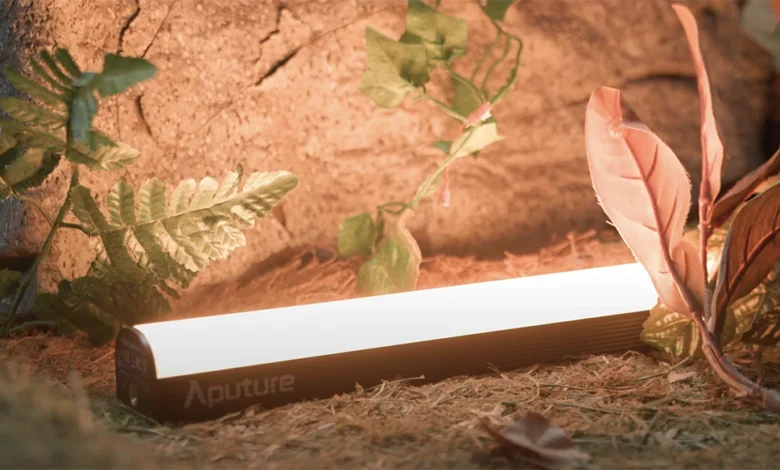
The introduction of linear LED tube lights transformed cinematic styling, but full-sized units often prove impractical for minor accents or confined spaces. To address this limitation, manufacturers have introduced miniaturized tube fixtures, exemplified by the Aputure MT Pro and the Nanlite PavoTube II 6C.
These compact linear instruments are engineered to be concealed within intricate set designs—tucked behind foliage, positioned beneath bookshelves, or hidden along architectural lines—to introduce subtle edge lighting, color contrast, and visual depth. In interview setups, these fixtures are frequently deployed to illuminate drab backgrounds or provide targeted highlights that elevate the production value of talking-head segments.
The Nanlite PavoTube II 6C, specifically targeted at documentary and corporate field crews, operates on an internal lithium-ion battery capable of delivering approximately 65 minutes of continuous runtime at maximum output. The unit features an expansive adjustable color temperature range from 2700K to 7500K, alongside fine-tuning capabilities for green-to-magenta tint correction. Furthermore, its color rendering performance is underscored by a high Color Rendering Index (CRI) of 98, ensuring accurate skin tones and color reproduction.
To expand creative possibilities on rapid-schedule shoots, both the PavoTube II 6C and the Aputure MT Pro incorporate pre-programmed, customizable visual effects. These simulated lighting sequences—ranging from emergency vehicle lights and flashing camera strobes to flickering campfires and lightning strikes—allow production teams to achieve complex visual effects practically in-camera, reducing reliance on post-production digital manipulation.
Rugged Bi-Color Illumination: Amaran AL-MX
For outdoor environments and rugged field conditions, durability is frequently prioritized alongside luminous output. The Amaran AL-MX, an all-metal bi-color fixture often referred to colloquially as "the brick," is constructed to withstand the physical demands of adventurous field production, such as landscape photography documentation and remote nature videography.
Despite its compact, robust aluminum-alloy chassis, the fixture delivers considerable output, reaching up to 1100 lux at a distance of 0.5 meters when operated in its high-intensity Boost Mode—a function designed to provide temporary maximum illumination at the expense of accelerated battery depletion.
Creators operating in low-light outdoor scenarios utilize the AL-MX for dual purposes: illuminating camera gear and workspace controls during nocturnal shoots, and serving as a portable key light for self-filmed narrative pieces or vehicle interiors. Its mechanical resilience and straightforward physical interface provide a reliable lighting solution for solo operators working independently of large support crews.
Industry Implications and Future Outlook
The proliferation of affordable, high-performance handheld LED lights reflects a broader democratization trend within the media production industry. As the technological gap between entry-level equipment and high-end cinema gear continues to narrow, independent creators and small production houses are increasingly equipped to execute complex visual narratives on modest budgets.
Market observers anticipate that future iterations of these portable fixtures will focus on enhanced energy efficiency, higher lumen-per-watt ratios, and deeper integration with cloud-based production management systems. As wireless protocols standardize and battery densities improve, the reliance on traditional auxiliary power distribution is expected to decline further, cementing the role of intelligent, pocket-sized lighting instruments as fundamental components of modern visual storytelling.