How we evolved from bi-standard and multistandard monitors to bi-rate and multirate display technology

The history of display technology is a narrative defined by the transition from complex analog signal handling to the streamlined precision of digital frame management. Decades ago, the terminology surrounding professional and consumer monitors was dominated by the concepts of "bi-standard" and "multistandard" capabilities. These terms reflected an era where hardware had to bridge the gap between fundamentally incompatible regional television standards. Today, that lexicon has shifted toward "bi-rate" and "multirate" monitors, a change that mirrors the industry’s move away from heterogeneous analog signals toward a standardized, digital-first infrastructure.
The Era of Analog Complexity: Understanding the Multistandard Legacy
To appreciate the current landscape, one must understand the Herculean tasks early display devices performed. In the mid-to-late 20th century, the global television landscape was fractured by divergent engineering philosophies. A multistandard monitor was not simply expected to handle different refresh rates; it had to reconcile disparate spatial resolutions and complex color encoding methods.
At the time, the world was largely split between 525-scanline systems (NTSC and PAL-M) and 625-scanline systems (PAL and SECAM). Furthermore, the methods used to encode color information within those lines—Composite video, Y/C (S-Video), and the intricacies of analog broadcast tuners—required monitors to contain complex circuitry capable of decoding multiple waveforms. A multistandard television set was effectively a universal receiver, tasked with interpreting analog broadcast signals that varied wildly in frequency and modulation.
This era required hardware engineers to build monitors with high tolerance for signal drift and regional variance. The "multistandard" moniker was a badge of technical versatility, signaling that the device could function in London, Tokyo, or New York, regardless of the local broadcast infrastructure.
The Digital Transition: From Standards to Rates
The transition to digital television (DTV) and the subsequent death of analog over-the-air broadcasting fundamentally altered the requirements for display hardware. With the consolidation of digital standards, the industry no longer needed to account for the physical variance of analog scanlines or complex color subcarrier modulation. Instead, the challenge shifted to managing the cadence of digital frames.
In the contemporary market, monitors are categorized by their "rate" capabilities rather than their "standard" capabilities. This reflects a reality where most source material arrives as a digital stream with a fixed resolution, leaving the monitor to focus almost exclusively on how it renders the temporal flow of information.
The Mechanics of Bi-Rate Monitors
Bi-rate monitors typically offer support for the two primary pillars of global broadcasting: 50Hz and 60Hz (with necessary support for the 59.94Hz standard common in North American production). While these displays are capable of handling these two frequencies, their internal processing varies significantly.
A common challenge for bi-rate displays is the handling of 23.976 fps cinema content. Because this frame rate does not divide evenly into 59.94Hz, many lower-tier displays utilize a process known as reverse telecine to adapt the signal. This process often disrupts the original "cadence" of the film, resulting in a stuttering effect known as judder. Higher-end bi-rate monitors, however, are designed to maintain the original temporal intent of the content by repeating frames at exact multiples, ensuring that the viewer sees the motion exactly as the director intended.
The Rise of Multirate 120Hz Displays
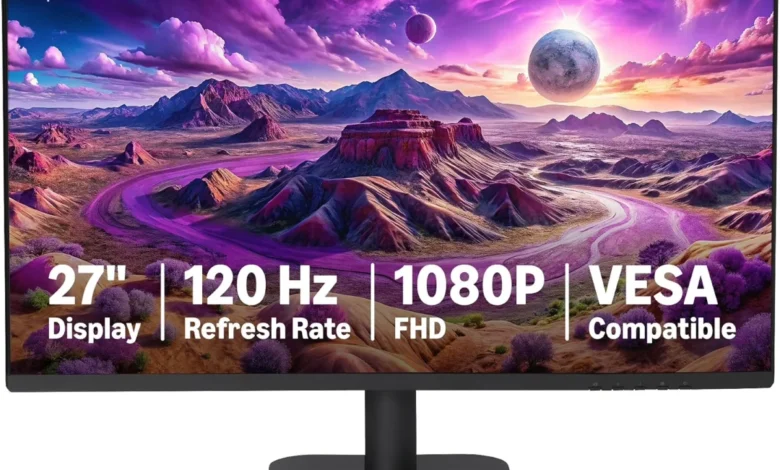
The industry has moved toward the "multirate" paradigm, with 120Hz panels serving as the current benchmark for high-performance displays. The primary advantage of a 120Hz monitor is its ability to mathematically accommodate almost all common film and video frame rates without the need for destructive interpolation or cadence-altering conversion.
Because 120 is an even multiple of 24, 30, and 60, these monitors can display these frames with perfect 1:1, 1:2, or 1:4 ratios. For example:
- 24 fps content is displayed by repeating each frame five times (5×24=120).
- 30 fps content is displayed by repeating each frame four times (4×30=120).
- 60 fps content is displayed by repeating each frame two times (2×60=120).
This mathematical alignment is critical for maintaining the cinematic look. When a display fails to achieve this, it often engages in "motion smoothing"—the controversial practice of synthesizing artificial frames to fill gaps in the timeline. While this may create a sense of fluidity for high-motion sports, it destroys the "filmic" aesthetic of movies. The rise of "Filmmaker Mode" in modern UHD sets is an industry-wide acknowledgement that viewers demand the preservation of original cadence, signaling a shift back toward accuracy over artificial enhancement.
Implications for Production and Post-Production
The move toward multirate technology has profound implications for production workflows. Professional colorists, editors, and directors now require displays that act as a "source of truth." In the analog era, a monitor might introduce subtle variations in color or geometry based on the standard being processed. In the modern multirate era, the goal is transparency.
The industry has largely moved away from the "black box" approach of the past. Today’s professional monitors are expected to be metadata-aware, adjusting their internal processing based on the incoming signal without requiring manual recalibration. This shift has reduced the overhead for production houses but has increased the pressure on manufacturers to ensure that their "120Hz" claims are not merely marketing terms, but are backed by a robust ability to handle the specific cadence of varied digital sources.
Industry Challenges and Future Outlook
Despite the advancements in multirate technology, challenges remain. Not all 120Hz monitors are created equal. Some budget-oriented models market themselves as "120Hz capable" while lacking the internal hardware to handle the refresh rates of non-standard sources. This often leads to hidden latency or frame-dropping, which can be detrimental in professional monitoring environments.
Furthermore, as high-dynamic-range (HDR) and high-frame-rate (HFR) content become more prevalent, the requirements for display hardware will continue to evolve. Future displays may need to move beyond simple multirate capabilities to support variable refresh rates (VRR) as a standard, further bridging the gap between gaming, professional production, and cinema.
The evolution from multistandard to multirate displays represents a broader maturation of the digital ecosystem. By moving away from the chaotic landscape of analog signal decoding, the industry has gained a level of precision that was unimaginable thirty years ago. However, this progress requires a deeper technical literacy from the end-user. As the market continues to expand, professionals and enthusiasts alike must look beyond the refresh rate number and verify the underlying cadence handling capabilities to ensure that the images they see are as faithful to the source as possible. The future of display technology lies in the silent, invisible accuracy of frame-perfect playback.