The Forgotten Legend: How the 1989 Pontiac 20th Anniversary Trans Am Became the Fastest American Production Car of Its Decade

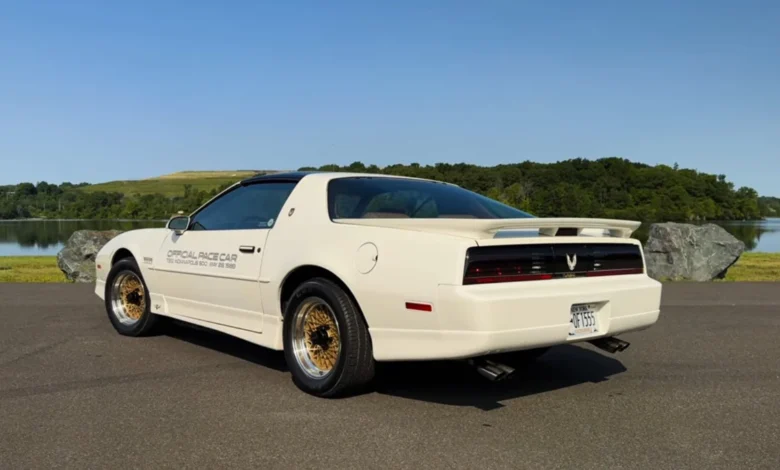
When automotive historians and enthusiasts compile the definitive lists of the fastest, most formidable performance vehicles to grace American roadways during the 1980s, the conversation invariably gravitates toward exotic imports and legendary domestic icons. Names like the Ferrari Testarossa, the Porsche 911, and Buick’s fierce Regal Grand National typically dominate the discourse. Yet, concealed within the annals of General Motors history is a remarkably potent machine that not only kept pace with these celebrated contemporaries but frequently outperformed them in acceleration metrics. That vehicle is the 1989 Pontiac 20th Anniversary Trans Am, a limited-edition powerhouse that briefly reigned as the fastest accelerating production car available on U.S. showroom floors.
Despite boasting supercar-challenging performance, a distinguished pedigree as an Indianapolis 500 Pace Car, and staggering acceleration figures that humbled elite sports cars of the era, this extraordinary machine has largely drifted out of public consciousness. This retrospective examines the engineering marvel that created the 20th Anniversary Trans Am, the chronology of its brief yet explosive market dominance, the performance data that cemented its legacy, and the curious paradox of why such a ferocious automotive achievement became an overlooked footnote in American muscle car history.
Main Facts and Engineering Background
To understand the magnitude of the 1989 Pontiac 20th Anniversary Trans Am, one must examine the mechanical alchemy that occurred behind closed doors at General Motors during the late 1980s. Pontiac was celebrating two decades of the Trans Am nameplate, a moniker that had become synonymous with pop culture styling, particularly after its cinematic immortality in films like "Smokey and the Bandit" throughout the 1970s. However, by the close of the 1980s, Pontiac wanted to mark the anniversary with more than just commemorative badges and specialized interior trim. They engineered a street-legal weapon.
Underneath the aerodynamic hood of the 20th Anniversary Trans Am lay a powerplant borrowed and refined from an unlikely sibling within the General Motors corporate family: the turbocharged 3.8-liter V6 developed by Buick. This was the same fundamental architecture that powered the notorious Buick GNX, a vehicle revered as the dark lord of the drag strip. In the Pontiac application, however, the engine was meticulously integrated into the third-generation F-body platform.
While official factory literature conservatively rated the engine at 250 horsepower and 340 lb-ft of torque—primarily to appease corporate insurance mandates and protect the flagship Chevrolet Corvette—automotive journalists and industry insiders widely acknowledged that these figures were heavily underrated. In reality, the turbocharged V6 was outputting significantly more power, delivering brutal mid-range acceleration that caught many traditional V8 enthusiasts completely unawares. Mated to a specialized 200-4R four-speed automatic transmission and a performance-tuned suspension, the package transformed the conventional grand tourer into an apex predator of the asphalt.
Chronology of a Record-Breaking Run
The trajectory of the 1989 Pontiac 20th Anniversary Trans Am was intensely brief, concentrated heavily around a specific calendar year of rigorous testing, motorsport prominence, and commercial deployment.
In May 1989, the automotive world turned its attention to the Indianapolis Motor Speedway. General Motors selected the 20th Anniversary Trans Am to serve as the Official Pace Car for the 73rd running of the Indianapolis 500. Notably, unlike many heavily modified pace cars of previous decades that required extensive race-prep engineering just to survive the circuit, the Trans Am pace car was virtually stock. It showcased the structural rigidity and high-speed stability of the production model directly to millions of television viewers and motorsport attendees.
Shortly after its pace car duties, the vehicle faced the ultimate litmus test of automotive journalism: the testing protocols of Car and Driver magazine. In the June 1989 issue, testers subjected the turbocharged Pontiac to rigorous performance trials at the drag strip and test track. The results sent shockwaves through the industry.
Supporting Data and Performance Metrics
The quantitative data generated during the summer of 1989 remains the most compelling argument for the vehicle’s historical significance. In Car and Driver’s testing, the 1989 Pontiac 20th Anniversary Trans Am rocketed from zero to 60 mph in a blistering 4.6 seconds. Furthermore, it completed the standing quarter-mile in 13.4 seconds at a trap speed of 101 miles per hour, ultimately achieving a top speed of 153 mph.
To contextualize these numbers within the landscape of late-1980s performance cars, the publication’s editors noted a striking reality. "That means, as we go to press, that the turbocharged Trans Am is the quickest 0-to-60 sprinter available in any U.S. production-car showroom — at any price," the review emphasized.
When measured against its direct domestic competitors, the Pontiac’s dominance becomes even more apparent. The lauded 1986 Buick Regal Grand National achieved the zero-to-60 mph sprint in 4.9 seconds, while its legendary successor, the 1987 Buick GNX, accomplished the feat in 4.7 seconds. The Trans Am managed to out-accelerate both of them. In fact, among domestic production cars of that specific era, only the highly anticipated 1989 Chevrolet Corvette ZR-1 managed to eclipse the Trans Am’s zero-to-60 time, and it did so by a mere fraction of a second—0.1 seconds, to be exact.
Official Responses and Industry Reception
At the time of its release, the executive offices at Pontiac Division and General Motors recognized that they had captured lightning in a bottle. The engineering teams had successfully bridged the gap between traditional American muscle and modern computer-managed turbocharging.
In contemporary press statements, Pontiac representatives emphasized that the 20th Anniversary edition was designed to be the absolute pinnacle of F-body performance. Dealerships received immense interest from regional enthusiasts, but the production realities dictated a strictly limited run. Pontiac announced that only 1,500 units of the 20th Anniversary Trans Am would ever be assembled. Every single unit was painted in a distinct white exterior finish, complemented by Camel tan leather interiors and unique commemorative graphics that subtly distinguished the model from standard GTA variants.
However, despite the glowing reviews from major automotive publications and the enthusiastic reception from die-hard brand loyalists, corporate positioning created a complex internal dynamic. General Motors was careful not to let the Pontiac division completely overshadow its halo sports car, the Chevrolet Corvette. This delicate corporate balancing act may have contributed to the understated marketing campaign surrounding the vehicle’s actual performance capabilities.
Broader Impact and Implications
As decades passed, the automotive community witnessed a strange phenomenon: while vehicles like the Buick Grand National and the Chevrolet Camaro IROC-Z achieved mythical status in American pop culture and collector circles, the 1989 Pontiac 20th Anniversary Trans Am largely faded into obscurity.
Several factors explain this cultural amnesia. First, the severely restricted production run of just 1,500 units meant that unlike mass-market performance cars, the average consumer rarely encountered one on the street. Consequently, it missed out on the widespread generational nostalgia that sustains the popularity of more common 1980s models. Second, the exterior aesthetics of the car were remarkably subtle. Aside from minor badging and the exclusive white-and-tan color scheme, it did not visually scream for attention in the way a winged superbird or a flared widebody exotic might. It required a knowledgeable enthusiast—someone with true "ball knowledge," in contemporary vernacular—to recognize the mechanical beast lurking beneath the hood.
Yet, this exact combination of extreme rarity and understated aggression has yielded interesting market implications for modern collectors. Entering the mid-2020s, automotive market analysts observed that pristine, low-mileage examples of the 20th Anniversary Trans Am could frequently be acquired at auction for remarkably reasonable figures, often hovering around the $35,000 threshold. For astute collectors who understand the historical telemetry and the sheer acceleration supremacy the car held in 1989, these valuations represent a significant bargain compared to the soaring prices commanded by lesser-performing contemporaries.
Ultimately, the 1989 Pontiac 20th Anniversary Trans Am stands as a fascinating testament to a transitional era in automotive engineering. It represents the twilight of the analog muscle era fused with the dawn of computerized forced induction—a fleeting moment when a Pontiac grand tourer could stand shoulder-to-shoulder with the fastest machinery in the world, leaving a permanent, if under-appreciated, mark on the history of American performance.