The digital signal processing landscape has seen a significant expansion with the release of Grungr, a new drive pedal emulation developed by cloph-dsp. Designed to cater to guitarists, bassists, and electronic music producers, the plugin is offered under a free or "pay-what-you-want" model, providing an accessible entry point for those seeking aggressive harmonic saturation. This release follows the developer’s previous success with Freeze95, a stochastic stutter and freeze effect that garnered attention earlier this year for its unique approach to temporal manipulation. Grungr shifts the focus toward spectral density and harmonic distortion, drawing inspiration from iconic hardware while implementing modern digital conveniences.
Historical Context and Development Background
The development of Grungr is rooted in the personal history of its creator, Pedro Castro, who sought to replicate the specific sonic characteristics of a classic hardware unit he utilized during his years as a performing musician. While cloph-dsp clarifies that the plugin is an independent project and is not officially affiliated with or endorsed by brands such as DOD or DigiTech, the influence of the DigiTech Grunge pedal is evident in both the name and the control layout.
The original hardware unit, released during the height of the 1990s alternative rock movement, was designed to capture the raw, unpolished distortion that defined the "Seattle sound." Over the decades, that specific circuit gained a cult following, particularly among bassists and noise artists who appreciated its uncompromising gain structure. By transitioning this aesthetic into the digital domain, cloph-dsp aims to provide a streamlined tool that bypasses the complexities of modern "super-plugins" in favor of a fast, intuitive workflow reminiscent of physical stompboxes.
This release fits into a broader timeline of cloph-dsp’s output in 2026. Following the launch of Freeze95 in May, the developer has focused on refining his DSP algorithms to ensure lower CPU overhead and higher stability across multiple operating systems. Grungr represents the next step in this evolution, moving from time-based effects into the realm of non-linear waveshaping.
Core Functionality and User Interface Design
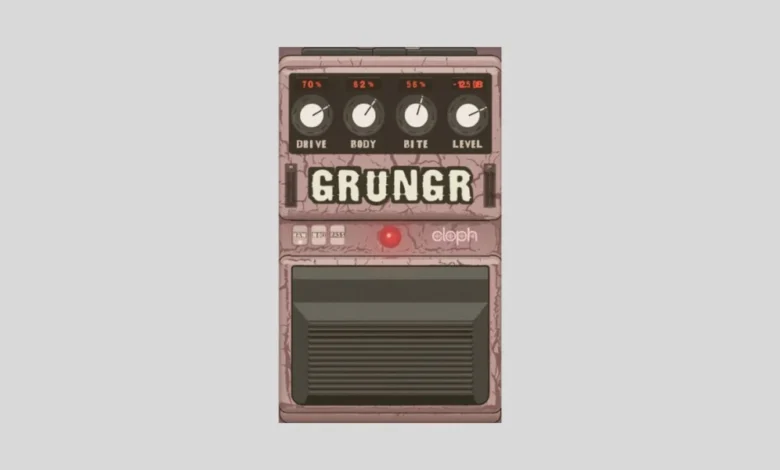
Grungr is characterized by its minimalist interface, which intentionally avoids nested menus and complex configuration screens. The objective is to facilitate immediate creative results through a set of four primary controls and a three-way voicing switch.
The four main parameters are:
- Grunge: This acts as the primary gain control, determining the amount of drive fed into the clipping stage. At lower settings, it provides a subtle grit, while higher settings push the signal into heavy saturation and near-fuzz territory.
- Body: This control manages the low-mid frequencies, allowing users to thicken the sound or thin it out to prevent frequency masking in a dense mix.
- Bite: Functioning as a high-frequency contour, this parameter dictates the "edge" of the distortion. It is particularly effective for helping guitars cut through a mix or for adding clarity to heavily distorted bass lines.
- Level: A standard output volume control used to compensate for the gain added during the distortion process.
The plugin’s versatility is further enhanced by its three voicing modes:
- RAW: This mode offers an open, direct crunch. It is the most transparent of the three, providing a broad-spectrum drive that retains the fundamental characteristics of the input source.
- MOD: A more focused and forward-sounding mode, MOD emphasizes the mid-range frequencies. This is designed for lead instruments or vocal processing where the signal needs to occupy a specific "pocket" in the frequency spectrum.
- BASS: Specifically tuned for low-end instruments, this mode adds significant weight to the signal while implementing internal filtering to prevent "flub"—the muddy, indistinct low-end response often associated with applying standard guitar distortion to bass frequencies.
Technical Specifications and Signal Processing
Under the hood, Grungr utilizes a sophisticated signal chain designed to mimic the behavior of analog circuits while maintaining digital precision. The core of the effect is a hard-clipping algorithm. Unlike soft-clipping, which rounds off the peaks of a waveform to create a "warm" tube-like saturation, hard-clipping abruptly shears the waveform peaks. This results in a more aggressive harmonic profile, rich in odd-order harmonics, which is essential for achieving the "grunge" aesthetic.
To ensure the high-gain signal remains manageable, cloph-dsp has integrated subsonic filtering. This removes inaudible low-frequency energy that can otherwise eat up headroom and cause intermodulation distortion. Additionally, a built-in limiter prevents the output from clipping the digital audio workstation (DAW) master bus, providing a safety net for users who are aggressively pushing the gain stages.
The plugin supports stereo processing, making it suitable for use on stereo synth patches, drum busses, or full-mix parallel processing. Furthermore, cloph-dsp has prioritized performance efficiency, ensuring zero-latency operation. This is a critical feature for musicians who need to monitor the effect in real-time during a recording session or live performance, as it eliminates the delay between the physical input and the processed output.
Technical Architecture and Format Compatibility
Grungr is built to support a wide array of modern production environments. It is available in VST3, AUv2, and CLAP formats. The inclusion of the CLAP (CLever Audio Plugin) format is particularly noteworthy. Developed as an open-source alternative to proprietary formats, CLAP offers improved multi-core CPU management and better metadata handling, and its adoption by independent developers like cloph-dsp signals a growing trend toward more transparent and efficient plugin standards.
For macOS users, cloph-dsp provides a Universal build that supports both Intel-based machines and Apple Silicon (M-series) chips. While the macOS version is currently marked as a beta release, it represents the developer’s commitment to cross-platform accessibility. Windows users on versions 10 and 11 are also fully supported.
In a move toward user-friendly distribution, the plugin features no installer and no Digital Rights Management (DRM). Users simply download the binaries and place them in their respective plugin folders. This "portable" approach is often preferred by professional engineers who maintain complex systems and wish to avoid the bloatware or background processes associated with many commercial plugin managers.
Broader Impact and Industry Implications
The release of Grungr highlights several ongoing trends in the music technology industry. First is the "democratization of DSP," where individual developers are capable of producing high-quality tools that rival those of larger corporations. By offering the plugin as "pay-what-you-want," cloph-dsp leverages a community-driven funding model that has become increasingly popular on platforms like Gumroad and Itch.io.
Second, the plugin reflects a renewed interest in "one-knob" or "limited-control" philosophy. As DAWs become increasingly complex, many producers are gravitating toward tools that do one thing exceptionally well without requiring extensive manual reading. Grungr’s design philosophy suggests that for many creative tasks—especially those involving distortion—speed and "vibe" are more valuable than surgical precision.
Finally, the focus on "grunge" as a specific sonic category points to the cyclical nature of musical trends. Just as the 1990s saw a rejection of the polished production of the 80s, modern producers are increasingly looking for ways to introduce "imperfection," "grit," and "analog-style chaos" into pristine digital environments. Grungr provides a specialized tool for this purpose, bridging the gap between historical hardware and contemporary digital workflows.
Availability and Future Outlook
Grungr is currently available for download through cloph-dsp’s Gumroad storefront. While the base price is set to zero, the developer encourages contributions from those who find the tool useful for their professional work. This model allows the developer to fund future updates and new projects while ensuring that students and hobbyists can access professional-grade tools regardless of their financial situation.
As the macOS version moves out of beta and into a stable release, users can expect further refinements to the DSP code. Given the success of Freeze95 and the initial reception of Grungr, cloph-dsp is positioning itself as a notable name in the niche market of character-driven, boutique audio plugins. For now, Grungr stands as a robust option for anyone looking to add harmonic bite and textured saturation to their digital audio arsenal.
Related posts: