The Mystery of the Forgotten Album: Could Newly Discovered Photographs Rewrite the Bonnie and Clyde Narrative

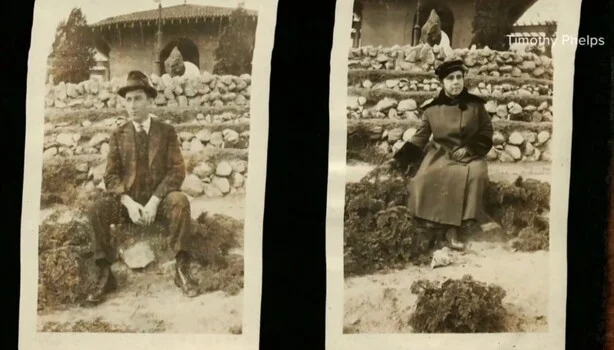
A dusty, forgotten photo album, pulled from the obscurity of a residential garage, has sparked a contentious debate among historians and forensic experts regarding the visual legacy of America’s most infamous outlaw couple, Bonnie Parker and Clyde Barrow. The album, which sat unopened for over a year after being discovered by Timothy Phelps while he was assisting a friend with an estate cleanup, contains a snapshot explicitly labeled with the names of the Depression-era duo. This discovery has set into motion a rigorous, often frustrating attempt to authenticate images that, if proven genuine, would represent a significant, previously unpublished chapter in the history of the Barrow Gang.
The Discovery and the Quest for Validation
Timothy Phelps, who has spent more than 15 years obsessively studying the lore and movements of the Barrow Gang, stumbled upon the album while clearing the garage of his friend’s late father. Amidst the clutter of mundane family snapshots, he found a print bearing a handwritten identification of the pair. For Phelps, the initial encounter was visceral. "I knew in my heart it was them," he recounted during an interview with KIII 3News.
However, the transition from intuitive recognition to academic acceptance has been fraught with obstacles. Over the past several years, Phelps has painstakingly compared these images against the existing canon of documented Bonnie and Clyde photographs. He has utilized modern investigative techniques to triangulate the locations depicted in the backgrounds—including a building bearing the word "hotel"—in an attempt to anchor the photos to known dates and locations frequented by the outlaws. Despite his dedication, the response from the established historical community has been largely dismissive, with many museums and independent historians refusing to authenticate the collection. Phelps reports that his efforts to verify the images have even been met with hostility, ranging from professional belittlement to direct threats.
Forensic Analysis: The Science of Skepticism
The central tension in the debate over the album lies in the conflict between provenance—the verifiable history of an object—and forensic morphology. When experts such as Mark Hall-Patton, the retired administrator of the Clark County Museum System and a well-known figure from the History Channel’s Pawn Stars, examined the materials, his conclusion was cautious. While he noted that the album, the photographic paper, and the handwriting style were consistent with the 1930s, he could not definitively identify the subjects in the frames.
Lois Gibson, a renowned Houston-based forensic artist and a Guinness World Record holder for the most successful identifications in her field, has provided the most compelling evidence for the album’s authenticity. Utilizing digital superimposition, Gibson overlaid the figures in the mystery photos with authenticated portraits of Parker and Barrow. According to Gibson, the results were definitive. "I put it in different degrees of transparency on top of the known Bonnie Parker photo, and every single feature lines up," she stated. Her analysis focused specifically on skeletal structures, noting that while soft tissue—affected by weight, aging, and lifestyle—can change over time, the underlying cranial anatomy remains constant. She applied the same methodology to the man in the photos, asserting that the facial bone structure is identical to that of Clyde Barrow.
Historical Context and the Burden of Provenance
In the world of historical artifacts, even a forensic match often falls short without provenance. The provenance of the Phelps album remains frustratingly thin; he has heard anecdotal rumors that it may have originated from a deserted shack in the California desert, but there is no documentation to bridge the gap between that location and the subjects. Without a paper trail, the images remain in a state of historical limbo.
The importance of provenance is best illustrated by the "Joplin Cache." In April 1933, the Barrow Gang narrowly escaped a police raid on their hideout in Joplin, Missouri. In their haste, they left behind a cache of undeveloped film and a camera. The subsequent development of this film by the Joplin Globe provided the public with the iconic images that defined the couple’s legend, including the famous shot of Bonnie Parker posing with a cigar and a revolver. These photos are considered "gold standard" artifacts because their origin is inextricably linked to the crime scene, providing an ironclad chain of custody.
Contrast this with the high-profile sale in September 2025, where an archive of roughly 600 photographs—once belonging to Clyde Barrow’s sister, Nell Barrow—fetched $23,750 at RR Auction. Many of these photos had been previously published in the 1934 memoir co-authored by Nell Barrow and Emma Parker. Because these images were kept within the families of the outlaws, their authenticity is beyond reproach, demonstrating the massive value placed on institutional and familial memory.
The Challenges of Facial Comparison
The forensic community maintains strict protocols regarding the use of superimposition in identification. The Facial Identification Scientific Working Group (FISWG), established by the FBI in 2009, emphasizes that superimposition is merely one tool in a larger investigative kit. Guidelines explicitly state that such comparisons should only be conducted when the photographs share the same viewpoint, angle, and distance.
Variations in lighting, focal length, and the physical degradation of vintage film can distort a face in ways that lead even well-meaning investigators to false conclusions. Because the settings in Phelps’ photographs are not yet identified, there is no way to cross-reference them with historical records, such as police reports or travel logs, to provide the corroborating context that forensic evidence requires. If Phelps can successfully identify the building marked "hotel" or other landmarks, he would provide the "third leg" of the stool: anatomical match, material age consistency, and spatial/temporal placement.
Broader Implications for Historical Research
The case of the garage album serves as a microcosm for the challenges inherent in digital-age historical research. As the generation that lived through the 1930s has passed, the reliance on physical evidence and forensic technology has grown. However, the gatekeepers of history—museums and established experts—are naturally hesitant to validate "new" discoveries without a transparent paper trail, fearing the reputational damage that would follow the exposure of a forgery.
For collectors and researchers like Phelps, the pursuit is not merely about financial gain or notoriety; it is an attempt to recover fragments of a narrative that was cut short by a hail of bullets in a Louisiana parish in 1934. Whether these photos represent a genuine missing link in the story of the Barrow Gang or are merely another chapter in the long history of Bonnie and Clyde myths remains to be seen.
As technology continues to improve, the gap between forensic identification and provenance may close. With more sophisticated AI-assisted facial recognition and refined methods for analyzing photographic chemistry, the scientific community may eventually reach a consensus that the current archival standards cannot yet support. Until that time, the album remains a provocative, if currently unverified, piece of Americana. The debate underscores the fact that even in an era of forensic precision, history often remains as elusive as the outlaws themselves—a series of fleeting images caught in the light, waiting for the right angle to reveal the truth.