On Friday, November 13, 2026, the United States aviation system experienced a historic disruption as the Federal Aviation Administration (FAA) issued an unprecedented nationwide ground stop for all departing domestic flights. The order, which remained in effect for several hours, sent shockwaves through airports across the country, grounding thousands of aircraft and leaving millions of passengers in a state of uncertainty. While the agency has since lifted the order and permitted domestic travel to resume, the event has reignited urgent debates regarding the resilience of American transportation infrastructure and the accelerating integration of complex, AI-driven management systems.
A Chronology of the Disruption
The crisis began in the early hours of Friday, following reports of widespread communication failures within air traffic control networks. As the morning progressed, the FAA determined that the integrity of the data stream required for safe flight operations had been compromised. By mid-morning, the agency took the extraordinary step of halting all departing flights across the U.S. National Airspace System.
For travelers, the impact was immediate and visceral. Airport terminals quickly transformed into hubs of congestion as departure boards flashed "delayed" and "cancelled" across the board. The ground stop specifically targeted departing flights; aircraft already airborne were allowed to continue to their destinations, while international arrivals were managed on an individual, case-by-case basis. By late Friday evening, the FAA officially lifted the restriction, citing that the underlying communications errors had been resolved, though the ripple effects of the delay—including displaced crews, misaligned aircraft, and significant passenger backlogs—persisted well into the weekend.

Historical Context and Rarity
To understand the gravity of the November 13 event, one must look at the rarity of such a decision. A nationwide ground stop of this magnitude is a measure of last resort, typically reserved for events of national significance. Historically, this level of total system paralysis is virtually unheard of outside of catastrophic scenarios. The most notable precedent occurred in the immediate aftermath of the September 11, 2001, terrorist attacks, when the entire U.S. airspace was closed for several days.
A more recent, albeit smaller, technical precursor occurred in January 2023, when a failure in the Notice to Air Missions (NOTAM) system caused a temporary halt to domestic departures. Comparing the two events, industry analysts have noted that the 2026 disruption appears significantly more complex due to the interconnected nature of the modern digital tools currently being deployed by the FAA.
The Role of Technology and Infrastructure
The timing of the incident has drawn intense scrutiny, particularly given the FAA’s ongoing efforts to modernize its aging air traffic control (ATC) infrastructure. For years, the agency has grappled with the legacy technology of the 20th century, including a reliance on systems that have only recently begun the transition to digital-first architecture.
Earlier in the week leading up to the incident, the FAA had announced a major expansion of its SMART (System-wide Management of Air Traffic) initiative. This $875 million program is designed to integrate artificial intelligence into the decision-making process for air traffic controllers. The software is built to analyze massive datasets—including real-time weather, flight path efficiency, and runway congestion—to provide predictive insights.

While the FAA has maintained that these AI systems are designed to enhance safety and efficiency, the juxtaposition of the system’s expansion with the subsequent total network failure has fueled skepticism. Critics and aviation experts are now calling for a comprehensive audit to determine whether the integration of new software into legacy systems created an unforeseen vulnerability. Furthermore, the agency’s long-standing project to phase out the use of floppy disks for specific data transfers by 2028 serves as a poignant reminder of the technical debt that still permeates federal aviation operations.
Social Media Reactions and Cultural Impact
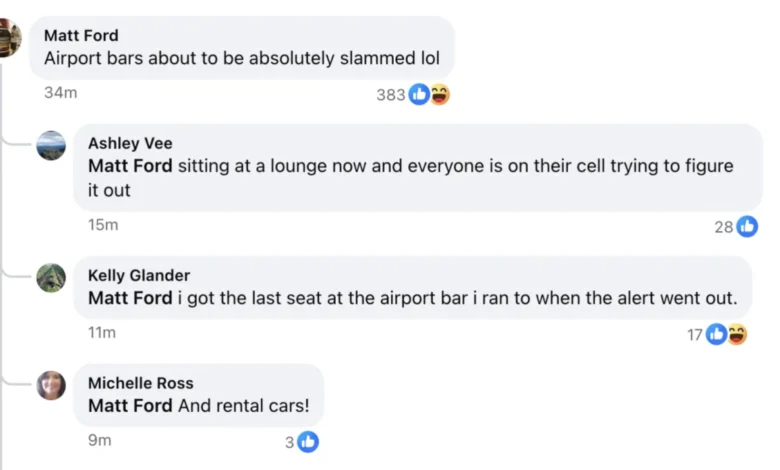
As news of the grounding spread, the internet became a clearinghouse for both anxiety and satire. On platforms like X (formerly Twitter) and Facebook, the atmosphere was a mix of genuine frustration and grim humor. Because the disruption occurred on Friday the 13th, many users drew parallels to other recent technological failures, including a major global Microsoft outage earlier in the year.
The response from the public was diverse. While some travelers shared images of crowded airport terminals and long queues, others utilized the platform to engage in "doom-scrolling" or to share memes that poked fun at the fragility of modern systems. High-profile figures, including author Stephen King, weighed in on the disruption, underscoring the sense of collective helplessness that accompanies such a large-scale breakdown of vital services.
Despite the humor, the underlying sentiment remained one of concern. The reliance on digital infrastructure has made the U.S. economy and public mobility exceptionally vulnerable to single points of failure. The incident served as a wake-up call for the average traveler, who, until Friday, likely viewed air traffic control as a background process that functioned seamlessly by default.

Economic and Operational Implications
The economic toll of a nationwide ground stop is profound. Airlines face significant costs associated with fuel, crew rerouting, and passenger compensation. Beyond the immediate financial impact on carriers, there is the indirect cost to the national economy—business meetings missed, supply chains delayed, and the loss of productivity for millions of stranded professionals.
Industry analysts expect that airlines will require several days to stabilize their networks. A ground stop does not merely pause operations; it forces a massive, manual realignment of assets. When a plane is grounded, it often cannot fly its next scheduled route, which causes a "domino effect" that can last for 48 to 72 hours after the initial incident.
Moving Forward: The Path to Resilience
As the aviation sector moves past the immediate crisis, the focus will undoubtedly shift toward accountability and infrastructure hardening. The FAA is currently conducting an internal investigation to identify the specific root cause of the communications failure. Lawmakers in Washington have already begun signaling their intent to hold hearings to determine if the current modernization efforts are being handled with adequate safety redundancies.
The aviation industry is at a crossroads. The transition to AI-supported management, while necessary for the long-term goal of increasing flight capacity and reducing environmental impact through more efficient routing, presents inherent risks. The central challenge for the FAA will be to ensure that these sophisticated digital tools are accompanied by robust "fail-safe" mechanisms that can operate independently of the primary network.

For now, the sky has reopened, and the flow of air traffic has resumed its regular pace. However, the events of November 13 have left a lingering question about the stability of the invisible systems that hold the modern world together. Whether the root cause was a software glitch, a hardware failure, or a complex interaction between legacy and modern code, the incident has highlighted that in an increasingly digitized world, the potential for systemic, nation-wide disruption remains a persistent reality. The traveling public will be watching closely as the FAA releases its findings and works to prove that the systems governing the skies are as reliable as the technology they seek to replace.