Snapchat Releases New Civic Engagement Report Highlighting High Voter Intent Among Young Users Ahead of Midterms

With the United States midterm elections approaching, political campaigns and strategists are constantly searching for effective ways to connect with elusive younger demographics. In an effort to capture a larger share of political advertising budgets, Snapchat has released a comprehensive new research report examining civic engagement and voter behavior among its user base. The study sheds light on how younger generations consume political information, interact with digital advertisements, and formulate their voting decisions in an increasingly complex sociopolitical landscape.
The findings suggest that the platform’s audience—predominantly composed of Millennials and Generation Z—is not only politically active but also uniquely receptive to digital outreach compared to non-users. By releasing this data ahead of the November elections, Snap Inc. is actively positioning its platform as an indispensable tool for political marketers aiming to reach voters who may tune out traditional broadcast media.
Methodology and Core Findings of the Alter Agents Study
Commissioned by Snap Inc. and conducted earlier this year by market research firm Alter Agents, the study is based on a robust survey of more than 1,000 Snapchat users ranging in age from 18 to 45. The research sought to uncover the underlying motivations, media consumption habits, and decision-making processes of young voters.
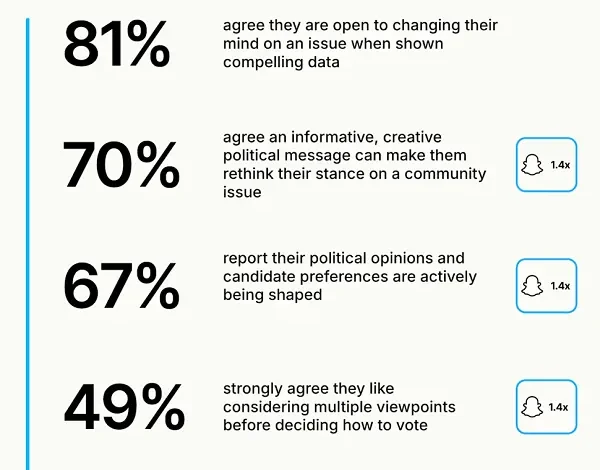
According to the compiled response data, nearly 80 percent—specifically 78 percent—of surveyed Snapchat users plan to cast a ballot in the upcoming midterm elections. This statistical benchmark places Snapchat users at 1.2 times more likely to participate in the electoral process than individuals who do not use the platform. This elevated level of civic intent challenges the prevailing cynical narrative that younger generations are politically apathetic or disconnected from the democratic process.
Furthermore, the study indicates that Snapchat users possess a distinct psychological approach to politics. Snap characterized its user base in the report by stating that, in a complex political landscape, Snapchatters are uniquely open-minded in their political approach, actively seeking out diverse viewpoints before choosing how to vote and remaining genuinely open to changing their positions. This receptivity to new information makes the platform a fertile ground for issue-based campaigns and candidate introduction strategies.
Digital Advertising as an Educational Tool
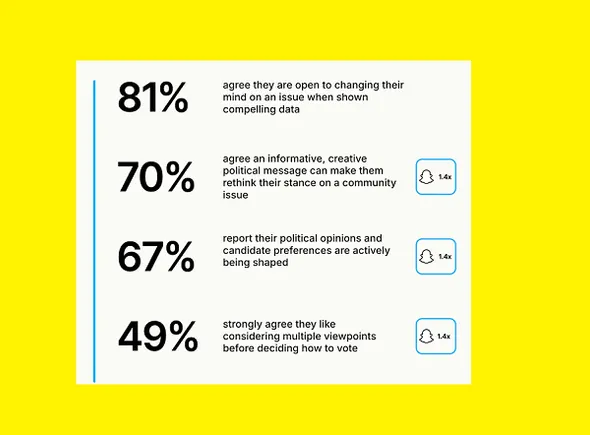
One of the most significant insights for political advertisers contained within the report is the profound influence of digital promotions on user awareness. Rather than viewing in-app political ads as a nuisance, a substantial majority of respondents reported that these placements serve a vital educational function.
Specifically, 80 percent of survey participants indicated that political promotions on Snapchat have successfully introduced them to candidates and political causes of which they were previously unaware. This highlights the platform’s efficacy as a top-of-funnel discovery engine for political campaigns that may lack the massive budgets required for widespread television or radio broadcasting.
Additionally, the survey revealed a strong correlation between ad exposure and post-impression engagement. Roughly 74 percent of respondents stated that they are significantly more likely to independently research candidates and their policy platforms after encountering related advertisements on the platform. This behavioral bridge from passive ad viewing to active research demonstrates that in-app touchpoints can successfully drive deeper political inquiry among younger voters.
Snapchat’s History of Voter Registration and Civic Tech Initiatives
Snapchat’s recent push for political ad spend is built upon a multi-year foundation of civic engagement initiatives. The platform has long recognized that while young people possess the desire to participate in democracy, the mechanics of voter registration and logistical planning can often present friction points. To mitigate this, Snap has systematically integrated non-partisan registration tools and educational resources directly into the user experience.
The trajectory of these efforts illustrates a scaling impact over successive election cycles:
In 2018, Snapchat deployed in-app tools designed to simplify the voter registration process. Following the conclusion of that campaign, internal data indicated that the platform had directly driven more than 450,000 individuals to register to vote, many of whom were participating for the very first time.
Building on that success, the platform expanded its outreach for the 2020 presidential election cycle. Leveraging targeted in-app prompts, notifications, and user-friendly registration widgets, Snapchat successfully facilitated voter registration for approximately 1.2 million users. These initiatives earned praise from bipartisan voting rights organizations for successfully mobilizing demographics that traditionally exhibit lower turnout rates.

The upcoming midterm elections represent the next major milestone for Snap’s civic tech infrastructure. By combining its historical success in voter registration with fresh psychographic data on ad receptivity, the company is attempting to prove that its ecosystem offers commercial and societal value to campaigns operating in tight electoral environments.
Implications for Political Campaigns and Media Strategy
The release of the Alter Agents study arrives at a critical juncture for political media buyers. With digital ad spend shifting dynamically across platforms, campaigns must carefully evaluate where to allocate finite financial resources to achieve maximum return on investment.
Traditional media strategies often struggle to capture the attention of voters under the age of 45, who are increasingly cutting traditional television cords and relying on mobile-first, ephemeral, and social communication channels. Snapchat’s core demographic sits squarely within this hard-to-reach cohort. By offering a platform where users are actively seeking out balanced perspectives and are willing to engage with cause-based messaging, Snap provides an alternative to the highly polarized environments found on other social media networks.
Moreover, the platform’s emphasis on cause-based outreach aligns with the shifting priorities of younger voters. Generation Z and Millennial voters frequently base their political alignment on specific, interconnected issues such as climate change, economic equity, reproductive rights, and mental health resources, rather than strict party line loyalty. The study suggests that campaigns that tailor their messaging around clear, values-driven causes—and deliver that messaging through trusted digital interfaces—are far more likely to resonate with the Snapchat audience.
Industry Reception and Future Outlook
While political consultants and media buyers will ultimately test these claims through live campaign performance in the weeks leading up to November, the data provides a compelling quantitative argument. The ability to bypass traditional media fragmentation and connect directly with a captive, open-minded audience of potential voters represents a powerful value proposition.
As campaigns enter their final stretch, the integration of targeted digital video ads, interactive filters, and seamless registration links will likely play a decisive role in mobilizing the youth vote. Snapchat’s latest research underscores a fundamental reality of modern elections: reaching the next generation of voters requires meeting them where they are, communicating in the formats they trust, and respecting their desire for substantive, educational political discourse.
Related posts: