Snapchat Report Reveals Shifting Consumer Perceptions of Artificial Intelligence and Everyday Chatbot Integration

Artificial intelligence has rapidly transitioned from a speculative technological frontier into an everyday companion for millions of consumers worldwide. A comprehensive new report published by Snapchat, titled "Navigating the Age of AI," sheds light on this monumental shift. Based on extensive research conducted in partnership with market research firms Ipsos and WPP, the study surveyed more than 4,200 active artificial intelligence users to examine how public perception, trust, and utilization of AI assistants are evolving as these technologies become deeply integrated into daily routines.
The findings indicate that AI is no longer viewed merely as a novelty or an experimental tool. Instead, it is increasingly regarded as a trusted partner, influencing everything from interpersonal communication to major decision-making processes and consumer purchasing habits. However, the report also highlights a complex consumer dichotomy: while users readily embrace AI for private assistance, brainstorming, and creative support, they simultaneously harbor deep-seated reservations regarding corporate data usage, hyper-personalized advertising, and entirely synthetic content.
Main Findings and the Massive Scale of Daily AI Adoption
The core revelation of Snapchat’s report centers on the sheer volume of daily interactions consumers have with artificial intelligence. According to the data, 48% of everyday consumers now utilize AI tools on a daily basis. Among digital creators and marketing professionals, that adoption rate jumps to 50%, with respondents identifying AI as a foundational, core component of their professional and creative routines.
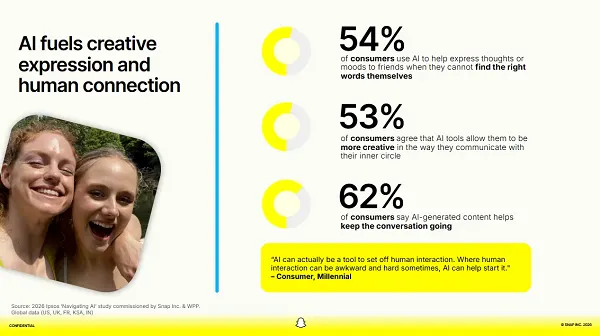
Rather than using AI strictly for complex technical computations or automated enterprise tasks, everyday users are leaning on chatbots for conversational support and cognitive offloading. Approximately 62% of surveyed AI users reported that these digital assistants help them maintain and navigate everyday conversations, suggesting a growing reliance on AI to articulate thoughts, overcome writer’s block, and refine ideas before presenting them to human peers.
Furthermore, platform-specific metrics within the Snapchat ecosystem reveal unique behavioral patterns among its user base. Snapchatters proved to be 2.2 times more likely than average consumers to agree that artificial intelligence positively enhances their social lives. They are also 1.6 times more likely to leverage AI assistants to plan real-world activities, ranging from social gatherings and travel itineraries to daily schedules and lifestyle management.
The Psychology of AI Companionship: A Judgment-Free Space
One of the most striking sociological insights detailed in the report is the psychological relationship users are forming with conversational AI models. More than 80% of respondents described artificial intelligence as a friendly and collaborative entity. This perception has fostered a unique environment where users feel comfortable exploring vulnerable or complex emotional states without fear of social repercussions.
Specifically, 74% of participants view AI interfaces as a judgment-free space. Many consumers use chatbots as private coaches, allowing them to practice articulating complex feelings, draft difficult messages, or process stressful interpersonal dynamics before sharing those thoughts with friends, family members, or colleagues. This dynamic transforms the chatbot from a mere search engine or productivity tool into a surrogate confidant, shifting the boundaries of traditional human communication and emotional processing.
Background Context: The Rapid Evolution of Consumer Chatbots
To understand the significance of Snapchat’s findings, it is essential to examine the rapid chronology of the consumer AI landscape over recent years. Following the widespread public debut of advanced generative large language models in late 2022, technology companies raced to embed conversational AI into mainstream social media applications, operating systems, and messaging platforms.
Snapchat introduced its own integrated AI assistant, powered by OpenAI’s technology, to millions of global users early in the deployment cycle. Initially met with a mixture of excitement, skepticism, and privacy concerns, these in-app companions have steadily evolved. Platforms like Snapchat, Meta, TikTok, and Google have iteratively updated their conversational agents to feel more conversational, context-aware, and seamlessly integrated into user interfaces.
As usage shifted from technical experiments—such as asking an AI to write code or generate fictional stories—toward casual day-to-day companionship, researchers recognized the need to study the psychological and behavioral impacts of this integration. The Ipsos and WPP partnership for Snapchat’s report represents a concerted effort by the tech industry to map out this new behavioral terrain and understand the long-term viability of AI integration in consumer software.
The Privacy Paradox: Willingness to Trade Data for Immediate Value
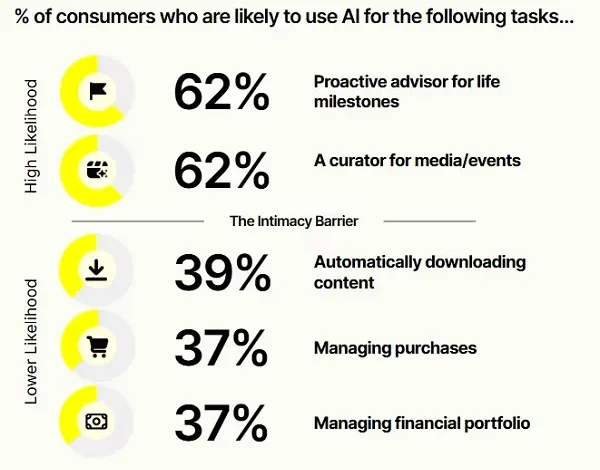
Despite the high levels of trust users place in AI chatbots for personal use, the report addresses the lingering anxieties surrounding financial management and online security. Consumers remain notably hesitant to allow artificial intelligence systems to manage personal finances, execute direct purchases, or oversee sensitive banking tasks without direct human oversight.
However, Snapchat argues that consumer boundaries regarding data privacy are far more fluid than conventional wisdom suggests. The report introduces a nuanced framework regarding modern digital privacy, explicitly stating that privacy is no longer treated as an absolute right, but rather as a sliding scale based on utility and convenience.
"Consumers aren’t asking, ‘Is this private?’ They’re asking, ‘Is this worth it?’" the report notes. "The reality is that users will willingly trade data for personalized AI experiences when the immediate value is obvious. But that value exchange has boundaries."
This acknowledgment touches upon a foundational economic model of the modern internet: the willingness of users to exchange personal data in return for free, high-utility digital services. While social media platforms have operated on this implicit contract for decades, Snapchat’s explicit framing provides a rare corporate validation of this trade-off as a strategic mechanism to drive enterprise AI adoption.
The Contradiction: Consumer Resistance to Ads and Soulless Content
Even as Snapchat outlines a framework where users willingly trade privacy for value, the report’s concluding data points reveal a sharp contradiction in consumer sentiment. While individuals appreciate AI as a private sounding board, they draw a firm line when artificial intelligence intersects with commercial advertising and content creation.
According to the data, 70% of consumers find the use of personal data in hyper-personalized AI-driven advertisements to be intrusive. Furthermore, 56% of respondents characterized 100% AI-generated content as "soulless." This creates a fascinating and complex dichotomy for platforms, advertisers, and developers alike.
On one hand, users are increasingly comfortable engaging in deep, data-sharing conversational loops with AI chatbots if the immediate utility is apparent. On the other hand, they reject the commercial exploitation of that same data profile for targeted marketing and express fatigue toward entirely synthetic media flooding their feeds.
Fact-Based Analysis and Broader Industry Implications
The implications of Snapchat’s report extend far beyond the app’s user base, offering critical insights for the broader technology and advertising sectors.
-
The Redefinition of Digital Trust
Trust in the digital age is becoming hyper-contextualized. Consumers trust AI when it acts as an extension of their own agency—helping them draft messages, organize thoughts, or plan weekend events. Conversely, they distrust AI when it acts on behalf of corporate entities, such as through targeted advertising or automated brand interactions. Technology companies must navigate this delicate boundary, ensuring that AI tools remain user-empowering rather than user-exploitative. -
The Advertising Conundrum
For digital platforms reliant on ad-based business models, the 70% disapproval rate for hyper-personalized AI ads presents a significant strategic hurdle. As consumers become more protective of how their data informs commercial algorithms, brands will need to find innovative ways to deliver relevant advertising without crossing the threshold into perceived intrusion. -
The Future of Human-AI Interaction
The normalization of AI as a judgment-free coaching space indicates that future software design will increasingly lean into emotional intelligence and conversational empathy. As younger demographics grow up interacting daily with chatbots, the social stigma surrounding digital companionship is rapidly dissolving. This cultural shift will likely accelerate the demand for personalized, highly responsive AI agents across education, mental health support, and professional collaboration.
Conclusion
Snapchat’s "Navigating the Age of AI" report captures a pivotal moment in the maturation of artificial intelligence. As daily adoption rates soar past nearly half of all consumers, the relationship between humans and machines is evolving from functional utility to intimate psychological collaboration.
Yet, the study serves as a cautionary reminder that user acceptance is not unconditional. While consumers are willing to trade personal information for immediate conversational and creative value, they draw a strict boundary against intrusive advertising and uninspired synthetic content. As the technology continues to evolve, the companies that succeed will be those that respect this fragile equilibrium—fostering genuine creativity and private utility while safeguarding user trust against commercial overreach.
Related posts: