Sharmistha Rays Geometry of Play Marks a New Era for Public Art and Civic Engagement at Pittsburghs Arts Landing

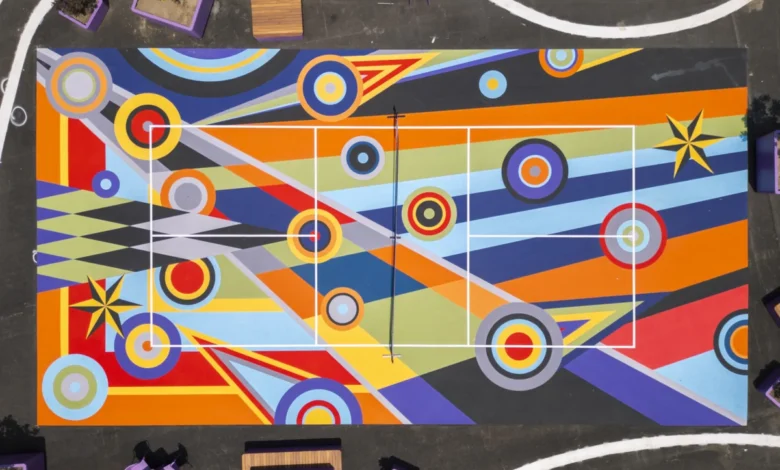
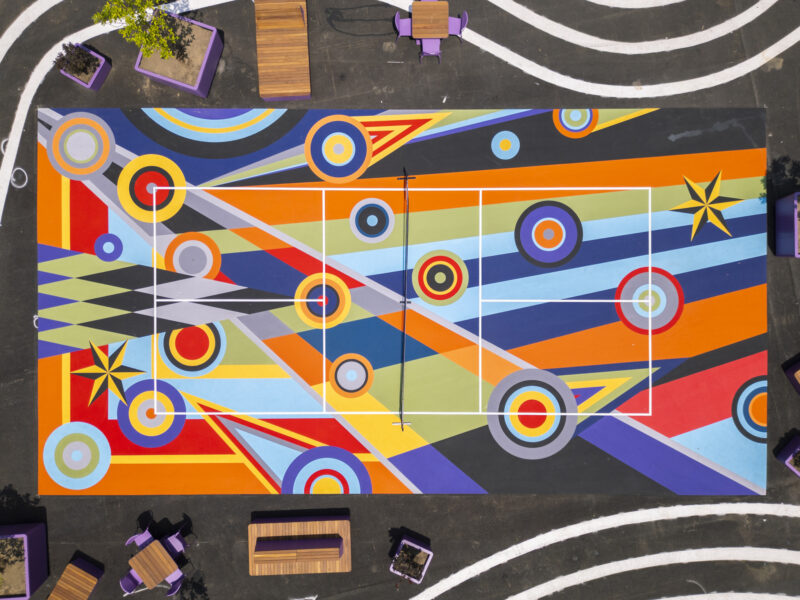
The city of Pittsburgh has officially unveiled its latest landmark in the Cultural District, a $31 million civic space known as Arts Landing, featuring a centerpiece installation that merges the boundaries of fine art and public recreation. Sharmistha Ray, a multidisciplinary artist whose work frequently explores the intersections of identity and abstraction, has transformed two functional pickleball courts into a massive, playable mural titled Geometry of Play. The project represents a significant milestone in the Pittsburgh Cultural Trust’s long-term vision for urban revitalization, marking the city’s first artist-designed sports surface. Unlike traditional public sculptures meant for distant observation, Ray’s commission invites the public to physically inhabit the artwork, turning every athletic match into a live, kinetic performance that activates the geometric composition.
The Architectural and Artistic Vision of Geometry of Play
Geometry of Play is situated within the newly developed Arts Landing, a sprawling riverside gathering space designed by the renowned landscape architecture firm Field Operations. The firm, famous for its work on New York City’s High Line, conceptualized Arts Landing as a multi-functional environment where performance, art, and ecology converge. Ray’s contribution utilizes the standard dimensions of a pickleball court—20 by 44 feet—as the structural framework for a complex visual narrative.
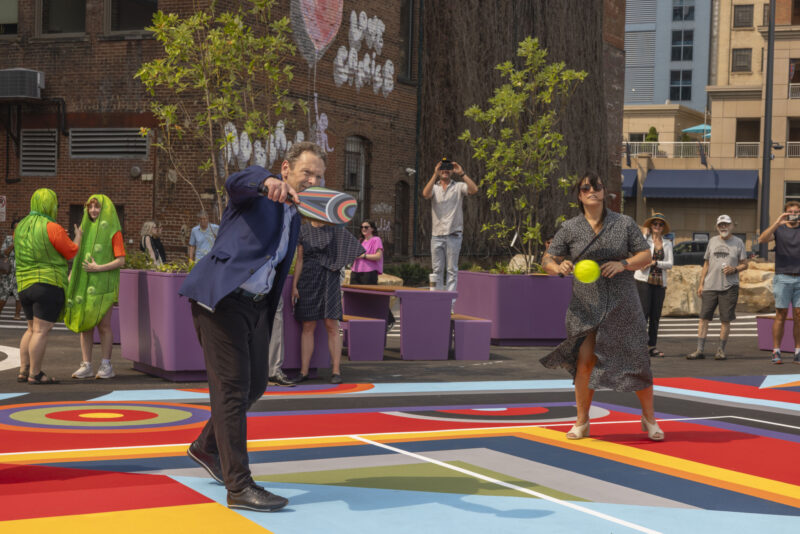
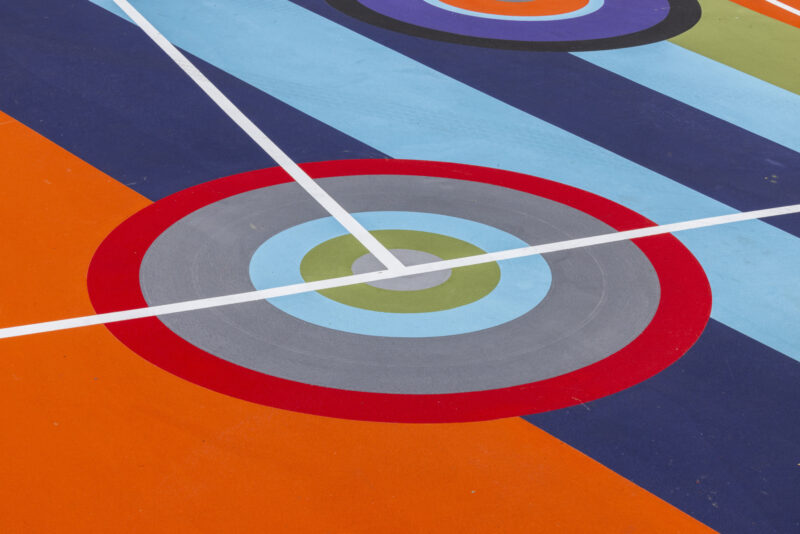
The mural is characterized by a kaleidoscopic array of interlocking circles, triangles, and grids. Ray’s palette utilizes the full ROYGBIV color spectrum, a choice intended to symbolize radical inclusion and diversity. The design logic is rooted in the history of board games, specifically the Indian game of Pachisi. By layering these ancient visual structures onto a modern sports court, Ray creates a bridge between traditional South Asian cultural heritage and contemporary American leisure. The result is a surface that shifts visually as players move across it; the perspective of a spectator looking down from an elevated vantage point differs significantly from that of a player standing within the "kitchen" of the pickleball court.
Historical Context and Cultural Inspiration
To understand the depth of Geometry of Play, one must look at the history of the games that inspired it. Pachisi, often referred to as the "national game of India," dates back to the 4th century. It was traditionally played on a cross-shaped cloth board, where the movement of pieces was dictated by the throw of cowrie shells. In the late 19th century, the game was adapted and patented in the United States as Parcheesi.
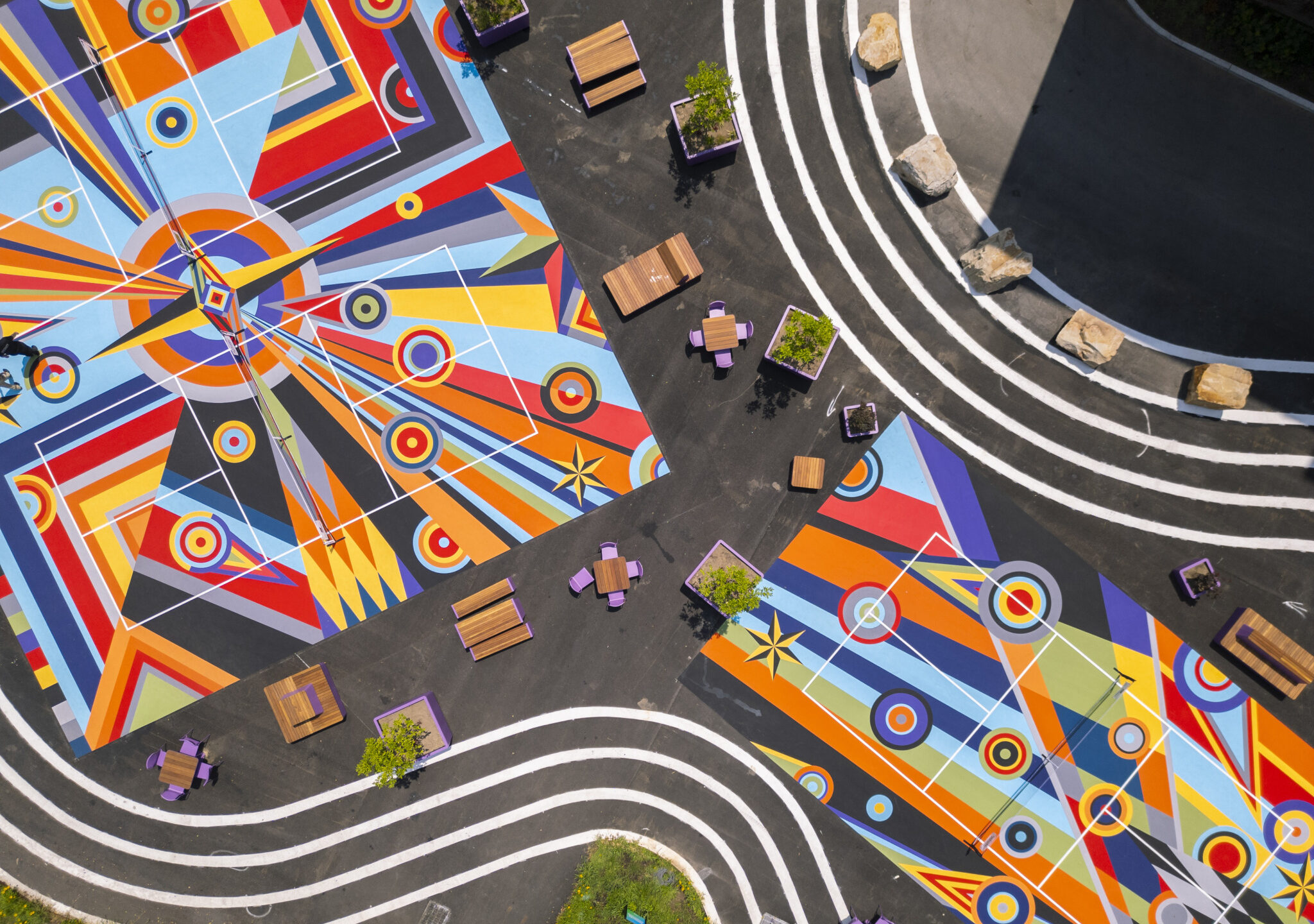
Ray’s use of these motifs is not merely decorative but deeply personal. Born in Kolkata and raised in Kuwait before relocating to the United States, Ray’s practice is a constant negotiation of "belonging." By placing the logic of an ancient Indian game at the heart of a quintessentially American urban renewal project, the artist highlights the fluidity of cultural exchange. The "pathways" and "grids" in the mural serve as metaphors for the journeys taken by immigrants and the structured environments they must navigate in new lands. This thematic depth elevates the installation from a simple beautification project to a sophisticated commentary on the global movement of people and ideas.
The Rise of Pickleball as a Tool for Urban Placemaking
The decision to feature pickleball courts as the canvas for Ray’s work is a strategic response to current demographic trends in American recreation. According to the Association of Pickleball Professionals, more than 36.5 million people played the sport in the United States between 2022 and 2023. Its rapid growth is attributed to its accessibility across age groups and its inherently social nature.
By integrating high-concept art with the country’s fastest-growing sport, the Pittsburgh Cultural Trust is engaging in "tactical urbanism"—the use of short-term, low-cost interventions to catalyze long-term change in the built environment. While the Arts Landing development was a high-capital project, the mural itself serves as the "active" layer that ensures the space remains populated. When the courts are in use, the players become part of the art, their movements echoing the "Geometry of Play" intended by the artist. This synergy between the static mural and the moving participants creates a "shared civic space" that functions as both a gallery and a community center.
Chronology of the Arts Landing Development
The journey toward the completion of Arts Landing and the unveiling of Ray’s mural spanned several years of planning and construction:
- 2021 – Project Inception: The Pittsburgh Cultural Trust announced plans for a major expansion of the Cultural District’s waterfront, aiming to connect the urban core with the Allegheny River.
- 2022 – Design Selection: Field Operations was commissioned to lead the landscape architecture, with a mandate to incorporate significant public art components.
- 2023 – Artist Commissioning: Sharmistha Ray was selected from a competitive pool of international artists to design the recreation area. Ray’s proposal stood out for its ability to integrate the functional requirements of a sports court with a complex aesthetic theory.
- Early 2024 – Construction Phase: The $31 million site underwent extensive environmental remediation and structural development.
- June 2026 – Grand Opening: Arts Landing officially opened to the public. Geometry of Play was unveiled alongside seven other major commissions, drawing thousands of residents and tourists to the Cultural District.
A Multi-Artist Ecosystem
While Ray’s pickleball courts are a primary draw, they exist within a larger ecosystem of public art at Arts Landing. The Pittsburgh Cultural Trust curated a diverse group of artists to ensure the space reflected a wide range of voices and mediums. The inaugural cohort of artists includes:
- Vanessa German: Known for her "power figures" and spoken-word poetry, German’s work at the site explores themes of healing and ancestral legacy.
- Thaddeus Mosley: The legendary Pittsburgh-based sculptor contributed large-scale wood-inspired bronze works that provide a rhythmic, organic contrast to Ray’s geometric precision.
- Shikeith: An artist who explores the psyche of Black masculinity through film and sculpture.
- Lenka Clayton and Phillip Andrew Lewis: This duo contributed conceptual pieces that challenge viewers’ perceptions of the natural versus the man-made.
- Mikael Owunna and Marques Redd: Their collaborative work combines African cosmologies with advanced digital imaging.
The presence of these artists ensures that Arts Landing functions as a comprehensive outdoor museum. The Pittsburgh Cultural Trust has committed to keeping these inaugural commissions on view for at least one year, with some likely to become permanent fixtures of the city’s skyline.
Technical Execution and Durability
Transforming a playable surface into an artwork requires more than just standard paint. The execution of Geometry of Play involved specialized materials designed to withstand the rigors of athletic use and the volatile weather patterns of Western Pennsylvania.
The mural was applied using high-grade acrylic resins infused with sand to provide the necessary "grit" for player safety and ball bounce. These materials are UV-resistant to prevent the ROYGBIV spectrum from fading under direct sunlight. Furthermore, the lines of the pickleball court—the boundaries, the sidelines, and the non-volley zone—had to be integrated with mathematical precision into Ray’s abstract design to ensure the courts remained compliant with USA Pickleball standards. This intersection of artistic freedom and regulatory constraint is a hallmark of Ray’s interdisciplinary practice.
Broader Implications for Pittsburgh’s Cultural Economy
The completion of Arts Landing and the inclusion of Sharmistha Ray’s work are expected to have a tangible impact on Pittsburgh’s local economy. Urban parks with significant cultural components have been shown to increase nearby property values and drive foot traffic to local businesses. For the Cultural District, which is home to numerous theaters and galleries, Arts Landing serves as a "gateway" that draws in a younger, more active demographic.
Economic analysts suggest that the "Instagrammable" nature of Ray’s mural will play a crucial role in the city’s tourism marketing. In an era where digital presence dictates physical footfall, a colorful, large-scale geometric mural provides the perfect backdrop for social media engagement, further cementing Pittsburgh’s reputation as a hub for contemporary design and innovation.
Official Responses and Community Impact
During the unveiling ceremony, representatives from the Pittsburgh Cultural Trust emphasized the project’s role in democratizing art. "Public art should not be a monologue; it should be a conversation," noted a spokesperson for the Trust. "Sharmistha Ray has given us a space where the conversation happens through movement, through play, and through the simple act of gathering."
Local residents have already begun to utilize the space. Early reports indicate that the pickleball courts are booked through the city’s reservation system weeks in advance. For many, the appeal lies in the novelty of the environment. "Playing here feels different than playing at a gym," said one local athlete during the opening week. "You feel like you’re part of something bigger, something creative. It changes the energy of the game."
The Future of Sharmistha Ray’s Practice
Geometry of Play is the latest in a series of high-profile commissions for Sharmistha Ray. The artist’s recent portfolio includes a massive installation at New York’s Grand Central Terminal and a forthcoming project for the new terminal at Pittsburgh International Airport. Ray’s ability to scale their work from intimate paintings to massive civic infrastructure has made them one of the most sought-after voices in contemporary public art.
Their collaboration with Grammy Award-winning musician Arooj Aftab, which features animated geometric works set to an original score, further demonstrates Ray’s commitment to interdisciplinary experimentation. As Ray continues to explore the "geometry of belonging," projects like the Arts Landing mural serve as a blueprint for how art can serve the public good while maintaining a sophisticated intellectual foundation.
Conclusion and Access Information
Arts Landing represents a successful fusion of landscape architecture, public policy, and creative expression. By commissioning Sharmistha Ray to reimagine the pickleball court, the Pittsburgh Cultural Trust has created a precedent for how cities can utilize recreation to foster cultural literacy. Geometry of Play is not just a place to play a game; it is a testament to the power of color, history, and geometry to transform a concrete slab into a vibrant community anchor.
Arts Landing is located in the heart of Pittsburgh’s Cultural District along the Allegheny riverfront. The site is free and open to the public daily from 7:00 a.m. to 10:00 p.m. While the pickleball courts are open for walk-in play, organized groups and those wishing to guarantee a time slot are encouraged to check the Pittsburgh Cultural Trust’s website for reservation details. As the mural remains on view through the coming year, it stands as a colorful reminder that in the modern city, the lines between work, play, and art are increasingly—and beautifully—blurred.