Wangari Mathenge Explores Cultural Memory and Kenyan History in New York Solo Exhibition Re-membering at Lévy Gorvy Dayan

Memory is rarely a passive exercise in looking backward; rather, it often functions as an active process of gathering, reconstructing, and critically examining what history leaves in its wake. This central premise serves as the driving force behind Re-membering, the inaugural solo exhibition of multidisciplinary artist Wangari Mathenge at Lévy Gorvy Dayan in New York City. Running through October 24, 2026, the exhibition showcases five newly created paintings alongside the artist’s first publicly exhibited sculptures. This ambitious body of work significantly expands upon a conceptual and visual series that Mathenge initiated in 2024, pushing her artistic vocabulary into three-dimensional spaces and deeper historical inquiries.
Main Facts of the Exhibition
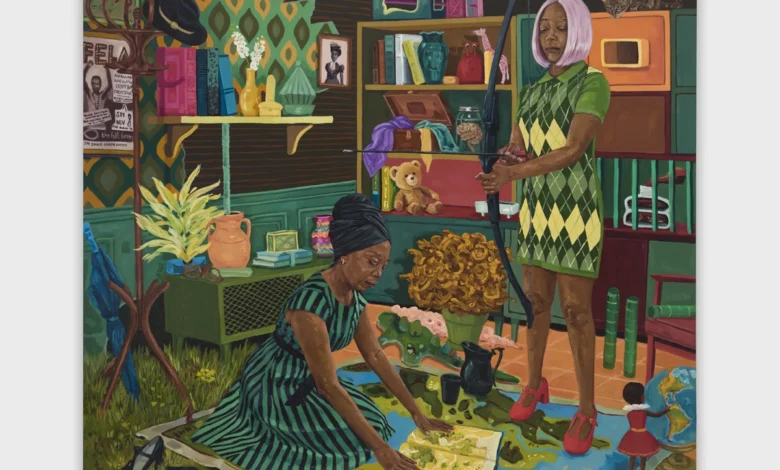
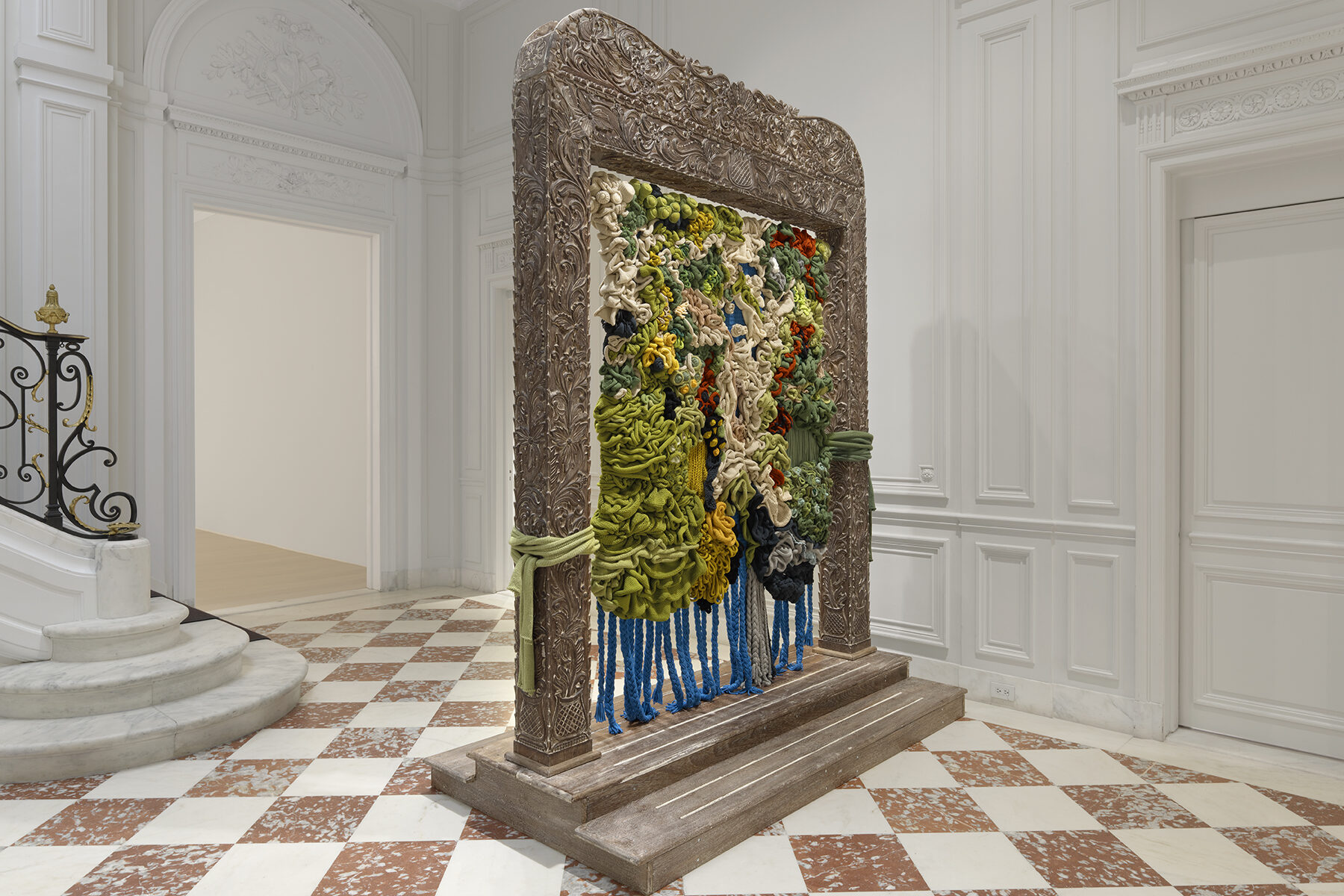
The exhibition is hosted at Lévy Gorvy Dayan, located at 19 E. 64th St. in New York City, a prominent venue known for presenting contemporary art of international significance. Re-membering brings together a focused selection of large-scale paintings—such as Re-membering XIII (May the Wind Be Always at Your Back) and Re-membering XII (The Wednesday Women’s Club)—and groundbreaking sculptural pieces, including Re-membering VIII (Before Us, After Us, Ever Changing) and Re-membering IX (The Shape of Inheritance).
The core of the exhibition investigates the complexities of Kenyan history, cultural inheritance, colonial impacts, and personal identity. By utilizing women as avatars for herself, Mathenge populates vibrant, richly layered domestic interiors set in the 1960s. These environments are packed with an eclectic mix of vintage-style decor, patterned walls, books, toys, and cultural markers. Through these meticulous compositions, Mathenge explores how domestic spaces can serve as archives of psychological and cultural history.
Chronology and Intellectual Framework
The conceptual foundation of Re-membering traces its roots to Ngũgĩ wa Thiong’o’s influential 2009 book, Something Torn and New: An African Renaissance. Mathenge’s artistic research began years prior with an exhaustive study of Kenyan colonial literature and cultural artifacts dating from 1900 to 1963. The terminal date of 1963 holds immense historical weight as the year Kenya officially gained its independence from the United Kingdom, ending decades of British colonial rule that profoundly altered the nation’s social, political, and cultural landscape.
By investigating this specific historical corridor, Mathenge interrogates the ways in which both official histories and her own personal cultural identity have been constructed. In her earlier phases, this inquiry manifested primarily through contemplative canvases. However, her latest evolution shifts that investigation decisively from contemplation toward active reconstruction. The works on display in New York represent the culmination of this multi-year research trajectory, translating historical critique into tangible material forms.

Defining "Re-membering"
To fully grasp the scope of Mathenge’s current exhibition, one must examine the specific linguistic and conceptual weight she assigns to its title. As the artist articulates, the term signifies far more than simple recall.
"Re-membering signifies not merely the act of recall, but the active gathering and reassembly of what has been fragmented: cultural memory, inherited forms, histories, and ways of seeing," Mathenge explains.
This philosophy manifests physically in her debut sculptural works, where history is literally put back together using collaborative and traditional methodologies. For instance, Re-membering VIII (Before Us, After Us, Ever Changing) merges a hand-carved wooden doorframe crafted by traditional artisans in Malindi, Kenya, with a densely embellished macramé textile. While the doorframe pays homage to the intricate architectural woodcarvings historically found in Lamu Old Town, the macramé textile—created with the collaborative assistance of Mathenge’s family and community members—evokes an imagined, fluid landscape that refuses to remain static.

Similarly, Re-membering IX (The Shape of Inheritance) utilizes clothing as a primary medium. Displayed on a dress form, a voluminous knitted sculpture reinterprets historical Gikuyu dress while boldly incorporating colonial fashion markers, such as the Victorian bustle and train. Much like her textile work, community members actively participated in the knitting process. This communal production transforms the artwork into a living dialogue about how cultural traditions and colonial impositions are inherited, negotiated, and carried forward rather than preserved in a museum-like stasis.
Supporting Data and Context of the Venue
Lévy Gorvy Dayan has established itself as a major platform for rigorous contemporary art dialogue, bridging historical movements with contemporary global perspectives. Mathenge’s exhibition arrives at a time of heightened international institutional interest in artists from the African diaspora who re-examine colonial histories through figurative and conceptual practices.
The inclusion of sculpture alongside painting marks a pivotal milestone in Mathenge’s career. By moving off the canvas, the artist scales up her engagement with physical space, inviting viewers to navigate thresholds, textiles, and forms that mirror the fractured yet resilient nature of post-colonial identity. The geographic span of the exhibition’s production—incorporating artisanal labor from Malindi and communal efforts alongside studio work in the United States—underscores a transnational network of making that mirrors the globalized realities of modern identity.

Official Responses and Critical Perspectives
While commercial galleries typically present concise promotional material, the critical reception and curatorial framing of Re-membering emphasize its departure from traditional historical representation. Rather than treating history as a fixed artifact to be faithfully replicated or visually cataloged, Mathenge treats historical archives as raw material for ongoing creative labor.
Art critics and cultural theorists noting the exhibition have highlighted how Mathenge utilizes the domestic interior not as a space of confinement, but as a theater of reclamation. The women populating her 1960s interiors are active agents, surrounded by literature, toys, and mid-century consumer goods that signal a newly independent nation grappling with modernity. The presence of colonial remnants—such as Victorian dress elements juxtaposed with indigenous Gikuyu forms—points to a complex synthesis rather than a simple narrative of resistance. It acknowledges that post-colonial identity is built from an amalgamation of indigenous heritage and historical impositions.
Broader Impact and Historical Implications

Wangari Mathenge’s exhibition arrives at a critical juncture in contemporary art history, where the politics of memory, decolonization, and cultural restitution occupy the forefront of global discourse. By framing her artistic practice around the concept of "re-membering," Mathenge offers a constructive model for addressing historical trauma and cultural displacement.
The broader implications of the exhibition extend into how cultural institutions and contemporary creators handle archival research. Mathenge demonstrates that engaging with colonial archives does not require mere illustration of past injustices; instead, it can serve as a catalyst for community-engaged creation, material experimentation, and psychological healing. By involving family and community members in the physical crafting of her sculptures, she democratizes the process of historical reconstruction, asserting that cultural memory belongs to the collective rather than the individual author alone.
As visitors navigate the rooms of Lévy Gorvy Dayan through October 24, 2026, they are confronted with an artistic vision that refuses easy categorizations. By collapsing the boundaries between painting and sculpture, private domesticity and public history, past inheritance and present agency, Wangari Mathenge cements her position as one of the most vital conceptual voices in contemporary art. Re-membering ultimately stands as a testament to the resilience of cultural forms, proving that what has been fractured can be consciously, beautifully, and powerfully reassembled.
Related posts: