Native Instruments Collaborates with A. G. Cook to Launch Super*Saw Software Synthesizer

Native Instruments has officially announced the release of Super*Saw, a specialized software synthesizer developed in close partnership with influential British producer and PC Music founder A. G. Cook. The instrument, which represents the culmination of a two-year research and development cycle, is designed to distill Cook’s signature "supersaw" production techniques—previously requiring complex multi-synth layering and intricate signal routing—into a streamlined, single-plugin architecture. By consolidating these high-density electronic textures into a unified interface, Native Instruments aims to provide contemporary producers with the specific tools used to define the sonic landscapes of artists such as Charli xcx, Caroline Polachek, Beyoncé, and Oklou.

The release of Super*Saw marks a significant moment in the intersection of avant-garde pop production and commercial music technology. While the "supersaw" sound has been a staple of electronic music since the mid-1990s, its resurgence in the "hyperpop" and experimental pop movements of the 2020s has created a demand for tools that can handle extreme harmonic density without sacrificing clarity or performance flexibility. Native Instruments’ decision to partner with A. G. Cook, often cited as a primary architect of this modern aesthetic, suggests a strategic move to capture a younger, more experimental demographic within the global music production community.
Technical Architecture and Oscillator Design
At the core of Super*Saw is a dual-oscillator bank system, a design choice that deviates from the standard single-engine approach found in many budget synthesizers. Each of the two independent banks is capable of generating up to 16 sawtooth waves simultaneously. In total, a single instance of the plugin can output 32 oscillators, all of which can be manipulated through global and per-voice parameters.

The "supersaw" effect is traditionally achieved by stacking multiple sawtooth oscillators and introducing minute variations in pitch (detuning) and phase. Super*Saw automates and expands upon this process, allowing users to control the "thickness" of the sound through dedicated detune, level, and stereo position controls. This architecture is specifically tuned to replicate the "wall of sound" effect characteristic of Cook’s productions, where synthetic textures often occupy a broad frequency spectrum while maintaining a distinct, glass-like transparency.
Beyond the basic sawtooth generation, the instrument includes advanced harmonic tools. These include chord and scale functions that allow producers to lock the synthesizer’s output to specific musical frameworks. Such features are increasingly common in modern software instruments, serving to bridge the gap between technical sound design and melodic composition. For producers looking to move beyond traditional harmony, the software allows for "controlled deviations," introducing dissonance and microtonal shifts that are frequently utilized in experimental electronic genres to create tension and grit.

The X/Y Morpher and Visual Identity
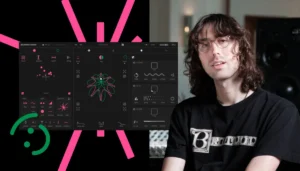
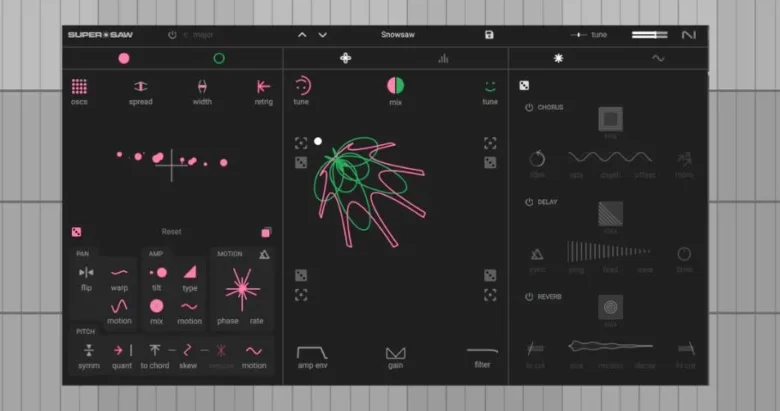
One of the most prominent features of the Super*Saw interface is the four-corner X/Y Morpher. This control system allows users to store four distinct "patch states"—snapshots of all current parameter settings—within a single preset. By moving a cursor across the X/Y grid, the user can interpolate between these states in real-time. This functionality replaces the need for dozens of individual automation lanes in a Digital Audio Workstation (DAW), enabling complex, multi-parameter transitions through a single gesture.
The visual design of the interface was a collaborative effort involving Simon Whybray, a long-term visual collaborator of A. G. Cook. Whybray’s influence is evident in the minimalist yet vibrant aesthetic, which departs from the skeuomorphic designs (software that looks like physical hardware) that dominated the industry for decades. The layout is divided into three primary functional zones: oscillator management, morphing/modulation, and effects processing. This clear segmentation is intended to facilitate a fast workflow, allowing users to move from initial sound generation to final polish without menu-diving.

Development Chronology and Production Context
The development of Super*Saw began in 2024, following internal discussions at Native Instruments regarding the evolution of pop production. The project team was granted access to Cook’s personal production sessions and custom-built patches, which served as the blueprint for the plugin’s DSP (Digital Signal Processing) algorithms.
Over the 24-month development period, the engineers focused on the challenge of "efficiency versus density." Creating a 32-oscillator stack can be taxing on computer hardware, particularly when combined with high-quality filters and effects. Native Instruments reportedly spent a significant portion of the development cycle optimizing the engine to ensure that Super*Saw could be used in multiple instances within a single project without causing CPU overloads.

A. G. Cook’s role in the project was not merely as a brand ambassador but as a lead consultant on the signal path. The goal was to eliminate the "friction" inherent in traditional synthesis. In previous interviews, Cook has noted that his signature sounds were often the result of "brute force" layering—stacking five or six different synthesizers to achieve the desired weight. Super*Saw represents the formalization of that "brute force" method into a refined, professional-grade tool.
Effects, Integration, and Hardware Compatibility
To complement the raw power of the oscillator banks, Super*Saw includes a suite of internal effects tailored for electronic music. These include a high-fidelity chorus, a versatile delay, and a reverb engine capable of producing both intimate spaces and vast, "infinite" washes. The filtering section offers low-pass, band-pass, and high-pass options with selectable two-pole and four-pole slopes, providing the necessary tools to carve out space in a dense mix.

Furthermore, Native Instruments has ensured that Super*Saw is fully integrated into its existing ecosystem. The plugin is NKS (Native Kontrol Standard) compatible, meaning it maps automatically to Komplete Kontrol keyboards and Maschine hardware. This integration allows for tactile control over the X/Y Morpher and oscillator parameters, further blurring the line between software flexibility and hardware immediacy. For live performers, this hardware mapping is a critical feature, allowing for the expressive manipulation of "supersaw" textures on stage.
Market Analysis and Broader Implications
The release of SuperSaw at a $99 price point positions it as a competitive alternative to established wavetable synthesizers like Xfer Records’ Serum or Vital Audio’s Vital. However, while those instruments are marketed as "all-purpose" tools, SuperSaw is a specialist instrument. Its focus on a specific, high-demand sound profile—the modern supersaw—suggests a trend toward "boutique" software instruments that prioritize character and workflow over feature-bloat.

Industry analysts suggest that this collaboration reflects a broader shift in the music technology sector. As the "bedroom producer" market continues to expand, companies are increasingly leaning on the star power and specific "secret sauces" of top-tier producers to differentiate their products. By "packaging" the techniques of A. G. Cook, Native Instruments is selling more than just a synthesizer; they are selling a direct link to a specific, chart-topping aesthetic.
The impact of this release is expected to be felt across various genres. While primarily associated with the PC Music label and the hyperpop movement, the supersaw sound is a foundational element of modern EDM, Trance, and even contemporary R&B. By making these complex layering techniques accessible to the average user, Native Instruments may contribute to a further "harmonization" of pop music, where the high-production-value sounds of major studio releases become increasingly replicable in home environments.

Official Response and Availability
In a statement accompanying the release, Native Instruments highlighted the importance of artist-led development. "Super*Saw is not just a tribute to a specific sound; it is a tool designed for the next generation of creators who value speed, expression, and sonic boldness," the company stated. "Working with A. G. Cook allowed us to look under the hood of some of the most influential pop tracks of the last decade and build an instrument that truly reflects that creative spirit."
The plugin is available for purchase immediately via the Native Instruments website and authorized retailers. It is compatible with both macOS and Windows systems in VST3, AU, and AAX formats. As part of the launch, a series of tutorial videos and artist presets—contributed by Cook and his peers—have been made available to help users navigate the instrument’s unique architecture.

As the digital music landscape continues to evolve, the arrival of SuperSaw stands as a testament to the enduring appeal of the sawtooth wave and the innovative ways in which modern producers continue to reshape the building blocks of electronic sound. Whether used for ethereal ambient pads or aggressive, distorted leads, SuperSaw provides a robust platform for the ongoing exploration of synthetic harmony.
Related posts: