Dreamtonics Completes Its Trilogy with Instrument X, a Neural Acoustic Modelling Platform for Orchestral Instruments

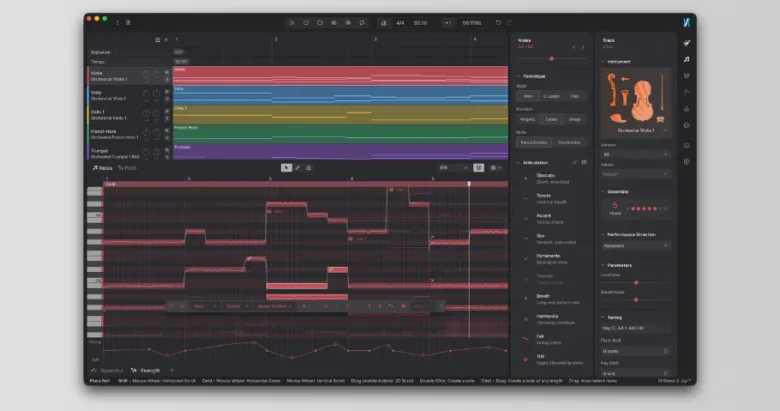
Tokyo-based software developer Dreamtonics has officially announced the release of Instrument X, marking a significant corporate and technological expansion from vocal synthesis into full orchestral scoring. Renowned previously for its advanced vocal synthesis engines Synthesizer V and Vocoflex, the company’s latest offering abandons traditional sample-based production models in favor of a neural acoustic modelling platform. By translating standard musical notation directly into realistic audio, Instrument X provides modern composers, arrangers, and producers with granular control over complex performance nuances—including precise bow movements, breath pressure, and key articulations—without relying on static loop-triggering mechanisms.

The Launch and Technological Foundation
Instrument X debuts with a comprehensive catalog comprising fifteen distinct instrument expansions distributed across three specialized collections. To ensure high expressive versatility out of the box, every included instrument features five distinct emotional style presets: Adagio, Allegro, con Fuoco, Pop, and Ballade. These presets dynamically shift the emotional character and phrasing of a performance to suit various musical genres, ranging from sweeping cinematic scores to contemporary pop productions.

At the core of the platform is a sophisticated neural acoustic engine capable of handling up to eleven simultaneous microphone feeds. This multi-mic capability accommodates traditional studio setups, including close microphones, Decca tree arrays, and ambient room configurations. Maintaining phase coherence and spatial accuracy across these multiple channels traditionally requires massive computational resources or static convolution reverbs. To solve this, Dreamtonics engineered a patent-pending spatial measurement method utilizing a custom-built dodecahedral speaker array. This hardware-software hybrid approach evaluates a recording studio’s physical acoustic geometry, allowing physics-augmented neural networks to cleanly separate the room’s directional acoustics from the dry source audio of the instrument.
Despite the heavy computational demands traditionally associated with neural network audio processing, Instrument X is engineered to run locally on a standard consumer laptop. The architecture requires neither a persistent internet connection nor a dedicated graphics processing unit (GPU), lowering the barrier to entry for mobile producers and working film scorers who require high performance outside of a fixed studio environment.

Background Context and Evolution of Dreamtonics
The launch of Instrument X represents the culmination of years of technological development by Dreamtonics, a company founded by Kanru Hua. Initially gaining critical acclaim within the digital music community for Synthesizer V—a singing voice synthesis software utilizing deep learning to produce human-like vocal performances—the company expanded its ecosystem with Vocoflex, an advanced vocal transformation and morphing tool.

According to Dreamtonics, user demand for instrumental accompaniment within their existing software ecosystem had steadily increased over the years. However, rather than forcing traditional orchestral sample libraries into the already specialized vocal workspace of Synthesizer V, leadership decided to architect an entirely independent environment. This decision ultimately formed the foundational strategy for what the company internally termed its product "trilogy."
Kanru Hua elaborated on the engineering challenges during development, noting that while artificial intelligence-driven audio synthesis provided a reliable technological foundation, scaling it up to meet the rigorous standards of professional orchestral production required a complete architectural redesign. Each instrument family possesses unique physical properties—such as string resonance, woodwind windways, and brass bell projection—necessitating bespoke neural models built from the ground up, even while maintaining a familiar user interface and workflow for existing Dreamtonics software users.

Main Use Cases and Industry Applications
Instrument X has been designed to address several critical bottlenecks in modern music production, film scoring, and game audio development. Primary use cases for the platform include:

- Rapid Cinematic and Orchestral Sketching: Film and television composers working under tight production deadlines can rapidly mock up complex orchestral arrangements with high dynamic realism, bypassing the tedious process of key-switching large multi-gigabyte sample libraries.
- Hybrid Pop and Commercial Production: Producers seeking to integrate authentic acoustic string or brass lines into contemporary pop, hip-hop, or electronic music can utilize the style presets to fit orchestral elements directly into modern mix frequencies without extensive EQ work.
- Educational and Academic Composition: Composition students and educators can visualize and hear notation rendered with realistic articulation, aiding in orchestration studies and score playback.
- Game Audio Integration: Interactive media composers can leverage the local processing efficiency and low resource footprint to prototype dynamic game scores that react fluidly to in-game events without straining system RAM.
Pricing, Evaluation, and Availability
Instrument X is available immediately through the official Dreamtonics online store. The core editor application is provided free of charge to users who purchase any individual instrument expansion, adopting a modular pricing ecosystem common in modern virtual studio technology (VST) markets.

To lower financial risk for prospective buyers, Dreamtonics has implemented a comprehensive trial structure. Users can access a free fourteen-day evaluation of the core Instrument X editor alongside seven-day trials for individual instrument expansions. These trial licenses can be activated instantly within the software’s built-in Product Manager panel, eliminating the need for external activation keys or coupon codes.
Broader Industry Implications

The release of Instrument X arrives at a pivotal moment in music technology, as neural audio synthesis increasingly challenges traditional sample-based paradigms. For decades, virtual orchestration has relied on massive sample libraries—often exceeding hundreds of gigabytes in storage size—that compile thousands of static recordings of individual notes played at various velocities. While these libraries yield high fidelity, they suffer from storage bloat, repetitive phrasing artifacts ("machine-gun effect"), and a lack of continuous transition between articulations.
Neural acoustic modelling offers a compelling alternative by generating audio waveforms based on physical principles and machine learning inference rather than linear playback. If platforms like Instrument X achieve widespread adoption among professional composers, the virtual instrument market may see a shift away from massive storage arrays toward lightweight, highly responsive generative engines. This transition could democratize high-end orchestral scoring, enabling creators with standard portable computer setups to produce expressive, production-ready acoustic arrangements without the hardware overhead historically required for professional composition work.
Related posts: