The manner in which the American public consumes news and stays informed about domestic and global affairs has undergone a fundamental transformation over the past decade. According to a comprehensive report published by Pew Research Center, more than half of all adults in the United States now consider social media platforms to be a vital source of news and current events. This milestone underscores the immense and growing influence that digital networks hold over the modern information ecosystem, shaping everything from casual daily conversation to high-stakes political participation and democratic engagement.
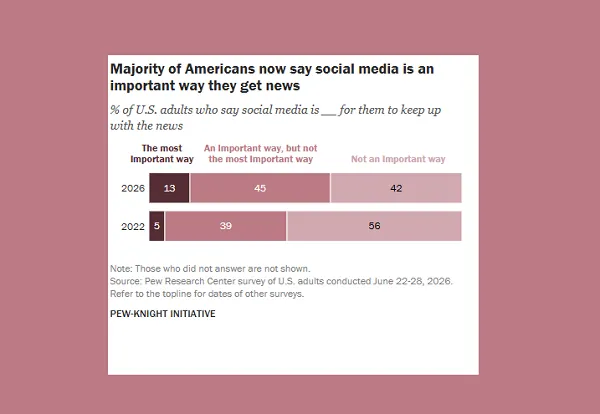
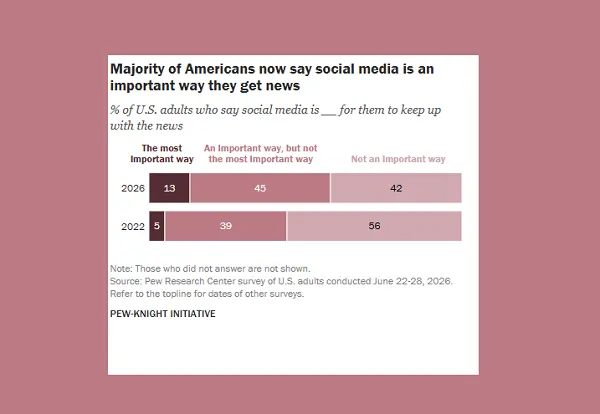
The study, based on a nationally representative survey of more than 3,500 U.S. adults conducted in June, provides a stark numerical representation of this paradigm shift. Data compiled by researchers indicates that 58% of Americans currently view social media as an important connector to ongoing events. More notably, 13% of respondents identify social applications as their primary and most important source of news. Given that the total U.S. adult population stands at approximately 270 million—according to demographic estimates provided by the Annie E. Casey Foundation—these percentages translate to roughly 35 million American adults who rely primarily on social networks to keep them informed, and over 150 million who depend on these channels to some degree.
This represents a substantial escalation from previous tracking data. When Pew Research conducted an identical study in 2022, only 43% of U.S. adults designated social media as an important news vehicle, while a mere 5% pointed to it as their single most important resource. The rapid upward trajectory highlights a structural migration away from traditional print, radio, and linear television broadcasts toward decentralized, algorithmically driven digital feeds.
The Chronology of Algorithmic Governance and the Free Speech Debate
The immense power wielded by social networks to dictate public narratives has transformed content moderation from a routine corporate task into a frontline political battleground. For years, tech conglomerates have grappled with the competing imperatives of protecting open discourse and curbing the proliferation of harmful misinformation.
The timeline of this modern debate is punctuated by several high-profile corporate pivots and regulatory interventions:
- 2021: Meta founder and CEO Mark Zuckerberg publicly acknowledged the inherent structural flaws in social media engagement patterns. In a widely discussed corporate note, Zuckerberg warned that unvetted algorithms naturally incentivize sensationalist and provocative content, drawing parallels to tabloid journalism and cable news. He cautioned that unchecked amplification at scale directly contributes to severe public polarization.
- October 2022: Billionaire entrepreneur Elon Musk completed his high-profile acquisition of Twitter (subsequently rebranded as X) for $44 billion. Musk justified the takeover primarily on free speech grounds, expressing deep concern that previous corporate management teams had engaged in democratic interference by artificially suppressing specific viewpoints and manipulating content visibility.
- January 2025: In a dramatic reversal of corporate policy, Meta announced a formal pivot away from traditional third-party fact-checking frameworks. Zuckerberg argued that major platforms hold an ethical obligation to maximize open discussion, prompting Meta to relax longstanding restrictions on sensitive and controversial cultural topics, including immigration policy and gender identity.
- December 2025: U.S. Secretary of State Marco Rubio formally announced targeted federal actions aimed at combating what the State Department characterized as the "censorship-industrial complex." The government initiative sought to penalize organized networks of activists and entities accused of coercing American technology platforms into suppressing, demonetizing, and censoring disfavored viewpoints.
The Mechanics of Engagement: Why Controversy Drives the Feed
To fully understand why social media’s rise as a news source creates such complex policy challenges, analysts point to the fundamental business models underpinning modern platforms. Unlike traditional newsrooms—which employ editors, fact-checkers, and journalistic ethics boards to curate information—social media feeds are governed by proprietary algorithms designed to maximize user engagement and retention.
Engagement-driven architecture inherently favors content that triggers emotional responses, particularly outrage, indignation, and surprise. As Zuckerberg noted in his 2021 assessment, when algorithms are optimized purely for interaction metrics, borderline, sensationalist, or misleading content frequently outperforms nuanced, fact-checked reporting. At scale, this dynamic distorts reality, creating insular information silos where users are repeatedly fed reinforcing narratives that deepen political and cultural polarization.
When platforms choose a hands-off approach to content moderation—as Meta did in its early 2025 policy update—they effectively delegate the policing of acceptable discourse to the crowd and the algorithms. While proponents of this model argue that maximum openness is the purest form of digital democracy, critics warn that it leaves the information ecosystem entirely vulnerable to bad actors, coordinated influence operations, and the viral spread of unverified claims.
Government Scrutiny and the Rise of the Anti-Censorship Movement
The intersection of national security, democratic integrity, and digital free expression has attracted intense legislative and executive oversight. The concept of the "censorship-industrial complex"—a term popularized by critics to describe coordinated efforts between government agencies, academic institutions, and non-governmental organizations to pressure tech companies into silencing specific viewpoints—moved from political rhetoric to official government policy in late 2025.
When Secretary of State Marco Rubio announced the State Department’s countermeasures, it marked a definitive escalation in the federal government’s involvement in Silicon Valley’s moderation practices. The administration argued that past practices, often framed as combatting misinformation, had devolved into partisan censorship that disproportionately targeted conservative and alternative viewpoints.
This regulatory pressure places technology executives in a precarious position. On one hand, federal authorities are demanding that platforms protect free speech and prevent institutional bias. On the other hand, public health officials, intelligence agencies, and civil society groups continue to warn that an unfettered flow of unverified information poses a clear and present danger to public safety, electoral integrity, and social cohesion.
Implications for the Future of Public Discourse
As the Pew Research data makes definitively clear, social media is no longer a peripheral diversion or a secondary medium for casual entertainment; it is the primary journalistic lifeline for tens of millions of Americans. This reality forces a critical examination of institutional responsibility.
If more than half of the American public relies on digital applications to understand current events, the rules governing those platforms dictate the boundaries of shared reality. When a platform alters its moderation stance—shifting from aggressive fact-checking to an expansive free-speech model, as Meta executed—the downstream effects ripple across elections, public health crises, and legislative debates.
The central paradox facing modern society is formidable: how to preserve the open, democratizing potential of the internet without surrendering public discourse to algorithms that profit on division, polarization, and falsehood. As tech giants navigate shifting political winds and user expectations, the challenge of maintaining a healthy, truth-seeking information ecosystem remains one of the defining trials of the digital age.
Related posts: