Action photography serves as the visual bridge between a fleeting moment and a permanent record, requiring a rigorous synthesis of technical skill, spatial awareness, and anticipation. While the medium has become more accessible through the widespread adoption of high-performance smartphones and mirrorless camera systems, the disparity between a standard snapshot and a professional-grade action photograph remains significant. Achieving high-impact imagery involves more than just rapid shutter speeds; it requires a deliberate approach to composition, gear selection, and an understanding of the physics governing motion.

The Evolution of Action Capture
The technical requirements for action photography have shifted significantly over the past two decades. In the early 2000s, professional photographers relied on bulky DSLRs with limited burst rates, often restricted by buffer speeds and the physical limitations of mechanical shutters. Today, the industry standard has transitioned toward high-speed electronic shutters capable of capturing 30 to 120 frames per second. This shift has altered the chronological approach to capturing events; photographers now have the luxury of selecting the single, most precise millisecond from a stream of high-resolution data.
Despite these technological advancements, the fundamental "walk-up" shot—characterized by a casual, unplanned approach from a standard eye-level perspective—remains the primary culprit for mediocre imagery. Professional analysis suggests that the majority of amateur action shots fail because they prioritize subject capture over environmental storytelling.

Strategic Gear Selection and Technical Parameters
The selection of equipment is dictated by the environment and the subject matter. For field-based sports such as football, baseball, or soccer, the standard industry tool is a 70-200mm f/2.8 lens. This focal length provides the necessary reach to isolate athletes from a complex background while maintaining the wide aperture required for fast shutter speeds. Data from recent sports photography benchmarks indicate that maintaining an aperture of f/2.8 is essential not only for light gathering but for creating the shallow depth of field that separates the subject from the distracting clutter of stadium seating or spectators.
For non-sports action—such as street photography or lifestyle motion shots—the trend has shifted toward ultra-wide-angle lenses, specifically in the 15-35mm range. By utilizing a 15mm focal length, photographers are forced to move closer to the action, which inherently increases the viewer’s sense of immersion. This technical choice transforms the photograph from a distant observation into an experiential document.

The Physics of Motion: Freezing vs. Blurring
The core debate in action photography centers on the choice between freezing a subject in crystalline detail or utilizing motion blur to convey energy. Freezing motion requires shutter speeds often exceeding 1/2000th of a second. This presents a technical challenge regarding light management. To maintain a clean, low-ISO image at such high speeds, photographers must operate in environments with high ambient light or utilize off-camera flash systems to compensate for the brief window the shutter remains open.
Conversely, intentional motion blur—or "panning"—requires a lower shutter speed, typically ranging between 1/30th and 1/60th of a second. The photographer must track the subject’s movement with fluid precision, ensuring the subject remains sharp while the background streaks. This technique effectively illustrates speed, a narrative element that a frozen, "statue-like" image often fails to convey. A sophisticated variation of this is rear-curtain sync flash, where a strobe fires at the end of a long exposure, providing a sharp "ghost" image of the subject at the conclusion of the motion trail.

Compositional Frameworks and Negative Space
Compositional discipline in action photography is defined by the "rule of movement." Standard protocols dictate that the photographer must leave negative space in front of the subject, aligned with the direction of their travel or gaze. This provides the viewer’s eye with a path to follow and prevents the subject from appearing trapped or visually "crammed" against the edge of the frame.
Professional critiques of student portfolios frequently identify the failure to account for this space as a primary technical error. When a subject is moving toward the edge of the frame, it creates a sense of psychological anxiety for the viewer, as the subject appears to be exiting the scene prematurely. Conversely, leaving sufficient lead room provides a sense of progress and anticipation, allowing the viewer to imagine the next sequence of the action.

Pre-Production and Environmental Staging
Professional action shoots are rarely left to chance. The process begins with a reference shot—a practice where a secondary subject or an assistant stands in the intended frame to verify exposure, focus, and composition before the primary action occurs. This practice is crucial in high-stakes environments where the action itself is a one-time event that cannot be repeated.
Focus management is equally critical. Modern camera systems utilize advanced artificial intelligence for subject tracking, yet manual focus locking remains a staple of professional technique. By pre-focusing on a specific point where the subject is expected to transition, the photographer eliminates the "hunting" lag associated with autofocus systems, ensuring the critical moment is captured in sharp focus.

Safety and Environmental Considerations
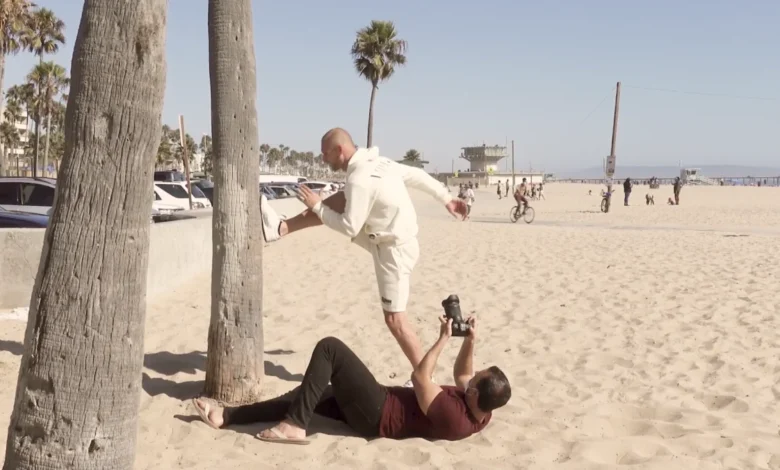
The inclusion of environmental elements—such as sand, water, or debris—can add a tactile dimension to action photos. However, these elements introduce significant risks to sensitive equipment. Professional photographers operating in coastal or rugged environments prioritize weather-sealed bodies and high-quality protective filters. The decision to incorporate flying debris, such as sand in a beach-side flip, is an aesthetic choice that must be balanced against the risk of hardware failure. From a logistical standpoint, the use of protective gear is not merely a preference but an essential investment for any professional working in dynamic, unpredictable conditions.
Implications for Future Creative Work
The democratization of high-end camera technology has created a saturation of imagery, making the differentiator for success less about equipment and more about creative intent. The shift in photography education, moving from purely manual camera settings to "creative frameworks," suggests that the industry is placing a higher premium on vision than on technical perfection alone.

As algorithms in cameras become more proficient at handling exposure and focus, the role of the photographer is evolving into that of a director. The ability to find unique angles—such as shooting from the ground up to incorporate sky as negative space—is what elevates a standard sports photo into a work of art.
In summary, the transition from an amateur to a professional in action photography is marked by the movement from reactive shooting to active orchestration. By understanding the interplay between shutter speed, focal length, and compositional rules, photographers can create images that transcend the limitation of a single frame, capturing the kinetic energy and narrative weight of the subjects they document. Whether through the crisp isolation of a frozen high-speed capture or the dynamic blur of a well-executed pan, the goal remains the same: to communicate the essence of motion with clarity, intent, and artistic precision.