How AI Models Evaluate Brand Reputation and Why Context is the New Frontier of Digital Visibility

The modern digital landscape is shifting from a search-based economy to an answer-based ecosystem. Companies that have spent years mastering search engine optimization (SEO) are now finding that their hard-won visibility is being compromised by the very artificial intelligence tools designed to simplify consumer research. As Large Language Models (LLMs) increasingly act as the primary interface for potential customers, the way these systems process brand reputation has become a critical business imperative. Recent data indicates that without proper context, AI models are prone to over-correcting for risk, effectively sidelining established brands based on isolated negative data points while ignoring the broader reality of their customer satisfaction records.
The Mechanism of AI Risk Aversion
Frontier AI models are programmed with strict safety guardrails, particularly in high-stakes sectors often categorized as "Your Money or Your Life" (YMYL) industries. These guardrails are designed to minimize harm by identifying potential red flags in a company’s history. However, the current methodology employed by many LLMs lacks the nuance of human judgment. When an AI scans the web for reviews or complaints, it frequently treats every negative data point with equal weight, regardless of the company’s operating scale or history.
For instance, a business serving 35,000 customers over 13 years may have five negative reviews and two Better Business Bureau (BBB) complaints. To a human analyst, this represents an exceptional customer satisfaction rate of 99.98%. To an unoptimized AI, however, those seven complaints are processed as distinct indicators of risk. Because the model lacks the "denominator"—the total volume of successful transactions—it often interprets these complaints as a signal to warn users away or steer them toward competitors. This phenomenon effectively punishes established, high-volume businesses for their existence in the public record, while smaller or newer competitors with fewer digital footprints may appear "safer" simply because they have less history for the AI to analyze.
The Data Gap: Contextualizing Performance
The discrepancy between how AI perceives a brand and how a brand actually performs is a direct result of data silos. Most AI models are trained on vast, fragmented datasets. When a user asks, "Do you recommend this company?", the LLM synthesizes disparate sources, often prioritizing controversial or negative content because such data is frequently more prominent or indexed more aggressively by web crawlers.

Controlled experiments have demonstrated that when AI is provided with a "full brand story"—a structured dataset including total customer count, years of operation, and documented resolutions to complaints—the output changes significantly. In a recent case study involving a firm with 75 positive reviews and seven negative occurrences, the AI initially framed the company as a "risky choice" in 64% of test prompts. By injecting structured context via an edge-server worker, the same AI systems shifted their stance. Within 14 days, the AI’s recommendation rate rose to 100%, and the system began explicitly acknowledging the company’s scale and the context of the complaints in its summaries.
Strategic Implementation: The Role of Edge Workers
To bridge this gap, organizations are beginning to deploy "machine-layer" strategies, specifically utilizing CDN (Content Delivery Network) edge workers. These workers function as a bridge between the company’s public-facing website and the bots crawling the internet. By placing an llms-full.txt file at the edge, companies can provide AI models with a comprehensive, verified briefing of their operations.
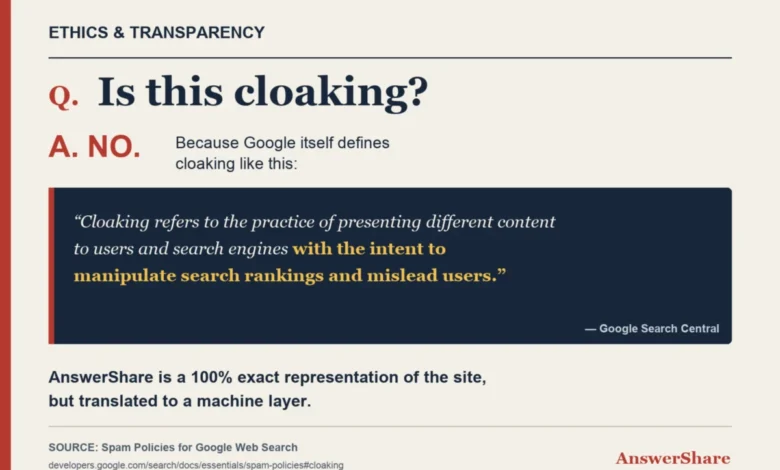
This approach is distinct from "cloaking," which is historically defined by search engines as the deceptive practice of showing different content to users and search bots to manipulate rankings. In contrast, the current methodology involves publishing the same factual, transparent information to the public web that is served to the machine layer. It is an exercise in data accessibility rather than concealment. By organizing information into five key pillars—operating history, service volume, resolution protocols, independent corroboration, and clear attribution—brands can ensure that AI systems have the "denominator" necessary to provide a fair assessment.
Chronology of Reputation Optimization
The process of correcting an AI’s perception is not instantaneous, as it requires the model to re-index and synthesize new data. Observations from recent implementations suggest a three-phase timeline:
- Days 1–3 (Initial Recognition): The AI begins to ingest the new structured data. During this period, the system often displays a "hybrid" understanding, occasionally still citing historical complaints but beginning to include qualifying statements regarding the brand’s scale.
- Days 4–10 (Contextual Integration): The AI begins to prioritize the provided brand context. If a complaint is mentioned, it is increasingly framed within the context of the company’s total customer base or its specific response to that incident.
- Day 14 (Stabilization): The model consistently provides balanced responses that accurately reflect the brand’s reputation. In successful deployments, the AI reaches a point where it acknowledges the company as a recommended option, even when historical complaints remain part of the conversation.
Broader Implications for the Digital Economy
The implications of this shift are profound. With an estimated 205 million active commercial websites and only a small fraction (roughly 2.5%) currently engaged in any form of AI-specific optimization, the market is facing a significant transition. Many companies are currently "hostile" to AI crawlers, inadvertently blocking the very systems that are increasingly responsible for driving consumer behavior.

For professional service firms, luxury retailers, and high-stakes B2B providers, the ability to control the AI narrative is becoming as important as traditional SEO. The evidence suggests that AI models are not inherently biased against successful brands; rather, they are "heuristic followers" that lack the necessary information to interpret performance metrics correctly. By providing the "rest of the story," as it were, businesses can transform AI from a potential critic into a powerful, objective advocate.
Ethical Considerations and Future Outlook
Transparency remains the cornerstone of this strategy. The most effective deployments are those that address negative information head-on, providing direct links to resolutions and clear documentation of company policy. When an AI sees a company acknowledging its own shortcomings—and demonstrating how it corrected them—the model often treats this as a sign of institutional maturity.
As the industry moves toward 2026 and beyond, the focus will likely shift toward standardizing how brands communicate with machine intelligence. The goal is not to "trick" the system, but to ensure that the factual reality of a business is accessible to the algorithms that shape public perception. In an era where a single AI-generated response can determine a customer’s purchasing decision, the ability to "Speak AI" is no longer a niche technical skill; it is a fundamental requirement for modern brand management.
Ultimately, the data suggests that AI models are eager to "get the facts straight." When provided with clear, verifiable, and comprehensive data, these systems are capable of synthesizing complex information to provide nuanced, fair, and highly accurate recommendations. The winners in this new digital environment will be the companies that stop viewing AI as a black box and start treating it as a stakeholder that requires a clear, consistent, and factual briefing.