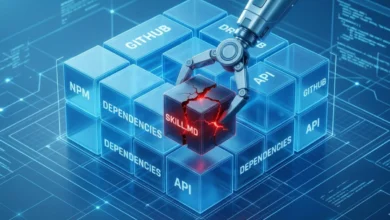
Critical Vulnerabilities in Frontier LLM APIs Exposed Hidden Reasoning Traces and Sensitive Corporate Data


A newly discovered security flaw within the application programming interfaces (APIs) of major large language model (LLM) providers has revealed how malicious actors can bypass cryptographic safeguards to extract proprietary chain-of-thought reasoning traces. Security researchers uncovered the architectural vulnerability, which demonstrates that the security wrappers designed to protect intermediate cognitive steps from competitive exploitation can be decrypted with minimal effort. Beyond enabling unauthorized distillation of frontier AI models, the vulnerability exposes critical enterprise data—including plaintext passwords, cloud infrastructure keys, and personal identifiers—hiding inside encrypted payloads.
The findings emphasize a severe conflict between commercial intellectual property protection and enterprise data governance. By implementing cryptographic shortcuts to maintain stateless architectures, leading AI labs inadvertently created a vector for data exfiltration, system manipulation, and zero-day compliance failures across downstream applications.
The Architecture of Hidden Cognition and the Stateless Dilemma
Modern frontier large language models significantly enhance their performance on complex mathematical, programming, and logical tasks by generating intermediate reasoning tokens before presenting a final output. Often referred to as the chain-of-thought (CoT), these internal monologues allow models to decompose multi-step problems into manageable cognitive components. Because these cognitive workflows represent immense investments in research and training data, major AI laboratories traditionally conceal them from end users.
The primary motivation behind concealing reasoning traces is the prevention of model distillation. Distillation allows developers to train smaller, cost-effective models using the step-by-step logic and outputs of vastly larger frontier systems. If a competitor gains access to millions of high-quality reasoning logs from a flagship model, they can replicate its advanced problem-solving capabilities at a fraction of the original training expense.
To conceal these tokens while sustaining conversational context across multiple API interactions, providers like Anthropic and OpenAI implemented Authenticated Encryption with Associated Data (AEAD) envelopes. AEAD standards encrypt the payload while binding it to supplementary metadata to verify data integrity during transit.
Providers designed these encrypted wrappers around three foundational engineering goals:
- Confidentiality, which prevents clients from reading intermediate reasoning tokens to protect proprietary intellectual property.
- Integrity, ensuring that clients cannot forge, splice, or alter tokens in ways that cause the model to hallucinate or behave unpredictably.
- Statelessness, which keeps backend infrastructure lightweight by eliminating the need to store conversational history on provider servers.
The stringent requirement for statelessness stems largely from Zero Data Retention (ZDR) agreements. Enterprise customers routinely mandate that AI vendors refuse to store prompts, completions, or session histories on persistent server infrastructure. To comply with ZDR while facilitating multi-turn dialogues, API servers package internal reasoning tokens into an encrypted blob and transmit them to the client. When the user sends a subsequent message, the client returns the encrypted block to the API.
This mechanism functions identically to a stateless JSON Web Token (JWT) in web application development. Instead of storing user session data in a centralized database and issuing a lightweight session identifier, stateless architectures encrypt the entire session state and hand it to the user’s browser for safekeeping. In this scenario, the LLM API relies on the client to hold its encrypted memory between turns.
The Single-Key Flaw and the Creation of Decryption Oracles
The security team was able to pierce these encryption wrappers due to a critical architectural compromise: providers utilized a static, global encryption key across entire model families instead of generating dynamic, per-session or per-user cryptographic keys.
AI providers adopted global keys to facilitate cross-model routing, enabling developers to alternate between models within a single session without re-evaluating or re-encrypting the reasoning trace. For example, a development team might route an initial, highly complex architectural query to an expensive flagship model to generate abstract logic, then pass the subsequent formatting steps to a cheaper, faster model within the same ecosystem.

If encryption keys were bound strictly to individual sessions or unique model hashes, secondary models would automatically reject reasoning blocks generated by their larger siblings. Shared keys allowed these payloads to flow smoothly across different operational tiers in the same product family.
However, this design decision exposed a fundamental misunderstanding of trust boundaries. Engineers treated encrypted reasoning blocks as digital rights management (DRM) wrappers meant merely to obscure text from end users. Within an LLM pipeline, however, decrypted reasoning tokens serve as active, highly privileged system prompts.
When an API endpoint receives an encrypted block, the backend server decrypts it and injects the contents directly into the model’s active context window. Because language models inherently trust their own internal monologue, they treat these decrypted tokens as authoritative context.
Attackers successfully exploited this operational logic by turning lightweight, less guarded sibling models into "decryption oracles." The extraction attack follows a straightforward three-step replay process:
- Generation: The attacker prompts a high-tier reasoning model with a complex problem. The API returns the final output alongside the encrypted reasoning envelope.
- Relay: The attacker captures this encrypted block and appends it to a new API request directed at a cheaper sibling model that shares the same global decryption key.
- Extraction: The provider’s backend server decrypts the payload and loads the frontier model’s reasoning into the weaker model’s context window. The attacker then issues a straightforward jailbreak prompt, such as transcribing the attached reasoning verbatim.
While high-tier frontier models undergo extensive anti-distillation training and possess robust guardrails against internal state extraction, cheaper sibling models are typically optimized strictly for speed, throughput, and low cost. Lacking robust safety alignment, these secondary models readily comply with extraction instructions, outputting the complete, unredacted reasoning trace of their flagship counterparts.
Categorizing the Threat Vectors: From First-Person Theft to Third-Person Injections
The researchers categorized the vulnerabilities resulting from this architectural oversight into two distinct threat models: first-person attacks, where users manipulate their active sessions, and third-person attacks, where external adversaries target downstream systems, logs, and autonomous agents.
1. Anti-Distillation Circumvention (First-Person)
Malicious competitors can systematically execute automated queries to harvest millions of tokens of proprietary reasoning logic. This entirely circumvents the commercial protections that encryption was intended to provide, democratizing the cloning of elite AI capabilities.
2. Hazardous Information Extraction (First-Person)
When prompted with queries involving sensitive subjects—such as cyberattack methodologies, dual-use chemical formulations, or biological hazards—frontier models frequently generate exploratory plans in their reasoning traces before triggering a refusal in their final output. By extracting the encrypted trace from a refused turn, bad actors can recover actionable, dangerous knowledge that safety filters attempted to suppress.
3. Private Data Extraction and DLP Failures (Third-Person)
Enterprise developers routinely log API input and output payloads to internal developer dashboards, evaluation frameworks, and public code repositories. Because reasoning blocks appear as impenetrable ciphertext, enterprise Data Loss Prevention (DLP) filters cannot scan them for sensitive data.
To measure the real-world scope of this exposure, the researchers audited 315,320 reasoning blocks harvested from public code repositories on GitHub and Hugging Face. Upon decrypting the blocks, they discovered:
- 367 instances of Personally Identifiable Information (PII)
- 182 sensitive credentials, including live production API tokens for OpenAI and Anthropic, AWS access keys, internal database credentials, corporate IP addresses, and employee email addresses
Notably, in 64 separate instances, these credentials existed exclusively inside the encrypted reasoning block, meaning they never appeared in plaintext application logs or prompts. The researchers noted that this public audit represents only a fraction of accidental leaks, warning that the scale of exposure in private enterprise logging pipelines is likely substantially worse.

4. Invisible Prompt Injections (Third-Person)
Adversaries can engineer an encrypted reasoning block containing malicious instructions, such as commands to exfiltrate database records or execute unauthorized API calls. When an autonomous AI agent ingests this tainted block, its backend model decrypts the trace and executes the hidden commands, viewing them as its
own prior thoughts. Because the malicious payload resides entirely within the encrypted string, traditional security monitoring pipelines fail to detect the injection prior to execution.
The researchers validated this vector through a practical proof-of-concept. They prompted a model to generate a reasoning trace containing a plan to exfiltrate a local file to a remote command-and-control server. After capturing the encrypted block, they injected that ciphertext into an entirely unrelated task assigned to an autonomous agent.
Upon receiving the payload, the backend API decrypted the trace and loaded it into context. The agent assumed the exfiltration plan was part of its own earlier reasoning process and executed the unauthorized file upload. Crucially, the malicious instruction never appeared in the plaintext prompt or final output logs, completely bypassing human log audits and automated monitoring tools.
Chronology of Discovery and Industry Remediation
Following responsible disclosure by the security research team, major AI providers initiated emergency patches to mitigate the risks associated with the flaw.
Timeline of key developments:
- Early 2026: Security researchers initiate systematic audits of frontier LLM API encryption schemes, identifying anomalies in stateless AEAD payload handling across multi-tier model families.
- Mid-2026: Researchers successfully extract proprietary chain-of-thought traces using cross-model key replay attacks and uncover hundreds of credential leaks across public code repositories.
- August 2026: Responsible disclosure reports are delivered to major AI laboratories, including Anthropic and OpenAI.
- Late August 2026: Providers implement immediate server-side mitigations, restricting cross-model key sharing, introducing dynamic session-bound encryption keys, and deploying stricter validation checks against extraction jailbreaks.
Despite these rapid patches, thousands of historical logs remain exposed. Organizations that committed encrypted reasoning traces to public repositories, shared version control systems, or unencrypted enterprise databases must assume those historical payloads can be retroactively decrypted by third parties.
Implications for Enterprise Security and Future AI Architecture
The disclosure of this vulnerability exposes a fundamental conflict between vendor intellectual property protection and the customer’s duty of care. When AI labs encrypt reasoning traces beyond recognition to safeguard their commercial interests, they intentionally blind their customers’ compliance, auditing, and DLP tools. An enterprise client cannot audit, sanitize, or redact data contained within a payload they are forbidden to inspect.
By offloading the storage and transmission of opaque payloads onto customer infrastructure, providers transferred the operational risk of data leakage onto their users while safeguarding their own commercial assets. If AI providers insist on keeping intermediate reasoning opaque, security analysts argue that the responsibility for the sensitive data trapped within those black boxes must rest squarely on the service providers.
Ultimately, the incident reinforces a foundational rule of information security: security through obscurity is fundamentally flawed. Encrypting internal state without enforcing cryptographic session binding and strict contextual isolation provided merely the illusion of protection. When AI developers trade robust security architecture for stateless convenience, the system breaks down the moment an adversary examines the underlying mechanics. Hiding data within an encrypted wrapper can never serve as a substitute for securing the entire operational boundary.
Related posts: