Bridging the Gap: How Google Analytics 4 Transforms Social Media Metrics into Measurable Business Outcomes

In the contemporary landscape of digital marketing, native social media analytics provide brands with a microscopic view of audience engagement, impressions, and likes. However, these on-platform metrics often fail to answer the most critical question for corporate leadership: What happens after the click? As marketing budgets face tighter scrutiny and boards demand quantifiable returns on investment, bridging the gap between social media activity and bottom-line revenue has become an existential priority for enterprise brands.
Recent industry data underscores a significant disconnect in how organizations evaluate their digital footprints. According to the 2025 Impact of Social Media Marketing report, merely 44% of corporate marketing leaders rate their social teams as true experts in measuring tangible business impact. This deficit exists despite social media serving as a primary driver of digital discovery. Globally, social channels account for an estimated 10.12% of all website traffic, a figure that surges to 15.23% in highly digitized consumer markets such as the United States.
To resolve this attribution challenge, digital strategists are increasingly turning to Google Analytics 4 (GA4). By utilizing advanced event tracking, precise source-medium categorization, and custom UTM parameterization, businesses can seamlessly transition from monitoring vanity metrics to tracking comprehensive user journeys that culminate in actual business outcomes.
The Strategic Imperative for Cross-Platform Measurement
For decades, social media managers operated within isolated silos, measuring success through algorithmic reach, follower growth, and post-level engagement. While these indicators remain valuable for creative optimization, they provide little insight into whether a viral campaign actually moves the needle on product sales, software subscriptions, or lead generation.
Integrating social media performance data with Google Analytics alters this dynamic by contextualizing digital outreach within broader organizational goals. According to the 2025 Sprout Social Index, 65% of marketing leaders report that connecting social performance directly to overarching business goals is the single most effective strategy for securing executive buy-in and increased budget allocation.
When configured correctly, Google Analytics allows decision-makers to track visitors from the exact moment they land on a website from a social network through their subsequent navigation patterns and ultimate conversion events. This capability eliminates the guesswork of top-of-funnel marketing, ensuring that mid-funnel content and bottom-funnel sales efforts operate in synchronization. Consequently, marketing executives can construct unassailable ROI models that justify continued capital investment in social channels.
Decoding GA4 Traffic Classification: Organic Versus Paid Social

A foundational step in mastering social attribution within GA4 is understanding how the platform automatically sorts incoming web traffic. Google Analytics distinguishes between unpaid and sponsored traffic based on strict rule-based logic involving source and medium parameters.
Organic social traffic is designated when a user arrives at a website via a non-ad link on a recognized social media platform. GA4 recognizes this either when the traffic source matches a pre-programmed regular expression list of known social networks or when the medium explicitly equals terms such as "social," "social-network," "social-media," "sm," or variants thereof. Typical examples include visitors arriving via an un-tagged Instagram profile link, categorized cleanly as "instagram / social."
Conversely, paid social traffic requires a distinct demarcation between the originating platform and a recognized paid advertising medium. GA4 classifies traffic as paid social when the traffic source matches the social network regex list and the medium simultaneously matches patterns associated with digital advertising, such as "^(.cp.|ppc|retargeting|paid.*)$." This ensures that sponsored campaigns executed on networks like Meta, LinkedIn, or TikTok are properly segregated from organic community-building efforts, allowing for accurate cost-per-acquisition calculations.
Granular Campaign Tracking via UTM Parameterization
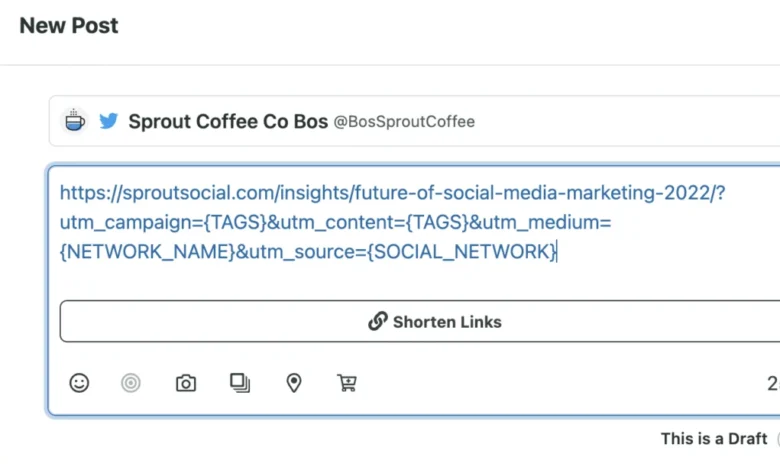
While GA4’s automated classification captures general platform referrals, sophisticated marketing campaigns demand granular tracking down to the individual post, creative asset, and promotional message. This level of precision is achieved through Urchin Tracking Module (UTM) parameters appended to destination URLs.
By adding standardized query strings—such as utm_source, utm_medium, and utm_campaign—marketers can isolate the exact vector driving user behavior. For instance, a promotional link for a seasonal product launch might be structured as:
https://www.example.com/spring-collection?utm_source=facebook&utm_medium=social&utm_campaign=spring_launch
Despite their efficacy, manual UTM tagging presents severe operational bottlenecks. Managing dozens of unique links across multiple social networks, active campaigns, and frequent posting schedules often results in fragmented spreadsheets, naming convention errors, and broken tracking strings. To mitigate this administrative overhead, enterprise marketing software—such as Sprout Social’s native integration with URL-shortening services like Bitly—now enables marketing teams to automatically generate, shorten, and embed clean UTM links directly within the publishing workflow, eliminating manual data entry errors.
Key Performance Indicators for Social Media in GA4

To extract actionable intelligence from GA4, analysts must focus on specific dimensions and metrics that reveal the true quality of social traffic. Rather than evaluating raw visitor volume alone, modern reporting frameworks emphasize user intent, engagement depth, and conversion propensity.
Audience demographics provide the first layer of validation, revealing whether social channels successfully attract the organization’s defined buyer persona by analyzing visitor age, geographic location, and language preferences. Acquisition metrics, specifically session source and medium reports, identify the precise networks and campaigns yielding the highest visitor concentrations.
Web engagement metrics within GA4 offer deeper qualitative insights. Analysts frequently rely on "Sessions" and "Engaged Sessions"—defined as visits lasting longer than 10 seconds, featuring a conversion event, or viewing two or more pages—to filter out accidental traffic and measure genuine audience interest. Furthermore, Average Engagement Time measures the duration users actively spend consuming site content, validating whether the landing page fulfills the expectations set by the initial social post.
Measuring Conversions and Key Events in GA4
The ultimate validation of social media ROI lies in conversion tracking. In GA4 terminology, valuable user actions completed on a website or application are designated as "Key Events" (formerly referred to as conversions), while the term "conversion" is reserved for key events explicitly shared with advertising platforms for automated bidding optimization.
GA4 natively records numerous user interactions, including article reads, product views, form submissions, and shopping cart additions. Organizations can designate any of these standard interactions—or custom events tailored to specific business models—as key events to quantify social media effectiveness. For example, to track newsletter subscriptions or user registrations originating from social channels, administrators must ensure that the recommended sign_up event is actively firing across their digital properties. Once recorded in the analytics property, administrators can navigate to the administrative configuration menu, select the Key Events tab, and toggle the desired interaction to active status. For newly created events not yet visible in recent activity logs, manual registration via the administrative interface ensures seamless tracking from day one.
Implications and Future Outlook for Enterprise Analytics
The convergence of social media marketing and advanced web analytics represents a fundamental maturation of the digital marketing discipline. As privacy regulations tighten, third-party cookies depreciate, and corporate boards demand rigorous accountability, the era of relying solely on superficial platform metrics has officially drawn to a close.
By leveraging Google Analytics 4 to unify disparate data streams, organizations can construct a closed-loop reporting ecosystem. This holistic visibility not only empowers marketing practitioners to optimize their creative messaging and audience targeting in real-time but also equips them with the empirical evidence necessary to secure long-term executive support and budget expansion. Ultimately, the ability to translate social media performance into verifiable business outcomes separates sustainable digital enterprises from those struggling to prove their digital worth.