The Proof of Reality Flywheel: Redefining Social Media Marketing for an Era of Fragmented Trust and AI


The traditional social media marketing funnel, predicated on a linear progression from awareness to consideration and finally to conversion, is increasingly ill-equipped for the complexities of modern consumer behavior. In an age where digital interactions are fragmented, trust is paramount, and artificial intelligence profoundly influences discovery, a new paradigm is emerging. Sprout Social’s "Proof of Reality Flywheel" reframes this conventional model, advocating for a continuous, self-sustaining loop that leverages genuine engagement and human-validated content to build brand confidence, enhance visibility, and drive action. This shift acknowledges that buying journeys are rarely straightforward, often involving extensive research across diverse platforms and a critical evaluation of authenticity.

The Evolution and Erosion of the Traditional Marketing Funnel
For decades, marketing strategies have largely been structured around sequential funnels, with the AIDA (Awareness, Interest, Desire, Action) model being a foundational example. These frameworks posited a predictable customer journey, where brands could guide consumers systematically through stages, often culminating in a purchase. With the advent of the internet and subsequently social media, marketers adapted, integrating platforms like Facebook, Twitter, and later Instagram into various funnel stages. Social media initially served as powerful tools for generating awareness, fostering engagement, and even driving direct conversions through targeted advertising and e-commerce integrations. Brands invested heavily in polished content, broad reach, and clear calls to action, operating under the assumption that a compelling message delivered consistently would lead to predictable outcomes.
However, the digital landscape has undergone a radical transformation. The rise of new platforms, the proliferation of user-generated content, the increasing sophistication of algorithms, and the recent surge in AI-generated material have collectively dismantled the linearity of the traditional funnel. Consumers, particularly younger demographics like Gen Z, no longer rely solely on brand messaging or traditional search engines. Their discovery paths are circuitous, involving a mosaic of touchpoints from influencer recommendations and niche online communities to direct messages and AI-powered assistants. A Sprout Social Q2 2026 Pulse Survey revealed that while traditional search engines remain a common starting point, social media now accounts for a significant 21% of initial searches across all age groups, a figure that narrows considerably among younger consumers who often turn to platforms like TikTok for experiential and visual information.
Why the Conventional Funnel Leaks in the Modern Era

The inherent limitations of the linear marketing funnel become glaringly apparent when confronted with contemporary digital realities:
- Fragmented Discovery and Non-Linear Journeys: The idea of a single, defined discovery path is obsolete. Consumers seamlessly jump between platforms – perhaps encountering a product via a creator on Instagram, then searching for reviews on Reddit, asking an AI assistant for comparisons, and finally receiving a direct link in a private group chat. This multi-touch, non-linear journey makes it impossible for a single-path funnel to capture or influence the entire process effectively.
- Erosion of Trust and the Authenticity Imperative: The digital space is saturated with content, much of it feeling generic, automated, or overtly commercial. The Sprout Social Pulse Survey further highlighted that 56% of consumers frequently encounter AI-generated content on social media, with 83% encountering it at least sometimes. This deluge has led to heightened skepticism. Polished brand messages, once a hallmark of professionalism, are now often viewed with suspicion. What truly resonates and earns attention is content that feels authentic, human, and genuinely helpful – proof that real people are engaging, talking about, and valuing a brand.
- Unpredictable Reach and the "Dark Social" Phenomenon: Platform algorithms increasingly prioritize interest-based feeds over follower feeds, making it harder for brands to consistently reach their owned audiences. Furthermore, when content does resonate, its propagation often moves into "dark social" channels like DMs, WhatsApp threads, or private group chats, where direct measurement is challenging. Public engagement metrics thus offer only a partial view of content’s true reach and impact.
- The Critical Breakdown at Consideration: The consideration stage, where potential buyers evaluate options before making a purchase, is where the traditional funnel most often falters. Consumers are actively seeking validation from trusted, independent sources: recent creator posts, candid discussions on platforms like Reddit, and recommendations from their social circles. If a brand cannot generate this crucial "proof of reality" during this stage, it risks losing potential customers right before they are ready to convert.
Introducing the Proof of Reality Flywheel
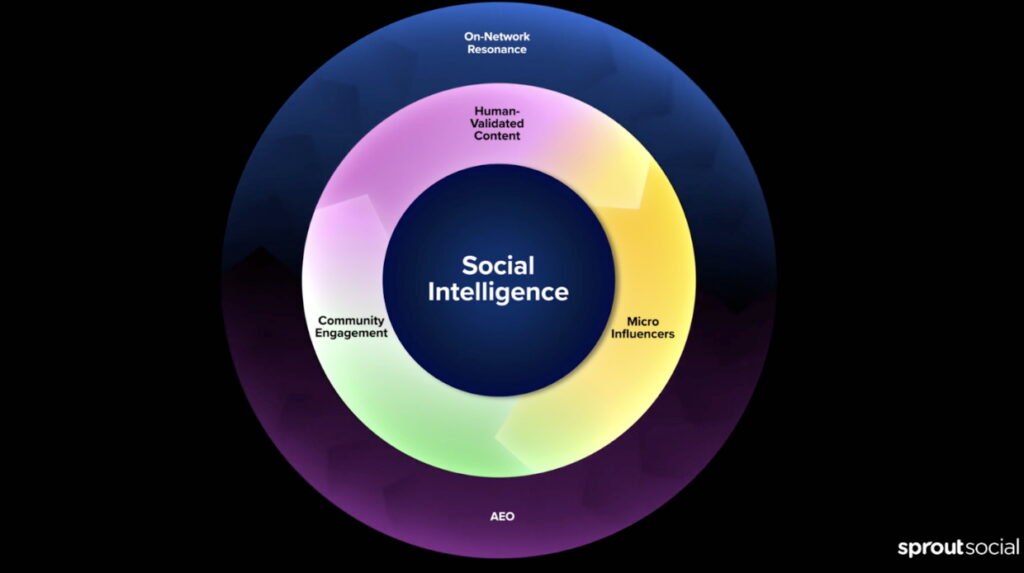
In response to these systemic challenges, Sprout Social has introduced the "Proof of Reality Flywheel." This model moves beyond the linear conversion funnel, reimagining the customer journey as a continuous, self-reinforcing loop. Instead of pushing individuals towards a singular purchase, it transforms genuine engagement into sustained momentum that amplifies across social communities, search results, and AI answer engines. The flywheel is powered by three interconnected stages, each feeding into the next:
- Social Intelligence: This foundational stage involves the meticulous analysis of social conversations, audience sentiment, market trends, and competitive activity. Unlike traditional content strategy that often starts with brand objectives, social intelligence begins with the audience’s real-world questions, debates, and behaviors across communities. These insights then inform content creation, messaging, and distribution strategies, ensuring that every piece of content addresses an actual audience demand, making it inherently more relevant and trustworthy. For instance, analyzing sentiment around competitor products or identifying emerging trends in customer service queries provides actionable data that can shape product development or marketing campaigns.
- Human-Validated Content: With social intelligence as its bedrock, this stage focuses on creating content that passes the audience’s authenticity filter. This means prioritizing credibility over mere polish. Examples include behind-the-scenes videos, practical answers to specific questions, or evergreen resources directly inspired by customer needs. As AI answer engines increasingly draw on social posts for information, content that garners genuine human engagement becomes a potent signal for search and AI discovery. Human validation imbues the flywheel with material worthy of distribution and trust.
- Influence Networks: This stage encompasses the diverse ecosystem of creators, micro-influencers, niche communities, and peer spaces that provide substance beyond a brand’s owned channels. While traditional funnels might rely on broad influencer reach or paid ads for mid-funnel distribution, the flywheel leverages more trusted paths. Relevant creators, with their category-specific authority, offer contextual proof. Platforms like Reddit, fueled by human-moderated communities, allow brands to participate authentically, answering questions and building presence in spaces where purchasing decisions are actively discussed. This engagement, in turn, generates new data points – comments, questions, shares, peer conversations – that feed back into the social intelligence stage, refining insights for the next cycle.
Operationalizing the Flywheel: A Strategic Blueprint

Implementing the Proof of Reality Flywheel requires a fundamental shift in how marketing teams listen, create, distribute, and measure social content.
- Deeply Understand Your Audience Through Advanced Listening: The starting point for a robust flywheel is superior social listening. Before any content is created or channels are chosen, marketers must leverage social intelligence to comprehensively understand audience concerns, preferred platforms, and expectations from brands. This involves analyzing competitor activity, identifying key topics, understanding audience demographics and psychographics, tracking sentiment, and monitoring relevant influencers. Such insights ensure content is grounded in real audience behavior and reveal how social interactions can influence the entire customer journey.
- Connect Social Goals to Broader Business Impact: For the flywheel to generate significant value, social media goals must align with measurable business outcomes beyond marketing. The 2026 Social Intelligence Report by Sprout Social highlighted a significant gap: only 36% of professionals reported that social intelligence regularly informs decisions outside marketing, despite 98% agreeing it helps achieve cross-functional outcomes. By mapping social metrics to KPIs relevant to brand teams (reach, share of voice), marketing leaders (engagement, conversions), customer care (response rate, satisfaction), and product development (sentiment trends, feature requests), organizations can demonstrate the holistic value of social strategy.
- Optimize for On-Network Resonance and Authenticity: Each social platform boasts its own unique content culture. Successful flywheel implementation demands an understanding of these nuances – what formats perform best, what questions users ask, and what types of content earn saves and shares. Prioritizing evergreen utility over fleeting trends ensures content remains valuable over time. The emphasis here is on human-led creative; while AI can accelerate production, genuine perspective and utility are what capture attention.
- Build for AI Discovery and Answer Engine Optimization (AEO): As AI tools like ChatGPT and Google’s AI Overviews become primary sources for recommendations and explanations, optimizing content for AI interpretation is crucial. This involves structuring social posts to answer common questions directly, using clear and concise language, incorporating rich media, and summarizing key takeaways. High-engagement posts and community discussions can significantly influence how AI tools understand and present information about a brand, category, and expertise, creating new discovery pathways.
- Partner with Topically Relevant Creators: In the flywheel model, the efficacy of creator partnerships hinges on topical relevance and authenticity, not just broad reach. Marketers should look beyond follower counts to evaluate creators based on their consistent subject matter, the questions their audience poses, and the communities where their recommendations carry genuine weight. Tools like Sprout Social Influencer Marketing can aid in identifying brand-safe creators aligned with niche topics and audience interests, fostering partnerships that build social proof without eroding trust.
- Invest in Continuous Testing, Iteration, and Measurement: A flywheel-driven strategy necessitates robust reporting that illustrates the interplay between trust, engagement, and AI discovery. Tracking deeper validation signals—shares, saves, comments, sentiment, and community discussions—provides insights into what truly resonates. Utilizing structured tracking tools, such as Sprout Tagging for organizing content by topic or funnel stage, and Custom Metrics for tailored leadership reports, is essential. Furthermore, continuous social listening should inform iterative improvements, allowing teams to refine content strategies and address any misinterpretations by AI answer engines.
Industry Perspectives and Broader Implications

Industry analysts largely concur that the shift from linear funnels to continuous engagement models like the Proof of Reality Flywheel represents a critical evolution in digital marketing. "This isn’t just a tweak; it’s a paradigm shift," notes Dr. Eleanor Vance, a leading digital marketing strategist. "Brands that fail to adapt to this fragmented, trust-centric environment will find their messages lost in the noise. The future belongs to those who prioritize authentic connection and community validation."
The implications for marketing teams are profound. It necessitates a move away from siloed content creation towards integrated strategies where social intelligence informs every aspect of communication. Skill sets within marketing departments will need to expand, emphasizing data analysis, community management, AI literacy, and the nuanced art of fostering authentic online conversations. Budget allocation may shift from purely paid advertising towards investments in social listening tools, creator partnerships, and community-building initiatives. The emphasis will be on long-term relationship building and cultivating brand advocates, rather than solely pursuing transactional conversions.
Conclusion
The traditional social media marketing funnel, designed for a more predictable digital landscape, is no longer fit for purpose. In an era defined by fragmented discovery, a heightened demand for authenticity, and the pervasive influence of AI, a new approach is indispensable. Sprout Social’s Proof of Reality Flywheel offers a compelling framework for this new reality, transforming discrete interactions into a continuous cycle of trust, engagement, and amplification. By leveraging social intelligence to create human-validated content and activating powerful influence networks, brands can cultivate a renewable source of attention and loyalty, ensuring their relevance and impact in the ever-evolving digital ecosystem. The future of social media marketing is not about guiding consumers down a single path, but about empowering a self-sustaining ecosystem of trust and genuine connection.