Alibaba Researchers Introduce SkillWeaver to Solve AI Agent Tool Routing Challenges with Up to 99 Percent Token Reduction


As artificial intelligence systems evolve from simple conversational chatbots into autonomous agents capable of managing enterprise-grade workflows, developers face a critical architectural bottleneck. Modern Large Language Models (LLMs) are increasingly expected to interact with massive, community-contributed tool ecosystems containing thousands of distinct application programming interfaces (APIs), software development kits, and specialized functions. Integrating these expansive libraries into a single prompt creates a severe trilemma: exorbitant financial costs, crippling processing latency, and premature context-window exhaustion.
To confront this systemic challenge, a team of researchers at Alibaba has introduced SkillWeaver, a pioneering framework designed to streamline how AI agents discover, compose, and execute multi-step tasks across vast digital toolsets. At the core of this innovation is a novel methodology known as Skill-Aware Decomposition (SAD), which replaces brute-force prompt stuffing with an iterative feedback loop. By systematically breaking down complex user prompts and dynamically adjusting task granularity to match real-world API boundaries, SkillWeaver achieves up to a 99.9 percent reduction in execution-time token consumption while substantially boosting task completion accuracy.
The Technological Bottleneck of Agentic Tool Routing
To understand the significance of SkillWeaver, one must examine the limitations of current agentic architectures. In contemporary AI engineering, "skills" or "tools" represent the foundational building blocks that allow an LLM to interact with external software environments—ranging from cloud infrastructure management systems and database query engines to financial analysis tools and visualization software. Public registries, such as Model Context Protocol (MCP) repositories, now host thousands of community-contributed skills, transforming the deployment landscape for software developers.
However, accurately routing a user’s natural language query to the correct subset of tools within a sprawling digital library remains an extraordinary challenge. Historically, developers have relied on the ReAct (Reasoning and Acting) framework, an industry-standard paradigm where an AI agent sequentially thinks about a problem, executes an action by calling a tool, observes the resulting output, and decides its next step. While effective for localized tasks, researchers discovered that traditional ReAct loops suffer catastrophic failures when confronted with enterprise-scale tool libraries.

In rigorous testing, standard ReAct architectures registered a zero percent Decomposition Accuracy—a strict metric measuring whether the predicted number of sub-tasks precisely matches the ground-truth requirement. According to Xueping Gao, the lead author of the research paper, the underlying issue is not an inherent flaw in the ReAct methodology itself, but rather its incompatibility with explicit compositional routing across thousands of disparate capabilities.
When developers attempt to solve this by dumping an entire tool catalog into an LLM’s prompt, they inadvertently trigger three distinct systemic failures:
- The Context Problem: Massive token consumption that quickly breaches operational thresholds and spikes API expenditure.
- The Decision Problem: Severe classification noise caused by hundreds of APIs possessing overlapping descriptions but distinct schemas, leading to frequent model confusion.
- The Planning Problem: The inability to reliably manage complex operational sequences, inter-task dependencies, and execution parallelism.
The Mechanics of SkillWeaver and Skill-Aware Decomposition (SAD)
To bypass these hurdles, the Alibaba research team formulated the problem as "Compositional Skill Routing." When presented with a complex, multi-step user prompt and a sprawling library of tools, an autonomous agent must simultaneously execute three distinct phases: decomposing the request into atomic sub-tasks, mapping each sub-task to the most appropriate available skill, and composing those individual skills into a cohesive, executable plan.
SkillWeaver orchestrates this tripartite workflow through three structured stages: Decompose, Retrieve, and Compose.
In the initial "Decompose" stage, a lightweight task decomposer LLM analyzes the user’s prompt, parsing the overarching request into a sequence of logical sub-tasks, each theoretically mapping to a single operational skill. Once these sub-tasks are defined, the framework initiates the "Retrieve" phase, employing semantic search infrastructure to generate a curated shortlist of candidate tools for each individual sub-task.
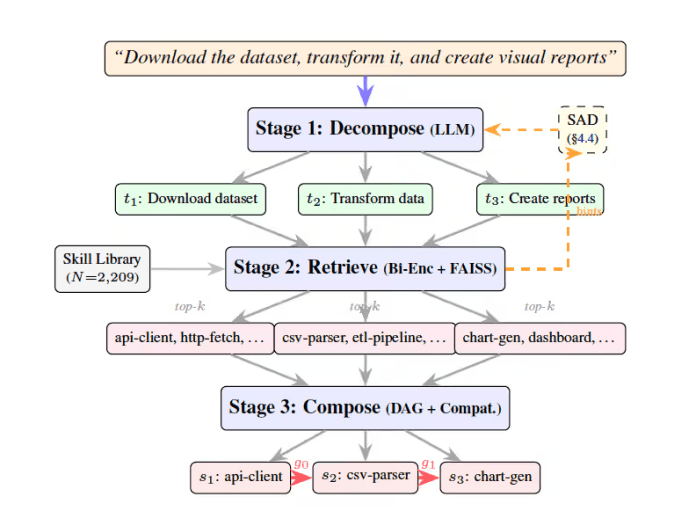
During the final "Compose" stage, an advanced planner evaluates the retrieved candidates based on functional compatibility. This component ensures that the data output of one tool naturally aligns with the input parameters of the subsequent tool in the sequence. The system then compiles the final execution blueprint into a Directed Acyclic Graph (DAG), an architectural schema that explicitly maps out dependencies and allows independent sub-tasks to run concurrently, maximizing computational efficiency.
Addressing the Granularity Mismatch
A profound obstacle in automated tool retrieval is the frequent disconnect between the generalized descriptions generated by an LLM and the strict, technical boundaries of real-world APIs. LLMs often produce vague task descriptions that fail to respect the modularity of the available software ecosystem.
For instance, an AI model might mistakenly group "download and parse a remote file" into a single, monolithic step, even though the underlying skill library provides separate, specialized functions for file-fetching and CSV-parsing. Conversely, the model might commit the opposite error, fragmenting a single HTTP GET request into four microscopic actions—connecting, sending headers, receiving data, and parsing the response—when a single pre-existing API wrapper covers the entire operation.
To resolve this granularity mismatch, SkillWeaver introduces Skill-Aware Decomposition (SAD). Rather than treating task decomposition as a static, one-off event, SAD establishes a dynamic feedback loop. The framework begins with an initial task breakdown, fetches a preliminary set of relevant skill hints from the library, and feeds that specific vocabulary back into a second decomposition pass.
As Xueping Gao noted during discussions regarding the research, these hints provide empirical evidence regarding the capability boundaries that actually exist within the system. Consequently, the model is not merely asked to self-correct its original assumptions; it is forced to restructure its problem-solving strategy in direct alignment with the operational vocabulary of the available tools.

Empirical Evaluation and CompSkillBench Findings
To rigorously validate SkillWeaver under realistic conditions, the Alibaba researchers engineered a specialized benchmark known as CompSkillBench. This evaluation suite comprises 300 complex, multi-step user queries spanning varying degrees of difficulty. To replicate authentic enterprise production environments, the team coupled the benchmark with a registry containing 2,209 genuine, production-grade skills harvested from public MCPs, distributed across 24 functional categories including cloud computing, database administration, and financial engineering.
The core computational engine utilized a highly efficient, lightweight 7-billion parameter model (Qwen2.5-7B-Instruct) for task decomposition, paired with a standard semantic search retriever (MiniLM utilizing a FAISS index) for tool identification.
Performance was benchmarked against three established baselines:
- An "LLM-Direct" brute-force method where all tool identifiers were stuffed into the prompt of a frontier model.
- A vanilla LLM-based decomposition process operating without the SAD feedback loop.
- A conventional ReAct-style "think-act-observe" agent loop.
The experimental data revealed striking insights regarding model scaling and decomposition accuracy. Operating under the vanilla setup without SAD, the 7B model achieved a decomposition accuracy of just 51.0 percent. However, activating the SAD feedback loop drove overall accuracy up to 67.7 percent. For highly complex tasks requiring the orchestration of four to five distinct skills, SAD yielded a staggering 50 percent improvement in task completion accuracy.
Counterintuitively, the study demonstrated that unguided larger models can often underperform smaller counterparts. When tested with a 14-billion parameter model in a vanilla configuration, accuracy fell below that of the 7B model because the larger architecture suffered from severe "over-decomposition," breaking workflows down into excessive, unnecessary micro-steps. However, the introduction of SAD successfully anchored the larger model by grounding its planning phase in retrieved tool hints. This finding suggests that aligning an agent’s internal vocabulary with its operational environment is far more impactful than merely scaling up model size and computational expense.

Significant Implications for Enterprise AI Deployment
Beyond accuracy gains, the architectural shift introduced by SkillWeaver delivers profound economic and operational benefits through token reduction.
Under the brute-force "LLM-Direct" baseline, exposing an agent to all 2,209 tools simultaneously required approximately 884,000 tokens per query. In contrast, SkillWeaver’s targeted retrieve-and-route mechanism restricted execution-time tool context to roughly 1,160 tokens per query—representing a reduction of over 99 percent. While the iterative SAD planning phase introduces a minor, fixed overhead during the initial setup, the reduction in active execution context fundamentally transforms operational efficiency.
Industry analysts emphasize that token reduction in agentic architectures extends far beyond mere API cost savings. By shrinking the active toolset available to an LLM during execution, developers drastically narrow the surface area for potential hallucinations. Fewer irrelevant choices reduce the likelihood of misdirected API calls, resulting in more stable system prompts, predictable execution graphs, and verifiable audit trails that engineers can thoroughly review prior to live deployment.
As organizations increasingly transition from experimental generative AI pilots to deeply integrated autonomous agent workflows, frameworks like SkillWeaver point toward a scalable future. By bridging the gap between expansive, community-driven tool repositories and the cognitive constraints of modern language models, Alibaba’s research establishes a robust blueprint for the next generation of enterprise AI infrastructure.