Native Instruments Introduces Super*Saw: The Revolutionary Synthesizer Co-Created with PC Music Founder A.G. Cook

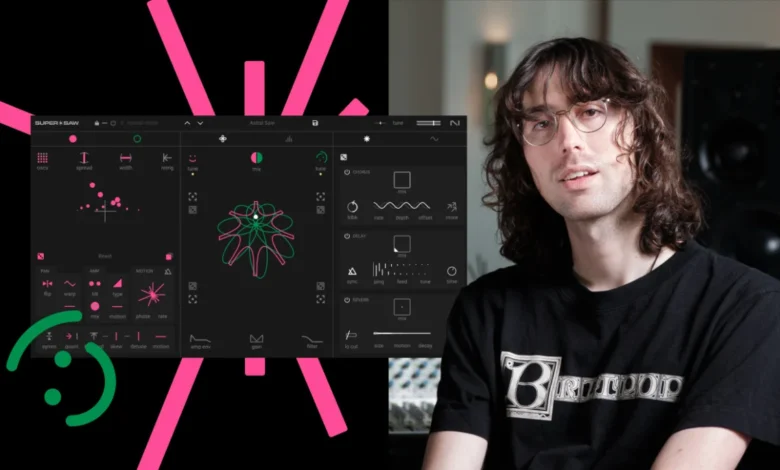
The landscape of electronic music production and modern sound design has long been defined by a select few seminal waveforms, chief among them the stacked sawtooth wave. Emerging prominently from the digital and virtual analog synthesizer revolution of the mid-to-late 1990s, the "supersaw" swiftly transcended its technical origins to become the indisputable driving force behind euphoric trance anthems, commercial pop crossovers, and massive wall-of-sound club records. Bridging this storied past with contemporary software innovation, industry titan Native Instruments has officially announced the release of Super*Saw—stylized and pronounced as SuperStarSaw—a cutting-edge software synthesizer engineered in direct collaboration with visionary record producer, songwriter, and PC Music founder A.G. Cook.
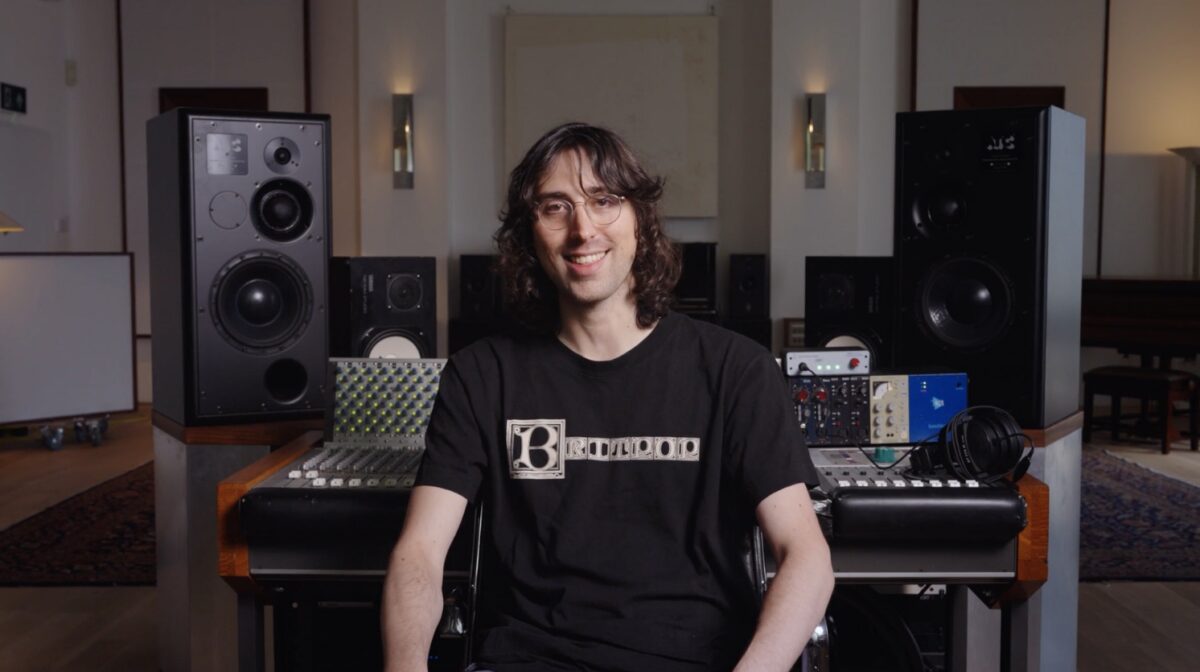
Unveiled to the public following an exclusive media preview and technical demonstration at Baltic Studios in London, Super*Saw represents a major milestone in virtual instrument design. Rather than serving as a static sample library or a generic emulation of vintage hardware, the plugin is meticulously crafted to condense complex, multi-layered stacking workflows into a single, highly expressive, and intuitive software environment. The collaboration marries Native Instruments’ decades of engineering expertise with Cook’s hyper-detailed, idiosyncratic production philosophy, offering both underground electronic artists and mainstream pop architects unprecedented control over harmonic density and textural manipulation.
The Genesis of a Collaborative Vision: Background and Context
The conceptual roots of SuperSaw trace back through more than a decade of avant-garde pop and electronic music production pioneered by A.G. Cook. As the mastermind behind the influential record label PC Music, Cook helped shape the sonic identity of the 2010s and 2020s underground and commercial landscapes. His extensive production and remix credits include marquee collaborations with global superstars such as Charli XCX, Caroline Polachek, and Oklou, alongside expansive critically acclaimed solo projects including his multi-part album 7G, his debut full-length Apple, and his recent record Britpop*.
Throughout his career, Cook has been recognized for challenging the boundaries of digital audio workstations (DAWs), frequently utilizing hyper-layered synthesis to blur the lines between pristine harmony and abrasive noise. Developing a signature software instrument has been a long-term professional aspiration for the producer. According to industry insiders, the partnership with Native Instruments materialized as both entities sought to demystify the labor-intensive workflows historically required to achieve massive, detuned chord structures.
In official statements surrounding the launch, Cook reflected on the realization of a lifelong ambition to design proprietary production tools. The overarching ideology of Super*Saw stems from examining established musical tropes and systematically subverting their conventional limits. By taking an iconic 1990s synthesis technique and reimagining its digital architecture, the instrument extends the proverbial family tree of a foundational electronic music concept, giving modern producers the means to push harmonic boundaries further than previously possible.
Navigating the Spectrum: Minimal versus Maximal Sound Design
A hallmark of A.G. Cook’s discography is the deliberate juxtaposition of stark minimalism against overwhelming maximalism. This artistic duality is prominently reflected in the architecture of Super*Saw. A standard, single-voice sawtooth wave is inherently sharp, aggressive, and harmonically rich, containing all integer harmonics of its fundamental frequency. When multiplied, detuned, and stacked across multiple oscillators, these waves coalesce into a thick, shimmering wall of sound that can completely dominate a mix.
Historically, capturing this effect required tedious, manual workarounds within digital audio workstations. Producers frequently had to duplicate tracks across multiple channels, meticulously automate fine-tuning parameters, and coordinate disparate plugins to simulate organic movement and width. Tracks from Cook’s catalog—such as "Stargon" from his earlier catalog and "Superstar" from his solo releases—exemplify the immense technical labor previously required to achieve these evolving sonic textures. On 7G, particularly aggressive tracks like "Mad Max," stacked saw waves were pushed to such extreme densities that individual chord notes ceased to be audibly distinguishable, instead transforming into dense, percussive blocks of white noise and heavy frequency modulation.
Super*Saw directly eliminates these technical friction points. By constraining the synth engine purely to sawtooth waves, the instrument deliberately strips away unnecessary distractions, forcing the user to focus entirely on the creative and mechanical potential of the stack.
Technical Architecture and Interface Design
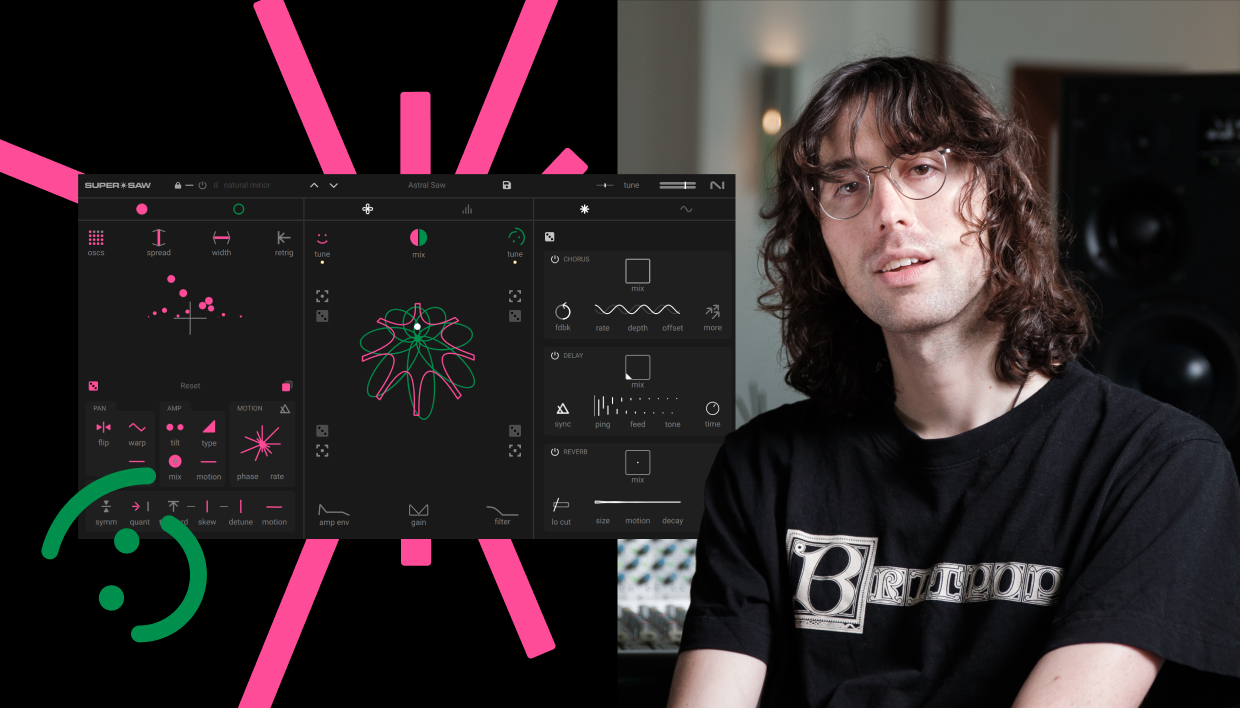
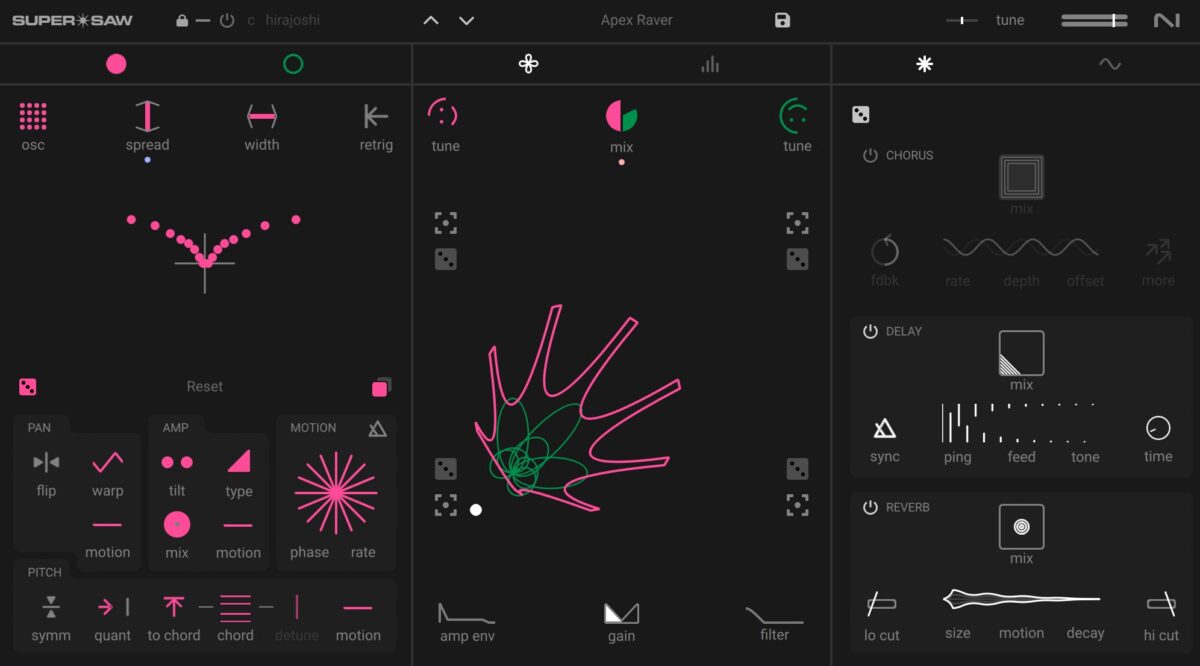
Under the hood, Super*Saw features a robust dual 8-voice sawtooth oscillator system. The instrument’s architecture is visually and functionally divided into two distinct, color-coded layers: a vibrant pink layer and a contrasting green layer. This dual-engine setup allows producers to assign complementary roles to each group, functioning similarly to a dialogue between contrasting musical elements. For instance, one layer can be configured to anchor a track with a heavy, monophonic fundamental bassline, while the other layer handles shifting, heavily modulated chord patterns and wide stereo spreads.
Designed heavily for real-time performance rather than static, post-production automation, Super*Saw incorporates a proprietary 4-corner Morpher. This interface element enables users to smoothly transition between different chord voicings, detuning rates, and modulation states fluidly as they perform on a MIDI keyboard or controller. Additionally, the instrument includes a star-shaped modulation control that can be dynamically mapped to essential parameters such as stereo panning, amplitude modulation, and pitch drift. To encourage spontaneous creativity, the interface features a randomized patch-generation function, allowing producers to instantly generate unexpected variations across the pink and green layers with the click of a button.
Broader Industry Implications and Commercial Impact
The release of Super*Saw arrives at a time of significant evolution within the software instrument market, where producers increasingly favor streamlined, specialized plugins over monolithic, do-it-all workstations. By distilling the complex, hyper-pop aesthetics of the 2020s underground into a commercially accessible product, Native Instruments and A.G. Cook have provided the electronic music community with a specialized tool tailored specifically for modern club music, futuristic pop production, and ambient soundscape design.
Industry analysts note that artist-branded software instruments often bridge the gap between high-end professional workflows and bedroom producers seeking professional polish. By turning the signature tonal palettes of albums like Britpop, 7G, and Apple into an interactive hardware-software hybrid experience, Super*Saw serves as both a retrospective coda to Cook’s foundational decade of releases and an accessible gateway for the next generation of sound designers.
Super*Saw is available now for purchase through the official Native Instruments digital store, fully integrated into the ecosystem of modern digital audio workstations and compatible with standard professional production setups. As electronic musicians begin integrating the dual-layer engine into their sessions, the plugin is poised to heavily influence the sonic contours of upcoming pop and club releases, cementing the enduring legacy of the supersaw for years to come.