Chasing Celestial Phenomena: A Journey to Samuelson’s Rocks in Joshua Tree National Park

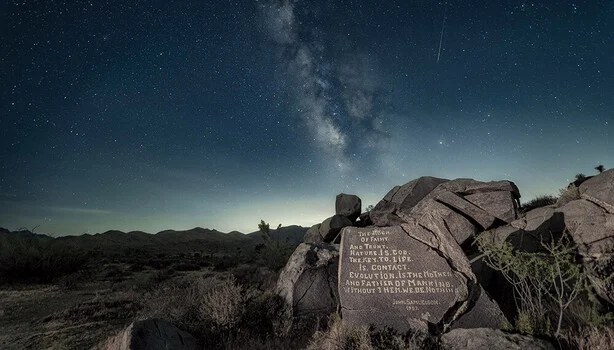
The pursuit of astrophotography in the American Southwest often leads practitioners to areas devoid of infrastructure, where the absence of light pollution reveals the night sky in high fidelity. Among these remote sites, Samuelson’s Rocks—a collection of seven geological formations featuring eight distinct philosophical and political inscriptions—stands as a unique intersection of historical legacy and natural beauty. Located deep within the boundaries of Joshua Tree National Park, these boulders represent the labor of John Samuelson, an eccentric Swedish immigrant who resided in the Mojave Desert during the 1920s. Capturing these carvings beneath the galactic core of the Milky Way requires a rigorous approach to wilderness navigation, environmental safety, and specialized photographic technique.
Historical Context of the Site
John Samuelson, a prospector and laborer, arrived in the Mojave region in 1926. He was known to have been employed by William “Bill” Keys, a prominent pioneer and rancher whose name is synonymous with the history of Joshua Tree. During his tenure in the desert, Samuelson utilized the local quartz-monzonite boulders as a canvas for his philosophical musings. The inscriptions, etched into the rock face nearly a century ago, offer a glimpse into the isolation and intellectual life of a desert inhabitant of that era. Because these boulders are situated off-trail, they are shielded from the heavy foot traffic of the park’s more accessible landmarks, preserving a sense of temporal stillness that photographers often seek.
Environmental Challenges and Safety Protocols
Navigating the Mojave Desert during the peak of summer presents significant physiological challenges. In August, temperatures regularly exceed 100°F (38°C). The National Park Service (NPS) maintains strict safety guidelines for visitors during this period, explicitly advising against strenuous physical activity, such as hiking, during the heat of the day. The risk of heat exhaustion and dehydration is acute, as the arid climate accelerates fluid loss.
Preparation for a nighttime expedition into this environment requires logistical precision. A three-mile trek in the dark, without the benefit of established trails, necessitates a comprehensive supply of hydration, navigation tools, and emergency signaling equipment. Professional guidance for desert trekking emphasizes the "pack-in, pack-out" ethos, along with the necessity of carrying a minimum of one gallon of water per person for a full day, though extended desert excursions often require more. For this specific expedition, the logistics included 1.5 gallons of water for the immediate hike, with additional reserves staged at the vehicle to account for the potential for prolonged exposure to heat.
Navigation and Chronology of the Expedition
The expedition commenced on August 5, 2026, following a day where local temperatures reached approximately 104°F (40°C). By initiating the hike after sunset, the traveler mitigated the risk of heatstroke and minimized solar exposure. The route necessitated reliance on GPS-integrated navigation, specifically the Garmin Explore application, which functions independently of cellular infrastructure.
The transit involved:
- 19:30 PST: Initiation of the trek, following sunset to allow for ambient cooling.
- 20:15 PST: Navigation phase, utilizing distant mountain silhouettes as natural waypoints to maintain a consistent heading.
- 20:42 PST: Arrival at the site after approximately 42 minutes of steady movement, accounting for frequent hydration breaks.
Navigating in total darkness requires a specific set of skills, particularly in terrain characterized by dense, prickly vegetation such as the Cylindropuntia (cholla) cactus. Constant vigilance is required to avoid injury, as the desert floor is often uneven and obscured by shadows. The use of low-intensity illumination, directed toward the ground, serves to minimize the disruption of nocturnal wildlife while ensuring the safety of the hiker.
Astrophotography and the Perseid Meteor Shower
The primary objective of the mission was to document the celestial movement during the lead-up to the annual Perseid meteor shower. The Perseids, caused by the Earth passing through the debris trail of the comet Swift-Tuttle, typically reach their peak in mid-August. Capturing a meteor in a long-exposure image is statistically difficult, requiring a high frequency of consecutive frames to increase the probability of catching a transient streak of light.
Technical execution involved:
- Stabilization: Deployment of a heavy-duty tripod, embedded firmly into the desert substrate to counteract the high winds frequently encountered in the Mojave after dark.
- Intervalometer Settings: Configuring the camera to fire continuously to create both high-resolution still images and a time-lapse sequence.
- Environmental Monitoring: Assessing lunar phase interference. As the half-moon rose, it introduced ambient light that eventually obscured the contrast of the Milky Way, signaling the conclusion of the photographic window.
Analysis of Results and Broader Implications
The review of the captured data revealed a successful exposure: a high-fidelity image featuring the Milky Way, the carved geological site, and a Perseid meteor. The alignment of the meteor with the carved boulder serves as a point of interest for both historical researchers and astrophotographers.
From an atmospheric perspective, the successful capture illustrates the importance of low-light pollution zones. Joshua Tree National Park is a designated International Dark Sky Park, an accreditation granted by the International Dark-Sky Association (IDA). This status is critical for research and public engagement, as it preserves the integrity of the night sky for scientific observation. The implications of this expedition underscore the necessity of protecting such environments, not only for their geological and historical value but for their status as critical observational nodes for celestial phenomena.
Expert Perspectives and Park Management
While individual expeditions provide high-quality documentation, park officials emphasize the collective responsibility of visitors. The "Leave No Trace" principles are paramount at sites like Samuelson’s Rocks. Because the site is not officially signed or maintained, it is vulnerable to degradation. The NPS encourages researchers and photographers to share their findings while simultaneously discouraging the disclosure of exact coordinates to prevent overcrowding and potential vandalism of the historic inscriptions.
The growing popularity of astrophotography has brought increased attention to remote sites. As interest in celestial events like the Perseids continues to climb, the balance between public access and site preservation becomes increasingly delicate. Industry experts suggest that the future of such photography lies in sustainable, low-impact visits that prioritize the safety of the individual and the preservation of the landscape.
Conclusion
The successful documentation of the Perseid meteor shower over the historic Samuelson’s Rocks highlights the convergence of human history and cosmic activity. It serves as a reminder that the desert is not merely a barren landscape, but a repository of historical narrative and a window into the broader universe. The expedition reinforces the necessity of meticulous preparation when engaging with extreme environments and highlights the ongoing value of dark sky preservation in the American West. As technology in digital imaging continues to advance, the ability to document these rare, transient moments grows, provided that the physical locations remain protected from the pressures of modern human impact.