UnplugRed and BlepFX Release Sucrose a Free Harmonic and Subharmonic Generator for the 2026 KVR Developer Challenge

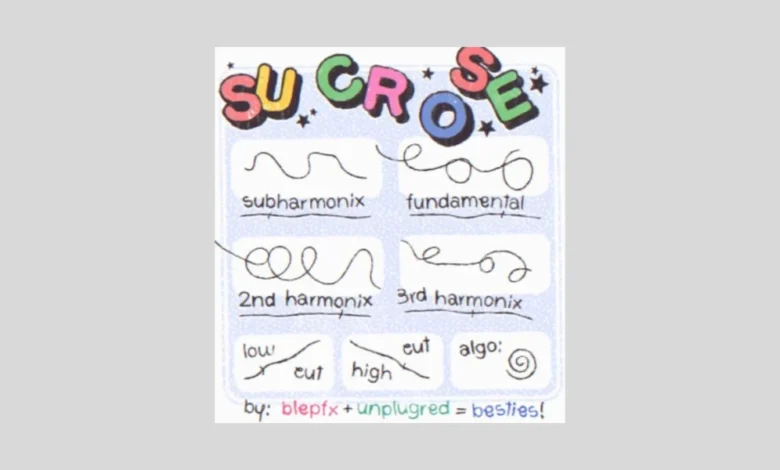
The digital audio workstation environment has seen a significant expansion in specialized signal processing tools with the release of Sucrose, a collaborative effort between developers UnplugRed and BlepFX. Launched as a featured entry for the 2026 KVR Developer Challenge (KVRDC), Sucrose serves as a comprehensive harmonic and subharmonic generator designed for music producers, sound designers, and mixing engineers. The plugin is available as a free, open-source tool compatible with macOS, Windows, and Linux systems, supporting the VST3, AU, and CLAP formats.
Sucrose distinguishes itself from traditional saturation and distortion effects by employing a sophisticated approach to harmonic synthesis. Rather than utilizing standard clipping or waveshaping—which often introduces unwanted intermodulation distortion and alters the dynamic range of the original signal—Sucrose utilizes a Hilbert transform-based phase multiplication technique. This mathematical approach allows the software to generate specific second and third-order harmonics while maintaining the transient integrity and dynamic envelope of the input source. This technical distinction positions Sucrose as a precision tool for tonal enhancement rather than a destructive coloring effect.
Technical Architecture and Harmonic Generation
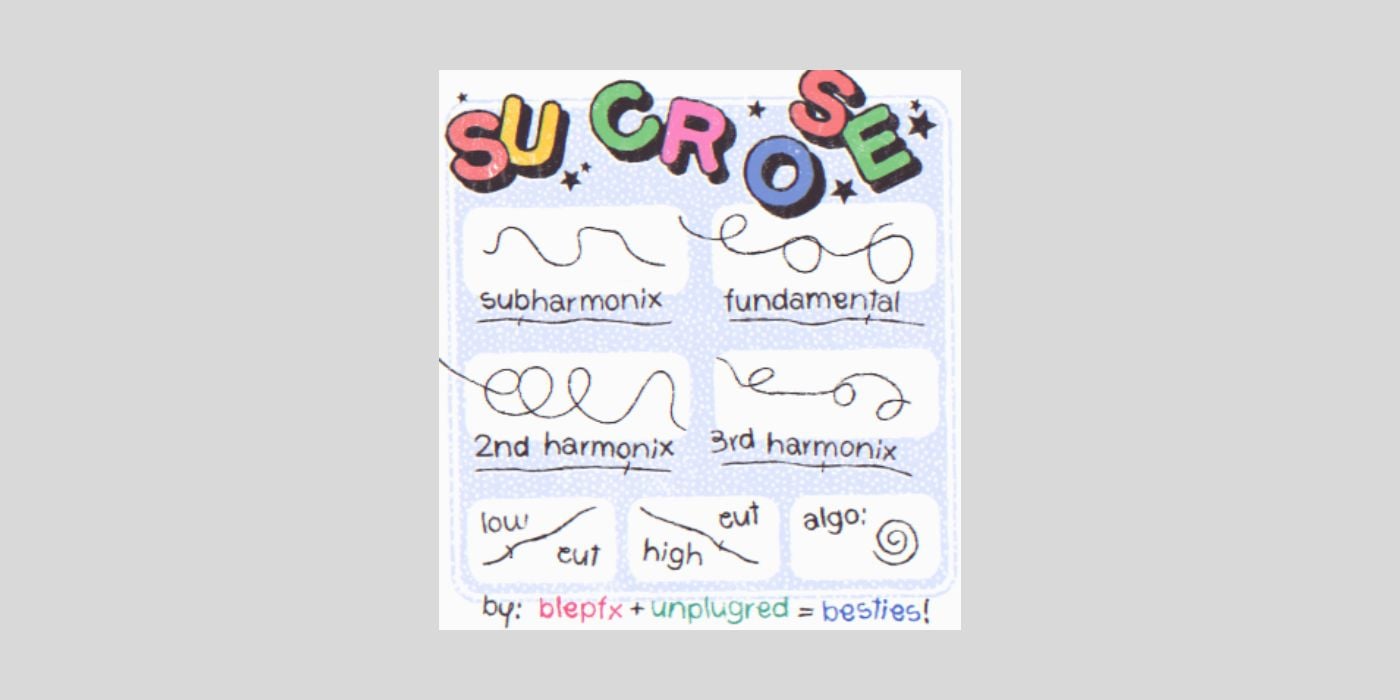
The core of Sucrose’s processing lies in its ability to operate across different levels of spectral complexity. The developers have implemented three distinct operating modes: 1-band, 4-band, and 16-band configurations. In the single-band mode, the plugin applies harmonic generation globally across the frequency spectrum, suitable for cohesive tonal shifts. The 4-band and 16-band modes utilize a crossover network to split the signal into multiple frequency regions, allowing for more granular control. This multiband architecture enables users to apply harmonic excitation to the high-mid frequencies to improve clarity without affecting the low-end stability, or conversely, to saturate the low-mids for warmth without cluttering the high-frequency air.
A critical technical feature of Sucrose is its zero-latency performance. In modern digital production, where complex signal chains often introduce significant delay compensation issues, zero-latency plugins are highly valued for their utility in live tracking and real-time sound design. By avoiding look-ahead buffers or heavy oversampling filters that typically introduce lag, Sucrose remains a viable option for use in live performance environments and intricate routing setups where timing precision is paramount.
The harmonic generation focuses on the second and third harmonics, which are psychoacoustically significant. Second-order harmonics (octaves) are often associated with warmth and "musicality," characteristic of vacuum tube amplification. Third-order harmonics provide "edge" and "presence," often associated with tape saturation or transformer-based hardware. By allowing independent control over these two harmonic tiers, Sucrose provides a tailored approach to signal enrichment that can help instruments cut through a dense mix without the loss of headroom typically associated with volume increases.
Subharmonic Synthesis and Low-End Enhancement
Beyond its capabilities in the upper-frequency registers, Sucrose features a robust subharmonic generation section. This component is inspired by vintage "flip-flop" based sub-octave guitar pedals, such as the classic Boss OC-2. Unlike modern pitch-shifting algorithms that can sound artificial or "granulated," the flip-flop method generates a square wave or derived signal exactly one octave below the input frequency.
The "Subharmonix" feature in Sucrose is specifically optimized for low-frequency instruments like kick drums and bass guitars. By synthesizing content below the fundamental frequency, the plugin can add weight and physical "thump" to signals that may lack low-end extension. This is particularly useful in electronic music production and cinematic sound design, where sub-bass frequencies are essential for impact. The developers have integrated these controls to ensure that the subharmonic content remains phase-aligned with the original signal, preventing the "muddiness" or phase cancellation that often plagues inferior low-end enhancement tools.
The 2026 KVR Developer Challenge Context
The release of Sucrose is a centerpiece of the 2026 KVR Developer Challenge, an industry-standard competition that has historically birthed some of the most enduring free tools in the audio world. The KVRDC encourages independent developers to push the boundaries of Digital Signal Processing (DSP) and user interface design. Previous iterations of the challenge have introduced the community to legendary plugins like TDR Nova and various high-quality synthesizers.
The 2026 edition of the challenge has been characterized by a trend toward specialized, high-utility tools that fill specific niches in the modern producer’s toolkit. Sucrose enters this competition as a strong contender due to its cross-platform compatibility and its adherence to the CLAP (CLever Audio Plugin) format. The CLAP format, an extensible and open-source alternative to VST and AU, has gained significant traction since its introduction by Bitwig and u-he, offering better multi-core performance and advanced parameter modulation.
Collaborative Development and Open Source Philosophy
Sucrose represents a strategic partnership between two respected names in the independent plugin scene. BlepFX, known for the highly regarded "Filtrr" nonlinear ladder filter, handled the primary DSP and mathematical modeling of the harmonic generation. UnplugRed, recognized for a portfolio of visually striking and unconventional audio tools, was responsible for the graphical user interface (GUI) and user experience design.
The interface of Sucrose departs from the "skeuomorphic" trend of replicating vintage hardware dials and wood panels. Instead, it adopts a "sugary" aesthetic that aligns with its name, utilizing a vibrant and intuitive layout that prioritizes ease of use. A notable point of pride for the development team is the absence of Artificial Intelligence (AI) in the plugin’s creation. In a market increasingly saturated with AI-driven mixing assistants and "one-knob" automated solutions, the developers of Sucrose have emphasized traditional algorithmic craftsmanship and manual control.
The plugin is released under the GPL3 (GNU General Public License v3), making it a fully open-source project. This allows other developers to study the Hilbert transform implementation and the subharmonic circuitry, fostering a spirit of educational exchange within the audio engineering community. The open-source nature also ensures the longevity of the plugin, as the community can maintain and update the code even if the original developers eventually move on to other projects.
Industry Implications and Sound Design Applications
The arrival of Sucrose reflects a broader shift in the audio industry toward more transparent signal processing. While "character" distortion remains popular, there is a growing demand for tools that provide the benefits of saturation—perceived loudness, harmonic richness, and presence—without the side effects of signal degradation.
In practical application, Sucrose serves several distinct roles:
- Mix Transparency: By using the Hilbert transform to add harmonics, engineers can make a vocal or lead synth sound louder and more "forward" in a mix without actually increasing the peak level, thus preserving headroom for the mastering stage.
- Instrument Reconstruction: For poorly recorded bass guitars or thin-sounding kick drum samples, the subharmonic generator can "reconstruct" the missing fundamental, providing a solid foundation that equalization alone cannot achieve.
- Sound Design: The 16-band mode allows sound designers to create complex, evolving textures by applying different levels of harmonic excitation to different frequency ranges, which can then be automated to create movement.
System Compatibility and Availability
Sucrose is designed to be accessible to the widest possible range of users. It is available exclusively as a 64-bit plugin, reflecting the industry’s total transition away from 32-bit architecture. Its support for Linux is particularly noteworthy, as the Linux audio ecosystem, while growing, often lacks the diversity of high-end harmonic processors available to Windows and macOS users.
The inclusion of the CLAP format ensures that users of hosts like Bitwig Studio and Reaper can take advantage of modern plugin hosting features, while VST3 and AU support ensures compatibility with industry standards like Ableton Live, Logic Pro, and FL Studio.
As the 2026 KVR Developer Challenge progresses, Sucrose stands as a testament to the power of community-driven development and the continued innovation within the free software movement. By providing high-level DSP—previously reserved for expensive "boutique" plugins—at no cost, UnplugRed and BlepFX have contributed a significant resource to the global music production community. The plugin can be downloaded directly from the UnplugRed website, where it remains a free resource for creators across all genres and skill levels.
Related posts: