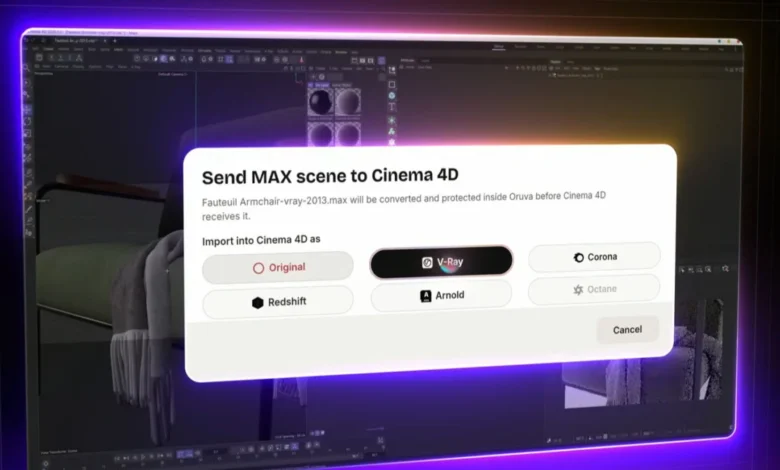
The introduction of Oruva, a new Windows-based application developed by Anass Anedjar, marks a significant shift in the interoperability landscape for 3D visualization professionals. By facilitating the direct conversion of Autodesk 3ds Max (.max) files into native scene formats for Cinema 4D, Blender, Maya, Houdini, and SketchUp, the software addresses one of the most persistent bottlenecks in modern digital production pipelines: format incompatibility and the subsequent loss of scene data during asset migration.
The Technical Evolution of 3D Pipeline Integration
For decades, the 3D industry has grappled with the proprietary nature of file formats. 3ds Max, a staple of architectural visualization and game development since its inception by Kinetix (a division of Autodesk), utilizes a complex binary file structure that has historically been difficult to parse outside of its native environment. Previous solutions for moving assets between software packages often relied on intermediary formats like FBX or OBJ, both of which are notoriously limited in their ability to translate complex material hierarchies, lighting setups, and modifier stacks.
Oruva changes this paradigm by performing a deep-level analysis of the .max file structure. Unlike traditional exporters that strip away procedural data, Oruva attempts to reconstruct the scene architecture within the destination software. This includes the translation of V-Ray and Corona materials—two of the most widely used rendering engines in the industry—into the target renderer’s native language. The software supports a wide array of modern rendering engines, including Redshift, Corona, V-Ray, Octane, Arnold, Cycles, Eevee, Karma, Thea, and Enscape. Furthermore, the application automates the tedious task of texture relinking, ensuring that map paths are correctly identified and remapped upon opening the scene in the new host application.
Chronology and Development Roadmap
The development of Oruva represents a multi-year effort to modernize how 3D assets are shared in collaborative environments. While Autodesk has maintained a dominant market share in architectural visualization, the industry has seen a massive migration toward more diverse toolsets, with Blender gaining significant traction in independent studios and Houdini becoming the industry standard for procedural generation and visual effects.
Anass Anedjar, the developer behind Oruva, has prioritized compatibility across a wide historical range of files. The software supports .max files dating back to the 2009 release through the current 2027 version. This is particularly vital for architectural firms and design studios that maintain massive archives of legacy assets. The ability to pull a project file from 2012 and instantly render it in a modern engine like Octane or Cycles represents a significant time-saving opportunity for firms looking to refresh their portfolio assets or repurpose old designs for modern clients.
Following the initial Windows release, the development roadmap includes a macOS version, which is expected to address the needs of design studios heavily integrated into the Apple ecosystem. By keeping the processing local, Anedjar has opted for a privacy-first architecture, ensuring that proprietary intellectual property remains on the user’s machine—a critical feature for high-security commercial and governmental design contracts where cloud-based conversion services are often forbidden.
Supporting Data and Industry Context
The necessity for a tool like Oruva is underscored by the current state of software fragmentation in the 3D industry. According to industry surveys conducted by CG trade organizations, the average mid-sized studio utilizes at least three different primary 3D applications for various stages of production. The "siloing" of assets has long been identified as a primary cause of downtime, with some estimates suggesting that artists spend between 15% and 20% of their billable time on asset management and file conversion tasks.
The pricing strategy for Oruva, set at a $99 one-time launch fee, positions it as a low-barrier-to-entry utility compared to subscription-based middleware solutions. By offering a 14-day free trial, the developer allows studios to conduct a proof-of-concept audit, verifying the fidelity of the conversion on their specific project files before committing to a purchase.
Analytical Implications for Workflow Efficiency
The emergence of Oruva has several implications for the 3D market. First, it effectively lowers the "switching cost" for studios considering moving away from a 3ds Max-centric workflow. When the pain of migrating assets is removed, studios are more likely to explore alternative software that may offer better performance for specific tasks, such as Blender for modeling or Houdini for simulations.
Second, the tool serves to democratize access to high-quality assets. A common issue in the 3D marketplace is that many high-end asset libraries are sold exclusively in .max format. For users of software like Cinema 4D or Maya, purchasing these assets often meant an expensive and time-consuming manual conversion process. Oruva acts as a bridge, allowing these users to purchase and deploy third-party assets without needing to own a license for 3ds Max itself.
Third, the impact on render farm compatibility is significant. By standardizing scene files into native formats, studios can more easily distribute workloads across different rendering nodes. If a studio transitions from V-Ray to a different engine, the ability to rapidly "translate" their existing library ensures that legacy assets do not become obsolete during the transition.
Official Response and Market Reception
While the developer has maintained a lean operational profile, the response from the 3D community on forums and technical social media channels has been largely focused on the fidelity of the material translation. Early adopters have noted that while geometry conversion is generally high-fidelity, the nuances of complex, nested shader graphs in V-Ray and Corona require ongoing updates to maintain perfect parity.
The commitment to supporting files up to 3ds Max 2027 suggests a long-term maintenance cycle. By ensuring the software can interpret files from the future, Anedjar is positioning Oruva as a future-proof tool that can evolve alongside the primary 3ds Max releases. This level of support is often the deciding factor for enterprise-level adoption, where software stability and longevity are paramount.
Broader Industry Impact
The broader context of Oruva’s release fits into a larger movement toward "openness" in the 3D ecosystem. With the rise of Universal Scene Description (USD) and other open-source standards, the industry is gradually moving toward a future where software interoperability is an expectation rather than a premium feature. However, until such standards are fully universal, utility software like Oruva serves as the essential "connective tissue" that prevents the fragmentation of digital workflows.
For architectural visualization, the stakes are particularly high. The shift toward real-time rendering—driven by engines like Unreal Engine and Enscape—means that designers are increasingly working in environments that require high-speed iteration. Oruva’s ability to streamline the path from an initial 3ds Max design file to a final, render-ready scene in a modern engine could significantly shorten the design-to-client-presentation cycle.
As Oruva continues to mature, its success will likely be measured by its ability to handle increasingly complex 3ds Max features, such as advanced particle systems, complex animation rigs, and custom plugins. If the developer can maintain the current pace of compatibility updates while expanding support for more niche plugins, the application could become a staple utility in the toolkit of every professional 3D artist.
In conclusion, the launch of Oruva represents a practical, user-focused response to a long-standing industry frustration. By providing a local, affordable, and robust solution for .max file conversion, the application offers a clear value proposition to both individual freelancers and large-scale production houses. As the industry continues to move toward more diverse and specialized software stacks, tools that facilitate seamless integration will become increasingly vital to the maintenance of efficient, high-output creative pipelines. Those interested in evaluating the software’s performance within their specific production environments are encouraged to utilize the 14-day trial available through the official Oruva portal.