The Strange Story of the Honda Crossroad: When a Japanese Giant Sold a British Land Rover

Badge engineering has long been a staple of the global automotive industry. In theory, the practice offers a strategic advantage to both manufacturers involved. The originating company secures increased production volume and factory efficiency, while the receiving manufacturer acquires a market-ready model without shouldering the prohibitive research, design, and development costs typically associated with launching a new vehicle from scratch. Automotive conglomerates such as General Motors have historically leaned heavily on this strategy—exemplified by Pontiac’s extensive portfolio of platform-shared models—to saturate various market segments quickly.
Honda, however, has traditionally charted a different course. Renowned for its fierce corporate independence, meticulous engineering culture, and self-reliant product development, Honda rarely resorts to outsourcing entire vehicle lines. Yet, during the early 1990s, shifting consumer preferences and an unexpected market vacuum forced the Japanese automaker into an uncharacteristic phase of corporate flexibility. To bridge a critical gap in its domestic showroom offerings, Honda forged temporary alliances with external partners, resulting in one of the most unlikely and fascinating badge-engineered vehicles of the decade: the first-generation Honda Crossroad.
The 1990s SUV Boom and Honda’s Strategic Blindspot
The automotive landscape shifted dramatically at the dawn of the 1990s. In the Japanese domestic market (JDM), consumer tastes pivoted away from traditional sedans and hatchbacks, setting off an unprecedented appetite for Sport Utility Vehicles (SUVs). Rugged, high-riding vehicles offering elevated driving positions and perceived versatility became the fastest-growing sector in the industry.
Unfortunately for Honda, company leadership had severely underestimated this lifestyle shift. At the time, the automaker did not have a single SUV under development in its product pipeline. Designing, engineering, and testing a competitive four-wheel-drive platform from a clean sheet of paper was a complex, capital-intensive undertaking that would take several years—time that Honda simply did not have if it wished to capture market share from domestic rivals like Toyota, Nissan, and Mitsubishi.
Faced with this strategic vulnerability, Honda turned to established global partners to fill the void. The company’s corporate entanglement with British Leyland—later the Rover Group—dated back to a capital and technology-sharing agreement signed in 1979. This partnership deepened significantly with a joint development agreement in 1983 and a subsequent manufacturing pact in 1984. The collaboration had previously borne fruit through the creation of the Honda Legend and the Rover 800, alongside the ill-fated Sterling brand venture in the North American market.
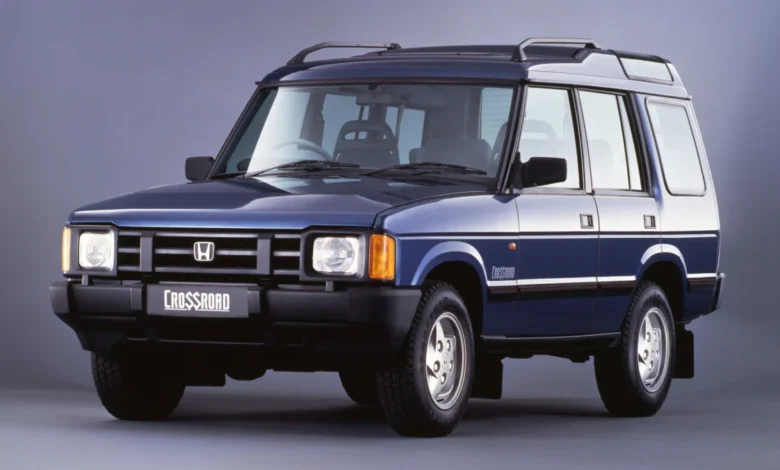
Simultaneously, the British automaker had introduced the Land Rover Discovery in 1989. To Honda executives, the Discovery represented an immediate, readymade solution to their domestic SUV deficit. In 1993, the two companies struck a commercial agreement allowing Honda to import, badge, and market the Land Rover Discovery in Japan under the nameplate Honda Crossroad, targeting a modest sales volume of approximately 1,000 units annually.
Anatomy of the Honda Crossroad: A British Heart with Japanese Badges
From an engineering and design perspective, the Honda Crossroad required virtually no adaptation before crossing international borders. Vehicles were manufactured at Rover’s plant in the United Kingdom, loaded onto cargo ships, and delivered directly to Japanese Honda dealerships with minimal modifications.
Visually, the Crossroad was nearly indistinguishable from its British sibling. Honda designers limited their intervention to swapping out the Land Rover emblems for Honda crests, adjusting minor trim details, and configuring the lighting to comply with Japanese regulatory standards. Underneath the sheet metal, the vehicle remained entirely British. The Crossroad retained Land Rover’s sophisticated permanent four-wheel-drive system, complete with a lockable center differential, long-travel coil-spring suspension, and a robust body-on-frame chassis.
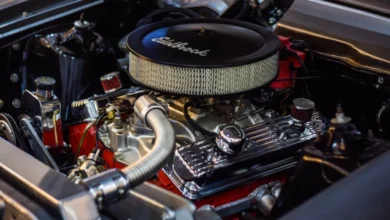
Powering the Crossroad was Rover’s venerable 3.9-liter V8 engine. While adopting a V8 powerplant was entirely foreign territory for Honda—a brand traditionally celebrated for high-revving, highly efficient inline-four-cylinder engines—the engine itself possessed a storied lineage. Rover had acquired the manufacturing rights to the lightweight aluminum V8 design from General Motors’ Buick division decades prior, progressively refining and expanding the engine for European motoring standards.
However, decades of incremental updates had failed to eradicate the underlying mechanical idiosyncrasies inherent to the design. The V8-powered Honda Crossroad proved to be plagued by the exact reliability concerns that historically shadowed Land Rover products. Electrical gremlins, cooling system vulnerabilities, and oil leaks were par for the course. For a brand like Honda, whose global reputation was built upon bulletproof reliability and flawless build quality, offering a vehicle with notorious durability issues was a calculated risk. Yet, the urgent corporate necessity of capturing SUV market share overrode traditional quality control anxieties.
Expanding the Surrogate Fleet: Isuzu Partnerships and Corporate Transition
The debut of the Crossroad marked only the beginning of Honda’s aggressive, temporary reliance on external partnerships. Recognizing that a single imported model would not suffice to establish a permanent foothold in the booming utility segment, Honda broadened its procurement strategy.
In the same year the Crossroad debuted, Honda introduced the Honda Jazz (not to be confused with the later subcompact hatchback), which was essentially a badge-engineered Isuzu MU. Furthermore, Honda leveraged its retail network to sell imported Jeep Grand Cherokees directly through its Japanese dealerships under a distribution agreement with Chrysler.
By the end of 1993, Honda showrooms across Japan featured a diverse, multi-brand collection of rugged off-roaders wearing foreign badges. The corporate strategy expanded further in 1994 with the launch of the Honda Horizon, yet another rebadged Isuzu vehicle (specifically, the Isuzu Trooper).
This multi-pronged importation strategy successfully bought Honda the necessary time and capital to engineer its own proprietary SUV platforms in-house. That internal development effort culminated in the introduction of the first-generation Honda CR-V in 1995. The CR-V proved to be an instantaneous global phenomenon. Following its successful domestic launch, Honda expanded production and exported the CR-V to North America and numerous international markets, where it achieved staggering commercial success.
The Decline and Demise of the Crossroad
With the CR-V firmly established as a high-volume, highly profitable global product, Honda no longer required foreign stopgap models to populate its showroom floors. The company’s reliance on badge-engineered vehicles from Rover and Isuzu quickly became redundant.
The eventual phase-out of the Honda Crossroad is attributed to a confluence of shifting corporate dynamics and unfortunate mechanical setbacks. Automotive historians and industry insiders offer varying accounts regarding the precise catalyst for the vehicle’s retirement. Some contemporary sources point to a severely mistimed safety recall that generated negative publicity and severely dampened consumer confidence in the Crossroad. Others highlight the tumultuous corporate restructuring that followed BMW’s acquisition of the Rover Group in 1994, which fundamentally altered supply agreements and international partnerships.
Regardless of the primary catalyst, the writing was on the wall. In 1998, Honda quietly discontinued the Crossroad in the Japanese market, drawing the curtain on one of the most unconventional collaborative experiments of the late twentieth century.
Broader Implications and Legacy
The brief existence of the Honda Crossroad serves as a compelling case study in corporate pragmatism and crisis management. It demonstrates that even the most stubbornly independent automakers are willing to temporarily compromise their brand purity when confronted with rapid, disruptive market shifts.
While the Crossroad ultimately failed to leave a lasting commercial footprint—remaining a rare collector’s curiosity today—it served its core corporate purpose. It insulated Honda from the immediate financial consequences of being late to the SUV boom, buying critical breathing room while engineering teams developed the legendary platforms that would define the brand’s success in the decades to follow. Today, the Crossroad is remembered as a fascinating historical footnote: the day Honda sold a British off-roader to Japanese buyers, proving that in the automotive industry, necessity can forge the most unexpected alliances.