
Q3 Ad Tech Earnings Expose Deep Industry Divide As Mobile Giants Surge While Open Web Providers Struggle


The third-quarter earnings season for publicly traded advertising technology companies has laid bare an intensifying dichotomy within the digital marketing ecosystem. Recent financial reports from six major players reveal a stark divergence in fortunes: mobile-centric advertising and app-based platforms are experiencing explosive, market-leading expansion, while traditional open web providers, display-focused firms, and legacy ad networks face escalating contraction and profitability pressures.
This quarterly reporting cycle underscores a fundamental restructuring of digital advertising budgets. Advertisers are increasingly reallocating capital toward closed ecosystems, app-centric environments, and connected television (CTV), leaving open-web publishers and intermediary tech vendors to compete for shrinking pools of display and desktop revenue. As the industry awaits upcoming reports from major market participants such as The Trade Desk, PubMatic, and Zeta Global, the initial cohort of filings provides a definitive snapshot of an uneven economic recovery and shifting foundational dynamics across global media channels.
The Great Divergence: The Haves And Have-Nots Of Q3
The primary narrative emerging from the third-quarter disclosures is the extraordinary dominance of mobile application advertising giants AppLovin and Unity. Together, these two mobile advertising rivals—who are concurrently embroiled in high-stakes legal disputes over data collection practices—have demonstrated that app-based media and mobile gaming monetization channels remain remarkably insulated from broader macroeconomic headwinds and regulatory privacy constraints impacting the wider web.
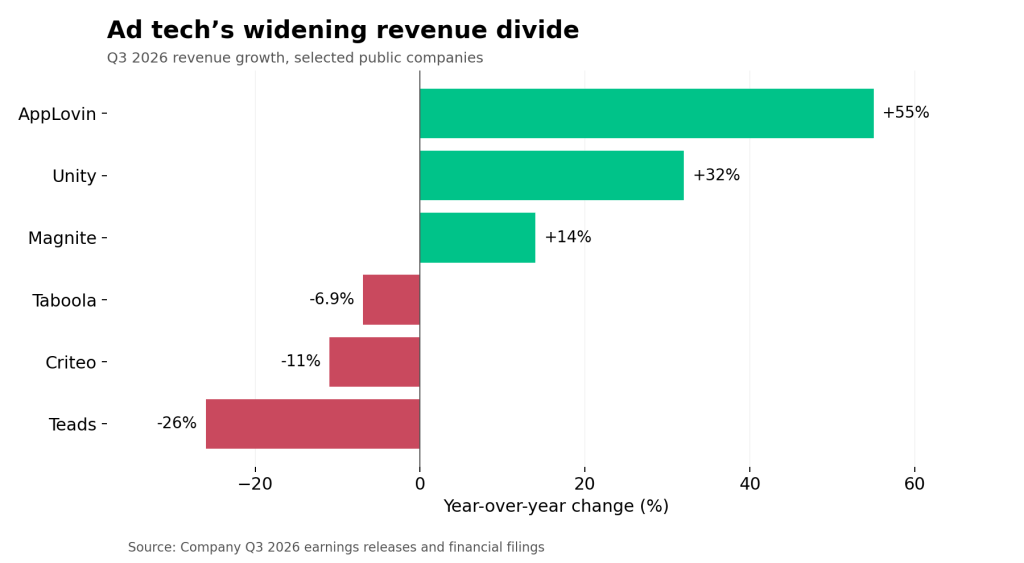
AppLovin delivered a blockbuster financial performance for the quarter, reporting $2.19 billion in revenue, representing a staggering 55% increase compared to the same period in the previous year. Furthermore, the company posted a net income of $1.44 billion, marking a 72% year-over-year surge. Demonstrating absolute dominance within the sector, AppLovin’s leadership informed analysts that its single-quarter revenue actually surpassed the combined quarterly revenue of the other five reporting ad tech firms in this cohort, which collectively totaled roughly $1.94 billion. Looking ahead, AppLovin projected fourth-quarter revenue to fall between $2.365 billion and $2.395 billion, signaling sustained momentum heading into the crucial holiday advertising window.
Similarly, mobile and gaming software rival Unity reported strong financial outcomes, registering $622 million in total revenue, a 32% year-over-year increase. Unity’s Grow Solutions division, which houses its core advertising and media monetization offerings, generated $457 million, reflecting a robust 44% growth rate. Within this division, Unity’s Vector ad platform experienced exponential expansion, surging 126% year-over-year and 40% sequentially. Crucially, Unity achieved a historic corporate milestone during the quarter, posting its first profitable period since its initial public offering (IPO), signaling that its aggressive restructuring and platform integrations are successfully converting top-line scale into bottom-line returns.
Contrasting Fortunes On The Open Web
While mobile and app ecosystems achieved record-breaking heights, companies tethered to the open web, desktop browsing, and traditional publisher monetization faced severe headwinds. The juxtaposition between mobile resilience and open-web vulnerability highlights a persistent migration of brand budgets away from standard web banner ads and toward targeted, authenticated app and video environments.
Criteo, a long-established leader in digital retargeting that has spent recent years pivoting its identity toward retail media, reported a challenging third quarter. Total revenue fell 11% to $416 million, while contribution ex-TAC (after accounting for traffic acquisition costs) dropped 17% to $240 million. Criteo’s retail media segment took a notable 23% hit, a decline exacerbated by enterprise-level contractions from two unnamed major retail clients that collectively reduced their business footprint by $20 million during the reporting period. Consequently, Criteo’s gross margin compressed from 55% to 50%, and net income plunged 85% to $6 million, illustrating the operational friction companies face when executing long-term strategic pivots amid declining legacy revenues.
Taboola experienced a similar top-line contraction, reporting $462.3 million in revenue, down 6.9% year-over-year, driven largely by lower overall advertising impression volumes across its publisher network. Despite the revenue decline, Taboola demonstrated operational cost discipline, successfully increasing its gross profit by 9.6% to $152.3 million through optimized yield management and efficiency initiatives.
However, the steepest contraction within the cohort was recorded by Teads, a historic rival and former prospective merger partner of Taboola. Teads reported a 26% year-over-year drop in revenue, bringing quarterly figures down to $235.1 million. On a post-TAC basis, Teads’ gross profit fell 28% to $93.5 million. Executive commentary from Teads pointed to persistent, structural weakness in open-internet advertising demand as the primary driver of the downturn. The company declined to reinstate formal financial guidance, and its quarterly filings revealed a deepened net loss of $325.5 million, compared to a net loss of $19.7 million during the same period in the previous year.
Connected TV Emerges As A Resilient Growth Engine
Amid widespread contraction across traditional digital channels, Connected TV (CTV) emerged as a reliable bright spot and an essential growth driver for supply-side platforms and video-centric advertising networks. As audiences continue to migrate from linear television to streaming environments, media buyers are aggressively shifting budgets into programmatic CTV inventory, insulating firms with robust video infrastructure from broader market declines.
Magnite, a leading independent sell-side advertising platform, successfully leveraged this trend to post solid overall growth. The company reported total revenue of $204.2 million, up 14% year-over-year, alongside a 20% increase in total contribution ex-TAC. Magnite’s performance was anchored by its CTV division, where contribution ex-TAC surged 39% to reach $105.4 million. This contrasted sharply with its DV+ business unit—which encompasses standard display and other digital video formats—where contribution grew by a modest 5%. Consequently, CTV expanded to account for approximately 53% of Magnite’s total ex-TAC contribution, up from 45% in the previous year.
A parallel dynamic was observed at Outbrain, where executive leadership highlighted a 37% year-over-year increase in CTV revenue. Nevertheless, because CTV currently constitutes only 12% of Outbrain’s overall revenue mix, this specialized expansion was insufficient to counteract a broader company-wide revenue decline of 26%. Similarly, Teads reported accumulating nearly $100 million in year-to-date CTV revenue, proving that while streaming video channels generate substantial commercial interest, their ultimate ability to rescue an entire corporate balance sheet remains strictly dependent on their scale relative to legacy revenue streams.
Profitability Mechanics And Margin Disparities
A critical analytical takeaway from the Q3 earnings cycle is that top-line revenue expansion no longer serves as a reliable proxy for corporate profitability across the ad tech sector. The financial filings demonstrate a widening decoupling between revenue growth rates and net earnings outcomes.
While AppLovin and Unity successfully translated massive revenue gains into substantial cash generation and profitability—with Unity crossing the historic threshold into post-IPO profitability—other firms experienced divergent profit paths. For instance, companies like Taboola managed to expand gross profits despite sliding revenue figures by aggressively streamlining operations and optimizing ad inventory yield. Conversely, firms like Criteo suffered simultaneous contractions across both top-line revenue and bottom-line margins, with net income deteriorating drastically despite management’s strategic emphasis on higher-margin retail media solutions.
These discrepancies underline the complex cost structures governing modern ad tech enterprises. Companies heavily reliant on traffic acquisition costs (TAC) and publisher revenue-share agreements found themselves acutely vulnerable when open-web ad yields compressed. Meanwhile, platform-based business models operating proprietary software, ad servers, or mobile monetization engines enjoyed greater operating leverage, allowing them to expand margins even as competitive pressures intensified.
Implications For The Broader Digital Advertising Market
The stark divisions revealed across these third-quarter earnings reports point toward structural, long-term transformations in how digital advertising capital is deployed. The concentration of wealth and growth among a handful of mobile and app-centric giants signals that major advertisers increasingly prioritize closed, deterministic environments characterized by verified user identities, first-party data accessibility, and high engagement metrics.
Conversely, the ongoing struggles faced by open-web intermediaries suggest that traditional publisher monetization models remain under severe duress. As signal loss, privacy regulations, and cookie deprecation continue to disrupt traditional web-based targeting, publishers and ad tech vendors tied to the open internet must navigate an unforgiving landscape marked by shrinking impression volumes and compressed publisher payouts.
As the current earnings reporting season progresses into its next phase—with reports anticipated from major market makers including Zeta Global, The Trade Desk, PubMatic, and Liftoff Mobile—industry analysts will be watching closely to determine whether the resilience demonstrated by mobile and CTV platforms represents a market-wide phenomenon or an exclusive sanctuary for dominant category leaders. Ultimately, the Q3 data confirms that the ad tech industry has entered a mature, highly stratified era where scale, proprietary infrastructure, and strategic channel diversification dictate survival.