Monumental Woven Altar Brings the Tradition of Día de Muertos to New York City’s Flatiron District

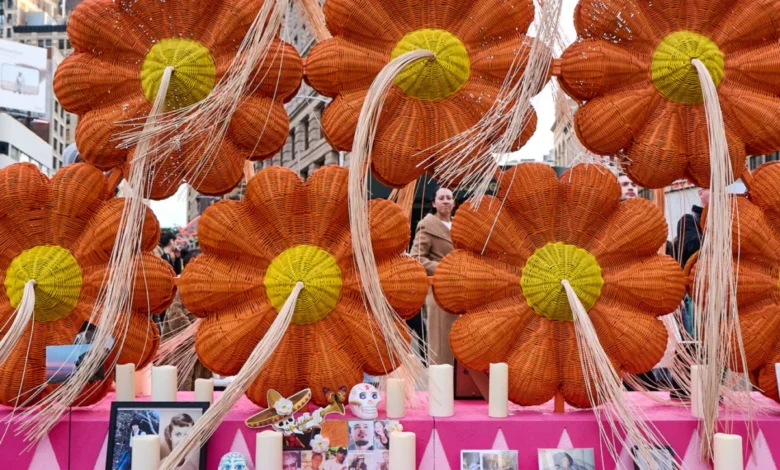
The intersection of contemporary art, traditional craftsmanship, and cultural heritage has transformed a bustling Manhattan plaza into a space of reflection, remembrance, and community gathering. Installed in the heart of New York City’s Flatiron North Plaza, a monumental, seven-tier architectural altar titled Twenty Petal Flower is currently welcoming visitors through November 3. Commissioned by the Flatiron NoMad Partnership and brought to life through a transnational collaboration between Mexico-based design studio Mestiz and Brooklyn-based fabrication organization Powerhouse Arts, the installation offers a fresh, large-scale reinterpretation of the traditional ofrenda associated with the Mexican holiday Día de Muertos.
At a time when public art increasingly seeks to engage pedestrians in meaningful civic experiences, this installation stands out by merging ephemeral cultural rituals with permanent architectural principles. Featuring oversized, handwoven wicker marigolds bathed in warm, candle-like illumination, the structure invites both the local Mexican diaspora and the broader public to participate in a shared act of mourning, memory, and cultural exchange.
The Core Narrative: Honoring the Hands Behind the Tradition
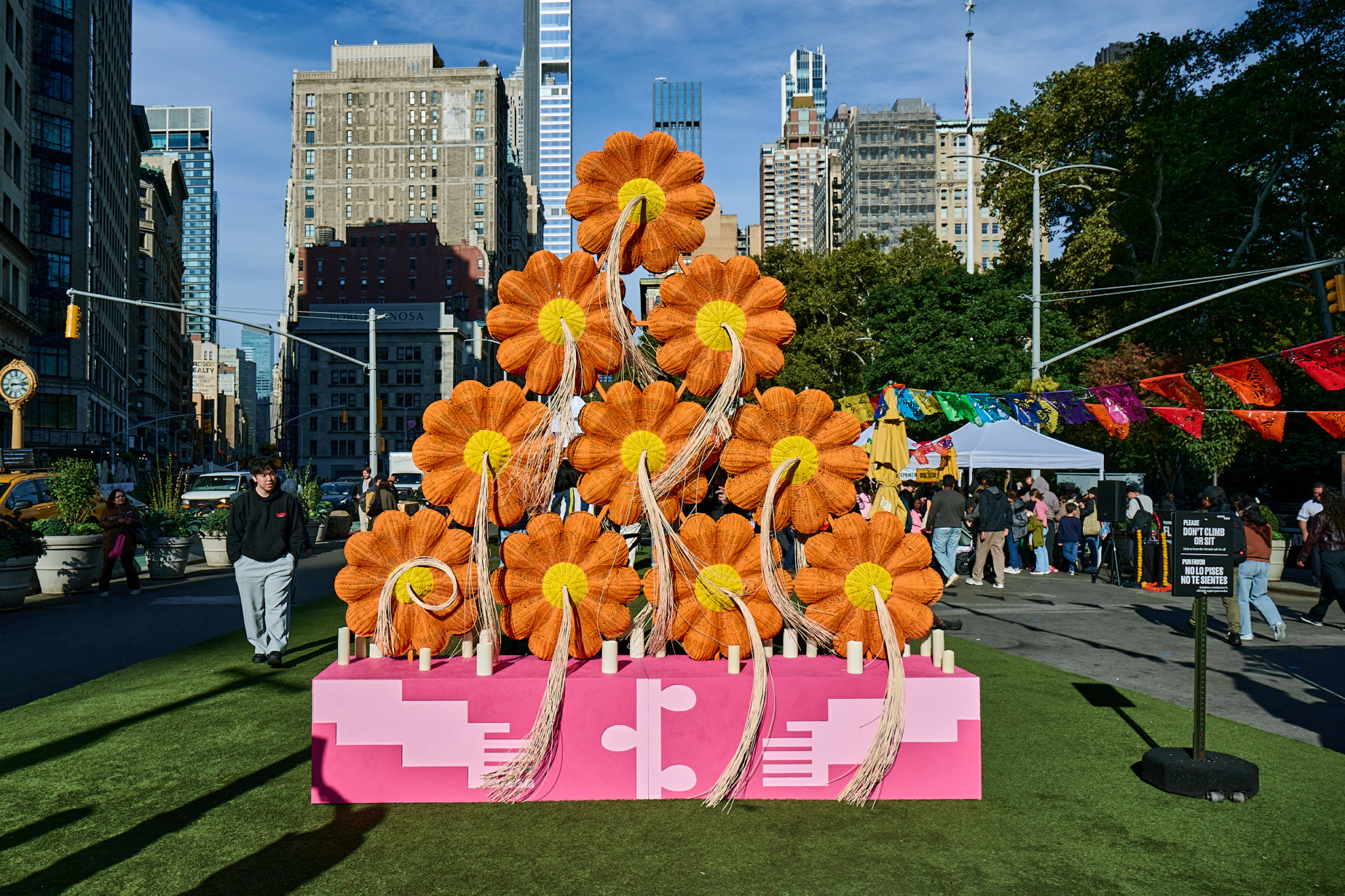
In traditional Mexican celebrations of Día de Muertos, the marigold—scientifically known as Tagetes erecta and referred to in Nahuatl as cempasúchil—is far more than a decorative element. With their vibrant, high-saturation orange petals and distinct, pungent aroma, these flowers are culturally believed to act as a sensory beacon, guiding the wandering spirits of deceased loved ones back to the earthly realm to visit their families.
However, artist and designer Daniel Valero, the founder of Mestiz, chose to expand the traditional narrative of the holiday. While standard ofrendas are dedicated exclusively to family members and public figures who have passed away, Twenty Petal Flower broadens its scope to recognize the living laborers, farmers, and artisans whose physical toil sustains the tradition year after year.
"An altar usually honors someone we love who has passed away," Valero explains, reflecting on the conceptual framework of the piece. "This time, I wanted to honor the many hands behind the cempasúchil, from the people who grow it to those who transform it into an ofrenda."
The installation takes its title directly from the etymology of cempohualxochitl, a Nahuatl compound word translating literally to "20-petal flower," from which the modern Spanish vernacular cempasúchil is derived. By tracing the conceptual and physical journey of the flower from the agricultural fields of Michoacán, Mexico, to the meticulous hands of basket weavers in Tequisquiapan, and finally to the concrete landscape of Manhattan, the project bridges geographical divides and underscores the globalized interconnectedness of contemporary craft.

Chronology and Collaborative Fabrication
The realization of Twenty Petal Flower required a complex logistical and artistic partnership spanning two countries and multiple disciplines. The timeline of the project began months prior to its public unveiling, starting with conceptual designs by Valero in Mexico, followed by material testing, structural engineering, and modular fabrication in Brooklyn.
Mestiz’s fiber workshop in Tequisquiapan served as the primary production hub for the intricate woven elements. Here, local artisans utilized traditional basketry techniques—primarily working with sustainably sourced wicker—to shape the delicate, organic geometry of oversized marigold blossoms. Translating the soft, temporary nature of a fresh flower into a durable, monumental architectural component presented significant technical hurdles.
To overcome these challenges, Mestiz partnered with Powerhouse Arts, a renowned Brooklyn-based non-profit fabrication organization dedicated to supporting public art and creative production. The two organizations maintained a rigorous, ongoing digital correspondence across international borders. Technicians and designers exchanged photographs of computer-numerical-control (CNC)-cut samples, texture variations, and custom paint color matches to ensure the final structural supports remained completely faithful to Valero’s original artistic vision.

Brittni Collins, Director of Public Art at Powerhouse Arts, noted the specific engineering constraints of installing a heavy, weather-resistant sculpture in an exposed urban plaza. "We wanted the internal structure to support the woven flowers without overpowering them," Collins states. "So we built a steel frame with a slim profile and color-matched it to the cempasúchil orange so it could hide behind the weavings. The flowers were secured with stainless steel zip ties that hold up to wind and weather."
Furthermore, acknowledging the environmental and financial footprint of modern public art installations, Powerhouse Arts engineered the supporting framework as a modular system. Rather than constructing a single-use temporary display destined for disposal, the components can be systematically disassembled, safely stored, and reinstalled for future cultural celebrations, extending the lifecycle of the artwork significantly.
Official Responses and Civic Impact
City officials and urban planners have increasingly emphasized the role of temporary public art in activating underutilized pedestrian spaces. The Flatiron North Plaza, situated at the confluence of Broadway, Fifth Avenue, and East 23rd Street, experiences high pedestrian density daily. The introduction of Twenty Petal Flower deliberately disrupts the hurried rhythm of the neighborhood, encouraging commuters and tourists alike to pause, reflect, and interact with their surroundings.

James Mettham, President of the Flatiron NoMad Partnership, highlighted the strategic importance of bringing such an immersive installation to the district. "The scale and openness of Flatiron North Plaza gave us an opportunity to create something immersive and unexpected in the middle of the neighborhood’s everyday rhythm," Mettham remarks. "What is so exciting about this project is that it does more than occupy the plaza. It changes how people move through it, invites them to stop and look more closely, and introduces them to the stories and traditions behind the work."
Beyond its visual and spatial impact, the altar serves as an interactive community monument. Visitors to the plaza are explicitly encouraged to approach the seven-tiered structure, spend contemplative time within its perimeter, and contribute their own personal mementos, photographs, and written remembrances honoring departed loved ones. This participatory element democratizes the art piece, transforming a professional design installation into a living, evolving collective memorial.
Broader Cultural Implications and Community Integration
The presence of Twenty Petal Flower in New York City reflects a broader demographic and cultural shift, wherein traditional Latin American festivities are increasingly celebrated on a major civic scale in global metropolitan centers. Día de Muertos, historically observed most prominently in central and southern Mexico, has experienced a widespread cultural elevation internationally over the past two decades.

For Valero and the creative team behind the installation, the project represents an exercise in meaningful cultural diplomacy and diaspora representation. By embedding a monumental indigenous Mexican narrative into the architectural fabric of New York City, the artwork provides emotional resonance for the city’s substantial Mexican-American and Hispanic populations while serving as an educational touchstone for the general public.
"I love the idea of someone walking through Flatiron NoMad and suddenly discovering this joyful, vibrant, handmade monument," Valero reflects. "Bringing an ofrenda into a public space allows it to become part of the city’s everyday life, a place where people can stop, remember someone they love, and leave an offering."
He adds, summarizing the overarching objective of the transnational collaboration: "I hope it brings a little piece of home to the Mexican community while inviting everyone in New York to share in the beauty of Día de Muertos."
Exhibition Details

Twenty Petal Flower remains on public view at the Flatiron North Plaza in New York City through November 3, offering daily access to pedestrians, art enthusiasts, and those wishing to participate in the ancient traditions of remembrance through a contemporary architectural lens.