William Shatner Defies Expectations With Live Heavy Metal Debut in Chicago at Age 95

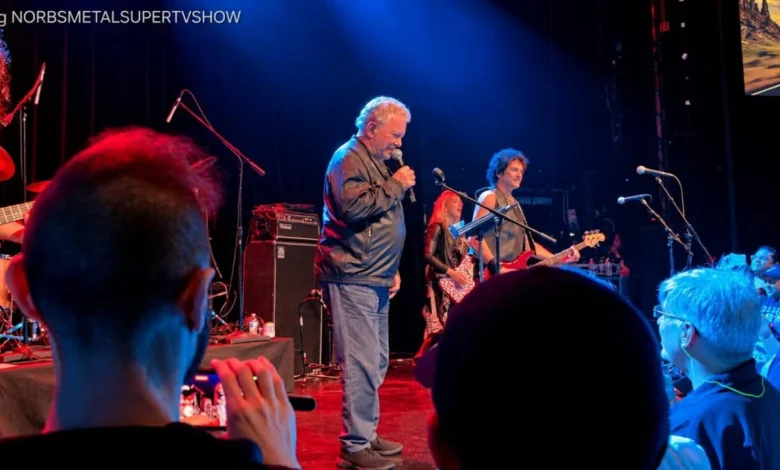
Veteran actor, author, and cultural icon William Shatner has added a decidedly unexpected chapter to his multifaceted career by making his live heavy metal debut over the weekend in Chicago, Illinois. Performing alongside a newly assembled backing band, the nonagenarian entertainer took to the stage to deliver a high-energy set of classic metal covers and original material. The weekend’s performances included an intimate, warm-up engagement at the Park West venue on Saturday night, followed by a prominent main-stage appearance at Riot Fest on Sunday.
The venture highlights a surprising late-career pivot for the performer, who has spent decades traversing television, film, spoken-word music, and literature. Supported by a backing ensemble featuring guitarists Marcus Nand and Britt Lightning, bassist Phil Soussan, and drummer Fred Achin, Shatner’s newly minted musical outfit—provisionally and provocatively titled "the *uckers"—showcased a sonic landscape vastly different from the spoken-word orchestrations that characterized his earlier musical recordings.
Chronology of the Chicago Weekend Debut
The sequence of events leading up to Shatner’s metal debut unfolded across several months of secretive rehearsals and strategic announcements. The project first came to public prominence following media speculation surrounding the actor’s impending musical releases and live bookings.
On the evening of Saturday, the ensemble hosted a private, invitation-only warm-up gig at Chicago’s historic Park West theater. The intimate setting allowed the band to test their live acoustics and stage presence in front of a select audience of industry insiders and dedicated fans. The setlist featured a mixture of canonical heavy metal anthems—including Metallica’s "Enter Sandman," Motörhead’s "Ace of Spades," and Ozzy Osbourne’s "Crazy Train"—interspersed with original compositions slated for an upcoming studio release.
Following the success of the Saturday night warm-up, the band transitioned to the expansive festival grounds of Riot Fest on Sunday afternoon. Playing to a significantly larger, multi-generational audience on the main stage, the ensemble executed a parallel setlist that combined theatrical spoken-word delivery with heavy guitar distortion, eliciting a mixture of shock, amusement, and genuine appreciation from festivalgoers.
Background Context and Musical Evolution
William Shatner’s foray into the heavier side of rock music is not entirely unprecedented, though it represents a radical departure from his previous musical ventures. His recording career began in earnest with the 1968 spoken-word concept album The Transformed Man, released via Decca Records. That debut established a distinct artistic template wherein Shatner recited lyrical poetry and popular songs—such as Bob Dylan’s "Mr. Tambourine Man" and Paul McCartney’s "Lucy in the Sky with Diamonds"—using his trademark dramatic, staccato delivery style, characterized by pronounced pauses and theatrical intonation.
Over the subsequent decades, Shatner expanded his musical footprint with projects like 2004’s Has Been, produced by Ben Folds, which featured collaborations with artists such as Joe Jackson, Henry Rollins, and Adrian Belew. Subsequent releases, including 2011’s Seeking Man, 2013’s Ponder the Mystery, and 2018’s Standard Time, saw him explore blues, progressive rock, and jazz standards.
However, his transition into heavy metal represents a stark evolution. Earlier this month, in an interview on the Moynihan Report podcast, Shatner admitted that he possesses limited formal familiarity with the heavy metal genre as a historical movement. Despite this, he explained that he was drawn to its raw intensity, having recently penned an impassioned response track titled "Patience" as a counter-narrative to Guns N’ Roses’ classic ballad. The lyrics reflect his characteristic self-awareness, featuring lines such as: "I’m tired of old age. I’m tired of losing hair. I’m tired of not eating. I’m tired of catching a cold. I’m tired of being tired. I’m tired!"
Supporting Data and Upcoming Releases
While specific financial figures and recording contracts surrounding the project remain private, industry analysts note that the commercial viability of legacy acts entering niche or extreme genres often relies on novelty value coupled with high-production execution. The backing lineup assembled for the project comprises seasoned professional musicians with deep roots in hard rock and heavy metal, lending immediate credibility to the sonic output.
Guitarist Marcus Nand and axewoman Britt Lightning provide the twin-guitar harmonies and heavy distortion, while bassist Phil Soussan brings extensive touring and recording experience from his work with Ozzy Osbourne, Billy Idol, and Vince Neil. Drummer Fred Achin anchors the rhythm section.
The band’s forthcoming full-length album, tentatively titled What The F Is Heavy Metal?, is currently in production. No official release date has been confirmed by distribution partners, though promotional campaigns are expected to ramp up following the conclusion of the group’s initial live run.
Social Media and Public Statements
Ahead of the Chicago performances, Shatner utilized his official social media channels to frame the thematic nature of his new musical direction. In a widely shared post, he remarked: "I have explored space. I have explored time. Now… I explore distortion."
The statement served as both a nod to his iconic television and film career—most notably his portrayal of Captain James T. Kirk in the Star Trek franchise—and an acknowledgment of the sonic shift toward overdriven amplifiers and heavy guitar riffs.
Broader Impact and Future Live Commitments
The implications of Shatner’s metal debut extend beyond a simple one-off novelty performance. By securing slots at major music festivals, the production team has signaled a serious intent to tour the project globally.
Prior to the Chicago weekend, plans for a major festival appearance next year were inadvertently revealed during an interview with CNN. Shatner mentioned that he was scheduled to perform at "the one in the desert" the following year. The comment prompted clarification from his daughter, Melanie Shatner Gretsch, who confirmed that the booking was indeed for the Coachella Valley Music and Arts Festival in Indio, California.
Cultural observers and music critics have noted that performances of this nature challenge traditional demarcations of age and genre within the contemporary music industry. By embracing heavy metal at age 95, Shatner continues to subvert expectations, maintaining an active, highly public performance schedule that defies standard physiological benchmarks of advanced age. As preparations continue for the release of What The F Is Heavy Metal? and subsequent festival appearances, the cultural footprint of the veteran actor’s musical evolution remains an unpredictable and compelling narrative within modern entertainment.