The Optimal Duration for Instagram Reels: A Data-Driven Analysis of Reach and Engagement in 2026

Content creators and marketing professionals have long debated the ideal duration for short-form video content on Instagram. While the platform has technically expanded its capacity to allow for videos up to 20 minutes in length, a comprehensive analysis of over 2.7 million posts published between January 1 and August 15, 2026, reveals that the strategic "sweet spot" for maximizing reach remains significantly more constrained. Data science teams at Buffer, working in collaboration with analytics experts, have identified a clear divergence between the objectives of audience expansion and community engagement, providing a roadmap for how creators should structure their video output to align with the current Instagram algorithm.
The evolution of Instagram Reels reflects the platform’s ongoing attempt to balance its identity as a hub for short-form entertainment with the demands of long-form storytelling. Since its inception as a direct competitor to TikTok, Instagram has gradually increased its duration limits. While the current 20-minute cap is a substantial departure from the original 15-second constraints, this technical allowance is misleading. Meta, the parent company of Instagram, has maintained a structural barrier at the three-minute mark. Any video exceeding 180 seconds is effectively disqualified from the platform’s recommendation engine, meaning it will not appear on the Explore page, the dedicated Reels tab, or in the feeds of users who do not already follow the account.
This limitation acts as a functional ceiling for growth-oriented content. For creators looking to reach new audiences, the data confirms that keeping content within the 90-second to three-minute window is the most effective strategy. During the study period, videos within this duration bracket consistently achieved 4% to 7% higher reach compared to the individual baselines of the accounts posting them. This indicates that the algorithm prioritizes these mid-length videos for distribution to non-followers, likely because they strike a balance between providing enough depth to keep users watching and maintaining a pace that fits the platform’s consumption habits.
A chronological look at these developments reveals that the three-minute threshold is not a new invention but a deliberate guardrail installed by Instagram to ensure the platform’s feed does not become saturated with television-length content that contradicts the intent of the "Reels" user experience. While creators can technically upload content as long as 20 minutes, the platform explicitly notifies users upon upload that content exceeding three minutes will not be pushed to non-followers. This deliberate friction is a signal from the platform that it does not intend to replicate the long-form environment of YouTube.

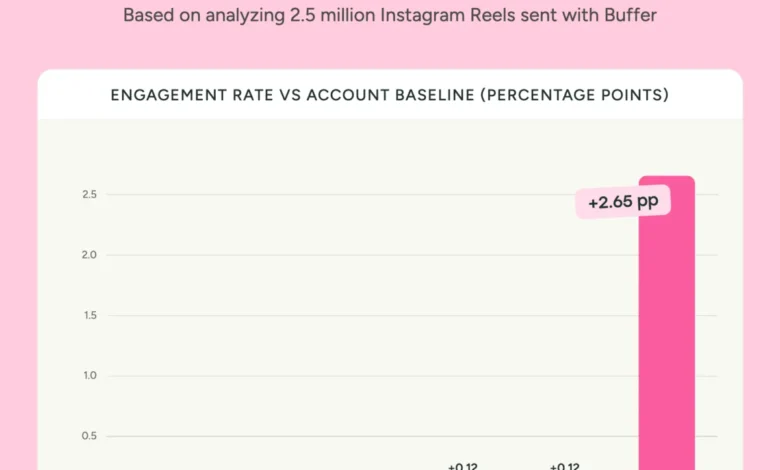
The study’s findings provide a nuanced perspective on engagement versus reach. While shorter, mid-length videos (90 to 180 seconds) win on total unique reach, the data shows that longer-form content—anything exceeding the three-minute mark—frequently produces higher engagement rates among the existing follower base. Reels longer than 180 seconds achieved an engagement rate 2.65 percentage points above their respective account baselines. This suggests that while these videos reach roughly 49% fewer people than shorter clips, the audience that does choose to watch is significantly more invested. This indicates a "depth over breadth" trade-off: long-form content is not an effective tool for discovery, but it is a potent mechanism for nurturing brand loyalty and providing in-depth educational or narrative value to an established audience.
For marketers and creators, the takeaway is that the choice of video length must be dictated by the specific goal of the post. If the objective is to reach new, untapped audiences, content must be tightly edited to fall under the three-minute limit. The study found that for videos under 90 seconds, the specific duration—whether 15, 30, or 60 seconds—had a negligible impact on performance. The metrics for these shorter buckets hovered within a narrow margin of error, suggesting that creators should focus on the quality of the hook, the clarity of the message, and the visual editing, rather than agonizing over a 10-second difference in length.
The methodological rigor of this study provides a reliable baseline for the industry. By utilizing a "self-comparison" model—evaluating each account’s performance against its own average—the researchers successfully removed the bias of account size. Viral content from accounts with millions of followers, which often skews general averages, was neutralized. This allowed for a cleaner look at how specific lengths performed regardless of the size of the creator’s existing footprint. The results were further refined through log-transformation, a statistical technique that prevents a single outlier, such as a massive viral success, from distorting the performance trends of the entire data set.
From an industry perspective, the comparison with other platforms is revealing. TikTok, which set the standard for the current era of short-form video, allows for much longer uploads, with some accounts now able to upload videos up to 60 minutes. YouTube Shorts, by contrast, has remained strictly capped at three minutes, with any content exceeding that limit automatically categorized as standard long-form video. Instagram’s position, with its 20-minute technical limit but a three-minute algorithmic filter, places it in a unique middle ground. It allows for the hosting of "mini-documentaries" or extended tutorials, but keeps those videos gated away from the discovery algorithm to maintain the fast-paced nature of the Reels feed.
Implications for the future of social media content strategy are clear: the era of "one-size-fits-all" video is coming to an end. Creators must adopt a bifurcated strategy. The first tier of the strategy focuses on "Top of Funnel" growth, utilizing videos between 90 and 180 seconds to maximize visibility through the Explore and Reels feeds. These videos should be high-energy, hook-driven, and designed to capture the attention of a casual scroller.

The second tier of the strategy should focus on "Bottom of Funnel" community development. These longer-form videos, exceeding the three-minute mark, should be treated as exclusive content for the core audience. Because they are not being pushed to new people, they do not need to be designed with the same "broad appeal" constraints as shorter clips. Instead, they can prioritize depth, storytelling, and detailed explanations, serving as a reward for those who have already chosen to follow the account.
When examining these results, it is important to acknowledge that length is but one variable in a complex ecosystem. Posting times, keyword optimization, the use of trending audio, and the visual quality of the content all play vital roles in the ultimate success of a Reel. However, the data confirms that length acts as a binary switch for distribution. Once the three-minute barrier is crossed, the algorithm changes its behavior, shifting from a discovery-focused distribution model to an audience-retention model.
For those planning their content calendars, the study suggests that the "trial reel" approach is the most effective way to test these hypotheses. By creating two variations of the same content—one under three minutes and one longer—and testing them against a core segment of the audience, creators can observe their own specific engagement metrics to see how their unique niche responds to varying durations.
Ultimately, while the technical capability to upload 20-minute videos exists, the data suggests that for the vast majority of creators, this is not an optimal growth strategy. The Instagram algorithm remains, at its core, a discovery engine built for rapid consumption. By aligning content length with the intended outcome—either reaching new users or deepening existing relationships—creators can navigate the complexities of the algorithm with greater precision, ensuring that their creative efforts are not just seen, but are reaching the intended audience in the most effective manner possible. In a digital landscape where attention is the scarcest commodity, the ability to match content duration to algorithmic constraints is perhaps the most valuable skill a modern content creator can possess.
Related posts: