Telepathic Instruments Orchid Review A Melodic Powerhouse for Songwriters and Electronic Producers

The intersection of celebrity-driven product design and high-end musical engineering has often yielded mixed results, yet the Telepathic Instruments Orchid, or ORC-1, emerges as a significant entry into the hardware synthesizer market. Developed in close collaboration with Kevin Parker—the multi-instrumentalist and visionary behind the world-renowned psychedelic pop project Tame Impala—the Orchid is marketed not merely as a synthesizer, but as an "ideas machine." While its pedigree suggests a focus on the lush, indie-inflected textures synonymous with Parker’s discography, the instrument’s entry into the broader music production landscape raises a pertinent question for the modern studio: can a device built for traditional songwriting provide a functional edge for electronic and dance music producers?

The genesis of the Orchid was rooted in utility rather than commercial ambition. According to Telepathic Instruments’ technical director, Tom Cosm, the project began as a bespoke solution for Parker himself. Seeking a portable, intuitive method to generate complex chord progressions without being tethered to a digital audio workstation (DAW) or a full-sized keyboard, Parker envisioned a tool that could bridge the gap between creative impulse and harmonic execution. This personal prototype eventually evolved into a commercial product that has captured the attention of the global music production community. The Orchid represents a shift in instrument design, moving away from exhaustive menu-diving and toward a tactile, immediate interface that prioritizes "vibe" and musicality over raw technical complexity.
Design Philosophy and Hardware Interface
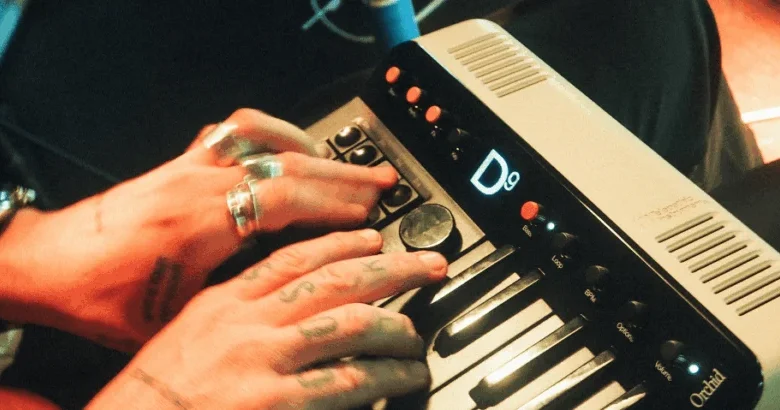
At first glance, the Orchid ORC-1 exudes a deliberate retro-futuristic aesthetic, reminiscent of high-end consumer electronics from the 1970s or early 1980s. The hardware is characterized by a sleek, minimalist chassis that balances portability with professional-grade build quality. The control surface is divided into two primary zones: a single octave of stylish, all-black keys on the right and a dedicated bank of eight chord buttons on the left. This layout is the heart of the Orchid’s workflow, allowing users to trigger complex harmonies with a single finger while manipulating the melody or bassline with the other hand.

The eight chord buttons correspond to fundamental and extended harmonic structures, including major, minor, suspended, diminished, sixths, minor sevenths, major sevenths, and ninths. This selection provides a comprehensive toolkit for both pop songwriting and more sophisticated jazz or neo-soul arrangements. To add further movement and variation, the "Voicing" dial allows the user to instantly cycle through different inversions and note distributions within the chosen chord. This feature is particularly valuable for producers who may lack formal training in music theory, as it allows for the discovery of "professional" sounding arrangements through experimentation rather than rote memorization.
Furthermore, the Orchid includes an integrated OLED display that provides clear, high-contrast feedback. When a chord is played, the display identifies the harmonic structure by name—a feature that serves an educational purpose for those looking to expand their theoretical knowledge. The unit also features high-quality onboard speakers and a built-in battery with an eight-hour lifespan, cementing its status as a truly portable composition tool.

The Dual-Engine Sound Architecture
Beneath its accessible exterior, the Orchid houses a sophisticated digital sound engine. The device actually utilizes two identical engines—one dedicated to the primary chord/melody section and a duplicate engine for the dedicated bass section. This allows for rich, layered arrangements that remain sonically cohesive. The synthesis options are curated into three distinct categories: virtual analog, physically modeled electric piano, and frequency modulation (FM).
The virtual analog engine provides the warmth and harmonic thickness required for classic synth pads and lead lines, while the electric piano modeling offers the organic, percussive response needed for soul and indie-rock textures. The FM engine adds a layer of digital clarity and "glassy" timbres, which are essential for cutting through a dense mix. Kevin Parker himself played a primary role in programming the factory presets, ensuring that the out-of-the-box sounds possess the "Tame Impala" signature: airy, slightly saturated, and emotionally resonant.

While hardware adjustments are intentionally limited to essential parameters such as filter cutoff and basic effects to maintain the "ideas machine" workflow, the instrument allows users to save their edits as user presets. This streamlined approach prevents the "option paralysis" that often plagues modern soft-synths, forcing the producer to focus on the musicality of the notes rather than the minutiae of sound design.
The Pistil Ecosystem and Software Integration
To satisfy the needs of power users and those who require deeper integration within a DAW environment, Telepathic Instruments offers Pistil. Pistil serves as both a standalone application and a plugin version of the Orchid’s internal sound engine. It acts as a bridge between the hardware and the software world, functioning as a patch librarian and a remote editor. Within Pistil, users can access a much wider array of synthesis parameters, allowing for the kind of deep-dive sound design that the hardware’s minimalist interface deliberately avoids.

However, the introduction of Pistil has been a point of discussion within the production community. Unlike many companion apps for hardware instruments, Pistil is not included for free with the purchase of an Orchid; it carries an additional retail price of £99. While the software is powerful and enhances the utility of the hardware—allowing the Orchid to function effectively as a high-end MIDI controller for its own virtual twin—the added cost is a factor for budget-conscious producers to consider.
Performance Modes and Rhythmic Features
To elevate the Orchid beyond a simple chord trigger, Telepathic Instruments has included a "Perform" mode. This feature transforms static chord stacks into dynamic musical phrases, including strums, arpeggios, and rhythmic pulses. These patterns can be synced to an internal or external tempo, ensuring that the generated ideas are rhythmically locked to a project.

The inclusion of a built-in rhythm section further enhances the device’s utility as a standalone "song starter." The Orchid comes pre-loaded with a variety of beats spanning modern genres such as trap, disco, and techno. This allows a songwriter to develop a progression in context, providing a sense of "groove" that a metronome cannot offer. For producers on the move, the internal audio looper allows for the immediate capture of these ideas. One can record a chord progression over a beat, layer a bassline, and then listen back through the onboard speakers, making it an ideal companion for travel or outdoor sessions.
Practical Application in Electronic and Dance Music
While the Orchid’s marketing leans heavily toward the indie-rock and pop sensibilities of Kevin Parker, its utility in electronic dance music (EDM) is substantial. In genres such as house, UK Garage (UKG), and melodic techno, the "hook" is often built upon a sophisticated chord progression or a syncopated synth stab. The Orchid’s ability to output MIDI on three separate channels—Channel 1 for Perform mode, Channel 2 for Bass, and Channel 3 for Chords—makes it a formidable MIDI controller.

In a studio setting, a producer can arm three different tracks in a DAW (e.g., a Juno-60 emulation for chords, a Moog emulation for bass, and a granular synth for arpeggios) and control them all simultaneously from the Orchid. This multi-channel output allows for the creation of complex, layered arrangements that feel "played" rather than programmed. For genres like house music, which rely on the rhythmic "sampling" of chords, the Orchid’s chord buttons allow producers to find the perfect voicings that might be difficult to play on a standard 61-key controller.
As Tom Cosm noted, the device is particularly well-suited for melodic genres. While a techno producer focused on industrial textures might find less immediate use for a chord generator, anyone working in the "melodic" spheres of electronic music will find the Orchid to be a significant time-saver and a source of constant inspiration.

Chronology of Development and Market Context
The journey of the Orchid began in the late 2010s as a private collaboration. Kevin Parker’s desire for a portable, "smart" chord tool led to early prototypes that focused on the interaction between the chord buttons and the keyboard. By 2023, the partnership with Tom Cosm and the formation of Telepathic Instruments signaled the transition from a celebrity vanity project to a serious hardware contender.
The Orchid enters a market increasingly interested in "theory-assisted" hardware. It competes philosophically with devices like the Isla Instruments KordBot or the recently announced AlphaTheta Chordcat. However, where the Chordcat offers a "Chord Cruiser" mode that guides the user through genre-specific progressions, the Orchid remains more of a "pure" instrument. It does not hold the user’s hand by suggesting the "next" chord; instead, it provides the tools and lets the user’s ear decide. This distinction is vital: the Orchid is designed to be learned and played, rather than just operated.

Critical Analysis and Future Outlook
Despite its strengths, the Orchid is not without its limitations. For an instrument in its price bracket, the inability to charge the unit via USB-C while simultaneously using it for MIDI over the same port is a notable hardware oversight (though it does include a standard 5-pin MIDI port). Additionally, while the initial firmware is stable and inspiring, the community has expressed a desire for more diverse scales beyond basic major and minor, as well as the ability to export MIDI loops directly from the hardware to a DAW.
The decision to charge for the Pistil software remains the most contentious aspect of the product’s release. In an era where "ecosystem" value is often used to justify high hardware costs, requiring an additional £99 for the plugin version of the engine the user has already purchased in hardware form may alienate some potential buyers.

However, Telepathic Instruments has signaled a commitment to long-term firmware support. Future updates could potentially address the MIDI looping limitations and expand the harmonic vocabulary of the device. Even in its current state, the Orchid succeeds in its primary mission: it makes the act of writing music faster, more intuitive, and significantly more enjoyable.
Conclusion
The Telepathic Instruments Orchid ORC-1 is a rare example of a celebrity-backed product that justifies its existence through genuine innovation and superior workflow design. It transcends the "chord pack" mentality of modern production, offering a tactile and expressive way to interact with music theory. For the indie songwriter, it is a dream portable companion; for the electronic producer, it is a powerful melodic engine that can breathe new life into stale DAW sessions. While the price of entry is high—particularly when factoring in the Pistil software—the Orchid stands as a testament to the idea that the best instruments are those that remove the barriers between a musician’s mind and their music. It is more than a chord machine; it is a sophisticated, beautifully designed instrument that encourages the user to play, learn, and, most importantly, create.