Prompt Engineering Isn’t Enough: How Four Bricks of Context Engineering Stop RAG Hallucinations

The Evolution of RAG: From Naive Implementations to Robust Systems
The emergence of large language models (LLMs) has revolutionized information retrieval, offering unprecedented capabilities in understanding and generating human-like text. Retrieval-Augmented Generation (RAG) pipelines quickly became a popular architectural pattern to ground LLMs with up-to-date, domain-specific, and factual information, thereby mitigating the risk of hallucinations and providing verifiable answers. Initially, many developers adopted what is now termed "naive RAG" – a straightforward approach involving parsing documents into flat text chunks, embedding them, retrieving the most semantically similar chunks based on a user query, and feeding these to an LLM for answer generation. While effective for simple, clean prose documents, this basic architecture frequently falters when confronted with the complexities inherent in enterprise-grade documents, leading to inaccurate or unconfident responses.
The core challenge lies not with the LLM’s ability to generate an answer, but with the quality and relevance of the context it receives. As the analysis in the original series highlights, common troubleshooting reflexes such as rewriting prompts, shrinking chunk sizes, or swapping embedding models often prove ineffective. The root cause of incorrect answers almost invariably originates upstream, in the initial stages of context preparation, rather than in the final generation phase. This realization has spurred the development of "context engineering," a methodology focused on optimizing each stage of the RAG pipeline to ensure the LLM receives the most accurate and structured context possible. The companion notebook for this article, available on GitHub at doc-intel/notebooks-vol1, allows for direct reproduction of these comparative runs, demonstrating the stark differences in performance.

Dissecting the Failures: The Four Bricks of Naive RAG
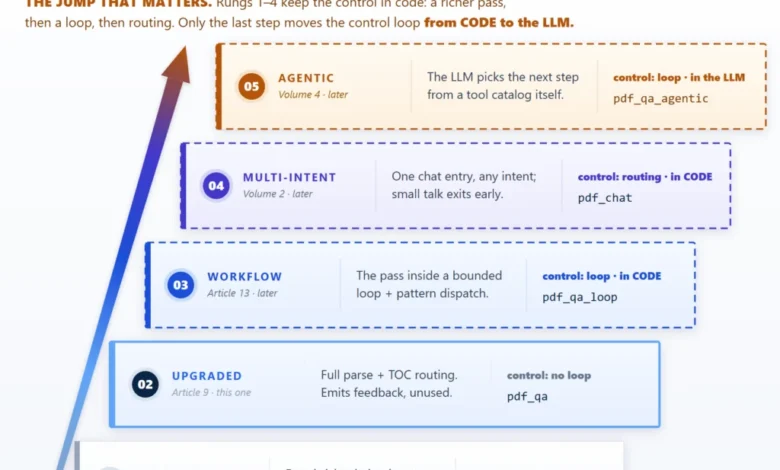
The upgraded RAG pipeline, while built upon the same four fundamental "bricks" – document parsing, question parsing, retrieval, and generation – implements each with significantly tighter "contracts" or specifications. This structured approach directly addresses the vulnerabilities where naive RAG pipelines typically break down. Each failure point, as detailed below, represents a real-world scenario where the naive approach provided a confident but incorrect answer, or failed to provide one at all, due to a specific deficiency in one of these four stages.
1. Document Parsing: When Structure Becomes Noise
The Problem: Naive RAG pipelines often employ basic parsing methods, such as get_text(), which dump a PDF’s content as flat text, followed by fixed-size chunking. This method is adequate for continuous prose but catastrophic for structured data, particularly tables. When a table, such as a financial forecast, is flattened, the inherent relationships between cells (e.g., a row label and its corresponding value) are destroyed. Subsequent chunking can then arbitrarily split these related pieces across different text segments.

Real-world Example: Consider the World Bank Commodity Markets Outlook, a report heavily reliant on price tables. A query like, "What is the 2025 annual average price forecast for U.S. natural gas (Henry Hub)?" exposes this flaw. The naive parser might separate "Henry Hub" from its "3.5" dollar value for 2025. When retrieval presents these disconnected chunks to the LLM, the model honestly reports "not stated in these lines," with a confidence of 0.00, because it never received the complete, aligned information. The data was present in the document, but the parsing process rendered it unusable.
The Fix: Relational Parsing: The upgraded pipeline employs relational parsing, which extracts document content into a line_df (dataframe of lines), preserving each text line with its bounding box coordinates. This approach maintains the spatial and structural integrity of tables. By keeping "Henry Hub" and "$3.5" on the same logical line or within a clearly defined table structure, the model receives the complete context. This enables it to accurately return "$3.5 per mmbtu" with a high confidence of 0.99. This emphasizes the critical insight that for many enterprise documents, simply extracting flat text is insufficient; preserving the relational shape of the information is paramount.
Implications: The inability to accurately parse and interpret tables, charts, and other structured data is a significant barrier for RAG systems in financial analysis, scientific research, regulatory compliance, and business intelligence. Organizations rely heavily on such data for decision-making. Failures here lead to critical inaccuracies, eroding trust in AI-powered solutions.
2. Question Parsing: Bridging the Lexical Gap

The Problem: Users often employ different terminology than what is explicitly used within a document. A naive RAG system, which typically transforms a question into keywords and searches for direct lexical matches, will fail when a user’s chosen term is a synonym for the document’s term, or a more general concept. The query might contain a word that simply does not appear in the document, leading to a retrieval failure even if the answer is conceptually present.
Real-world Example: When querying NIST SP 800-207, "Zero Trust Architecture," with the question "What are the pillars of zero trust architecture?", a naive pipeline struggles. The document never uses the word "pillars"; instead, it refers to "tenets." The keyword-based search returns no relevant pages, leading the LLM to respond, "the specific pillars are not listed," with a low confidence of 0.20. The correct information exists, but the lexical mismatch prevented its retrieval.
The Fix: Semantic Question Parsing: The upgraded brick normalizes and expands the query before retrieval. It leverages an LLM or a sophisticated synonym dictionary to map user-supplied terms (e.g., "pillars") to document-specific vocabulary (e.g., "tenets," "principles"). This semantic expansion ensures that retrieval searches for the actual words used in the document, effectively bridging the lexical gap. In the NIST example, the expanded query correctly anchors to the "tenets" section, allowing the LLM to return all seven tenets with 0.95 confidence, explicitly noting the document’s preferred terminology. This is crucial for user experience, as it allows for natural language queries without requiring users to guess the document’s specific jargon.
Implications: For domains rich in specialized terminology, such as legal, medical, or technical fields, effective question parsing is non-negotiable. Without it, RAG systems become frustratingly rigid, demanding precise phrasing from users. The ability to handle synonyms and conceptual mappings significantly broadens the usability and applicability of RAG across diverse datasets and user bases.

3. Retrieval: Beyond Simple Frequency and Top-K Cutoffs
The Problem: Many documents, especially lengthy technical standards or reports, repeat key terms across numerous sections. Simple keyword frequency or cosine similarity-based retrieval, characteristic of naive RAG, struggles to distinguish between a casual mention and a definitive definition or a core discussion. If the true "answering page" falls outside the arbitrary top-k cutoff of retrieved chunks due to lower frequency or similarity score compared to other irrelevant mentions, the LLM will lack the necessary context.
Real-world Example: In the 32-page NIST Cybersecurity Framework 2.0, the term "Profile" appears frequently – in section titles, prose, and examples. However, only one specific section provides its formal definition. A naive pipeline, relying on keyword or cosine similarity, might retrieve several pages containing "Profile" but miss the critical defining section because other pages had a slightly higher frequency score or semantic similarity for the term. The LLM, presented with these insufficient contexts, reports, "not defined in these lines," with a confidence of 0.10.
The Fix: Structure-Aware Retrieval: The upgraded pipeline moves beyond raw frequency by incorporating document structure. It utilizes a small LLM to interpret the document’s native table of contents (TOC). When asked about "Profiles," it identifies the "CSF Profiles" section directly from the TOC and anchors retrieval specifically within that logical segment. This structural routing ensures that the precise defining paragraph is retrieved, allowing the LLM to return the full definition with a citable span and 0.95 confidence. This approach scales effectively; for a 400-plus-page document like NIST SP 800-53, a naive system might dilute a specific control (e.g., AU-2 Event Logging) among hundreds of similar entries, leading to a "NA" response. A structure-aware router, however, can directly navigate to the AU family and the AU-2 entry, retrieving the full requirement with high accuracy.

Implications: The ability to navigate documents based on their inherent structure is vital for large, complex datasets like regulatory documents, technical manuals, or legal texts. Without it, RAG systems become overwhelmed by document length and repetition, rendering them unreliable for precise information extraction. This method enhances precision and reduces the computational overhead of processing irrelevant sections.
4. Generation: Ensuring Self-Correction and Transparency
The Problem: Even with perfect context, LLMs, when prompted for a free-text answer, possess a natural tendency to respond. If the specific piece of information requested is not present in the provided context, a naive generation pipeline might lead the LLM to invent plausible but incorrect details, often by extrapolating from nearby information or defaulting to its pre-trained knowledge. This is the classic "hallucination" problem reported by users, occurring at the final stage despite having relevant surrounding context.
Real-world Example: Using the World Bank Commodity Markets Outlook (April 2024), which provides forecasts only up to 2025, a question like, "What is the 2026 annual average price forecast for crude oil (Brent)?" highlights this issue. Both pipelines retrieve the correct energy pages and price tables. However, the document simply lacks a 2026 forecast. A naive pipeline’s free-text generation prompt might cause the LLM to confidently provide the 2025 value ($79) as the 2026 forecast, stating, "the 2026 Brent forecast is $79 per barrel." This answer is fluent, confident, but entirely wrong, with no mechanism in a free-text response to indicate a missing value.

The Fix: Typed Generation Contracts: The upgraded generation brick does not ask for a free-text answer. Instead, it demands adherence to a predefined schema, which includes fields like complete_answer_found (a boolean), an evidence_span for citation, and a confidence score with justification. When the LLM, having received the relevant context, cannot locate the specific 2026 forecast, it is constrained by the schema. It must set complete_answer_found: false and explicitly state, "the 2026 forecast is not provided; the latest is 2025." This prevents silent fabrication and makes missing or partial information transparent. This contract also guards against shipping partial answers as complete, ensuring the LLM flags gaps when retrieval only provides part of the requested information.
Implications: This is perhaps the most critical safeguard against AI hallucinations in RAG systems. For applications where accuracy and verifiability are paramount – such as financial reporting, medical diagnostics, or legal advice – the ability of an LLM to explicitly state "information not found" rather than fabricating an answer is invaluable. It shifts the responsibility from hoping the model doesn’t hallucinate to enforcing a structured output that must indicate data presence and provide verifiable citations, significantly increasing trust and reliability.
Context Engineering: The Holistic Solution
The four distinct failures underscore a singular truth: LLMs are faithful to the context they receive. When the context is flawed – be it scrambled by parsing, mismatched by lexical gaps, diluted by poor retrieval, or incomplete for generation – the LLM’s answer, however fluent, will be incorrect. The label "hallucination," while pointing at the model, often misdirects from the upstream causes.

The effective solution is not found in superficial tweaks to prompts or models, but in context engineering. This holistic approach enforces specific contracts at each stage of the RAG pipeline:
- Parsing: Preserve the document’s relational and structural shape.
- Question Parsing: Translate user queries into the document’s native vocabulary.
- Retrieval: Route intelligently using document structure, not just keyword frequency.
- Generation: Bind answers to a typed, verifiable contract that demands self-checking and citation.
By getting the context right at every step, the possibility of a confident but wrong answer is significantly diminished. While naive RAG may suffice for simple, clean documents, the complexities of enterprise data – with its tables, specialized vocabulary, length, and intricate structures – necessitate a more sophisticated, engineered approach. The findings are based on real-world runs, not theoretical assumptions, highlighting the practical necessity of these advancements.
Broader Impact and Future Outlook
The insights gleaned from comparing naive and upgraded RAG pipelines carry profound implications for the widespread adoption of AI in enterprise environments. As businesses increasingly seek to leverage LLMs for knowledge management, customer service, and decision support, the reliability and accuracy of RAG systems become paramount. Inaccurate AI responses can lead to financial losses, reputational damage, and misinformed decisions.

The emphasis on context engineering represents a maturation of the RAG paradigm. It moves beyond the initial excitement of simply connecting LLMs to data, towards a more disciplined and engineering-centric approach that recognizes the criticality of data quality and structural integrity throughout the pipeline. This shift is vital for building trust in AI systems and ensuring their practical utility in high-stakes applications. Industry trends indicate a growing demand for robust, explainable, and verifiable AI outputs, and context engineering directly addresses these requirements.
Further research and development in this area will likely focus on even more sophisticated methods for document understanding, semantic query expansion, multimodal retrieval (integrating images, charts, and diagrams), and dynamic schema generation for typed answers. The journey from "minimal RAG" to "production-grade RAG" is a testament to the continuous innovation required to harness the full potential of LLMs for real-world challenges, making AI not just powerful, but also reliable and accountable.
Related posts: